




PPG Primes Second Location for New Aerospace E-Coat Pilot System
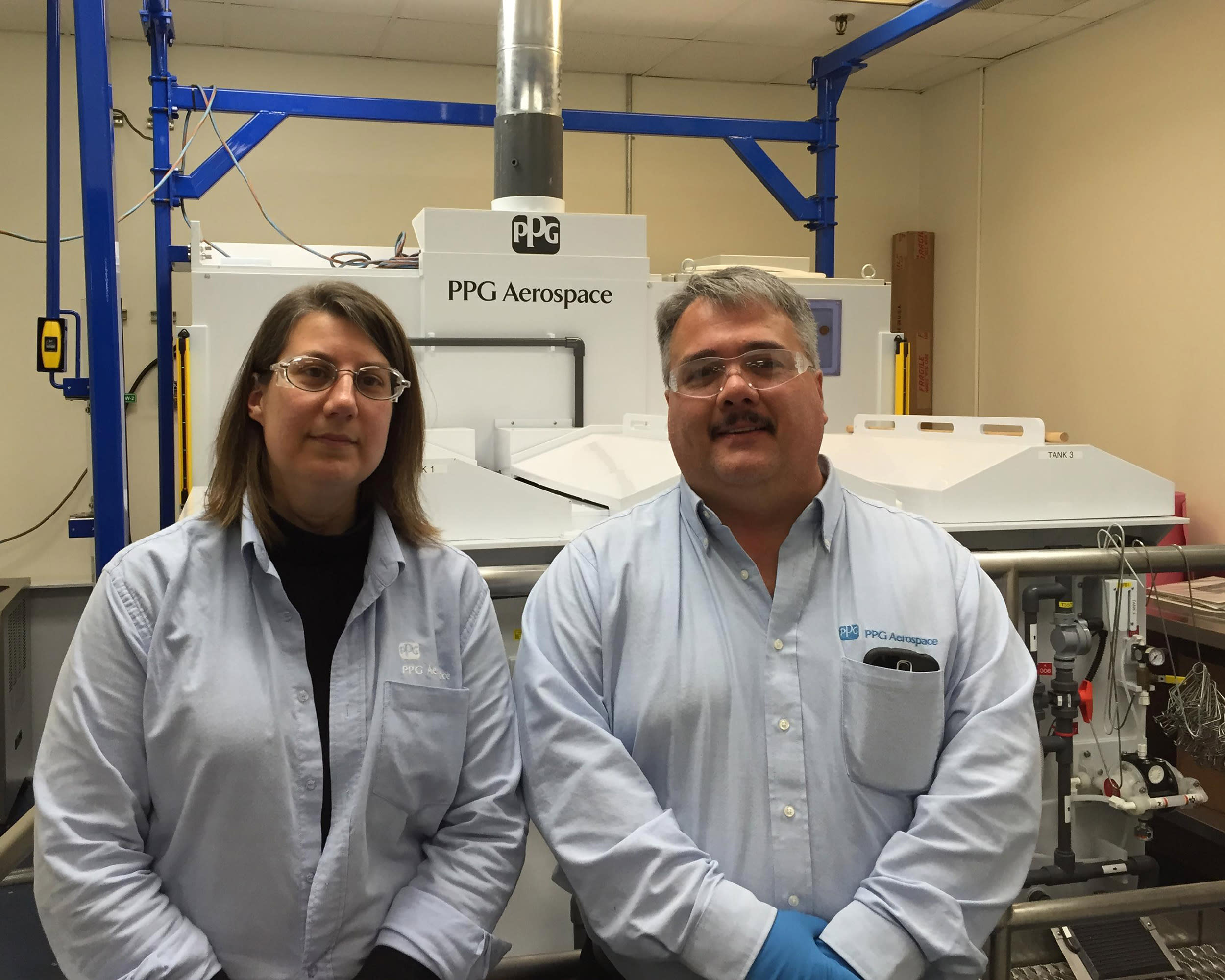
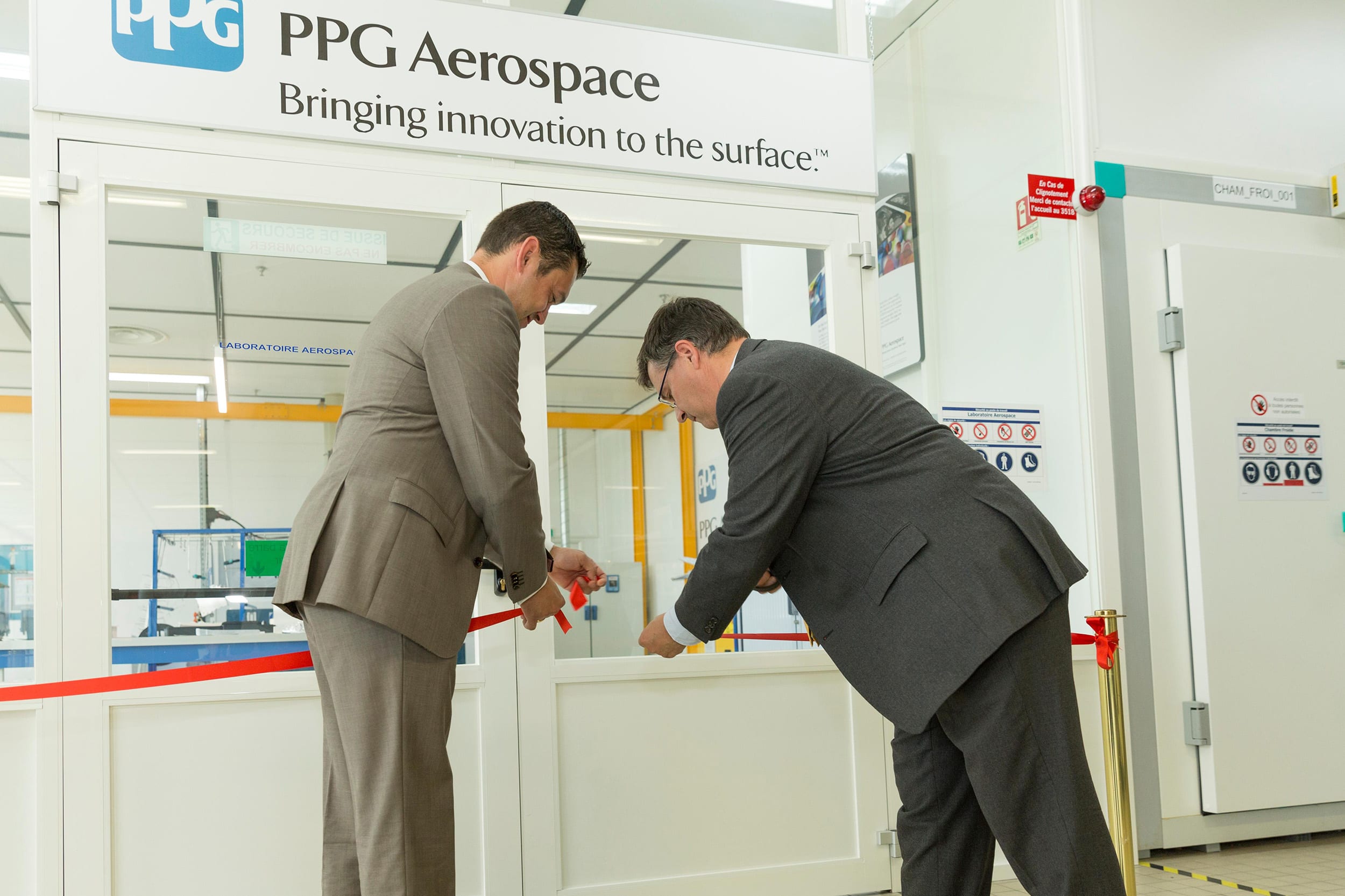
PPG opened a new coatings research center in Marly, France, in September 2016, the company’s second investment for an Aerocron e-coat primer installation. Like its first primer installation, which is located near Pittsburgh in the U.S., the Marly PPG facility will be used for customer application trials and qualifications.

The new laboratory “is a significant asset designed to benefit PPG customers in this region,” said Daniel Bencun, Aerospace Coatings Segment Manager for the Europe, Middle East and Africa region.
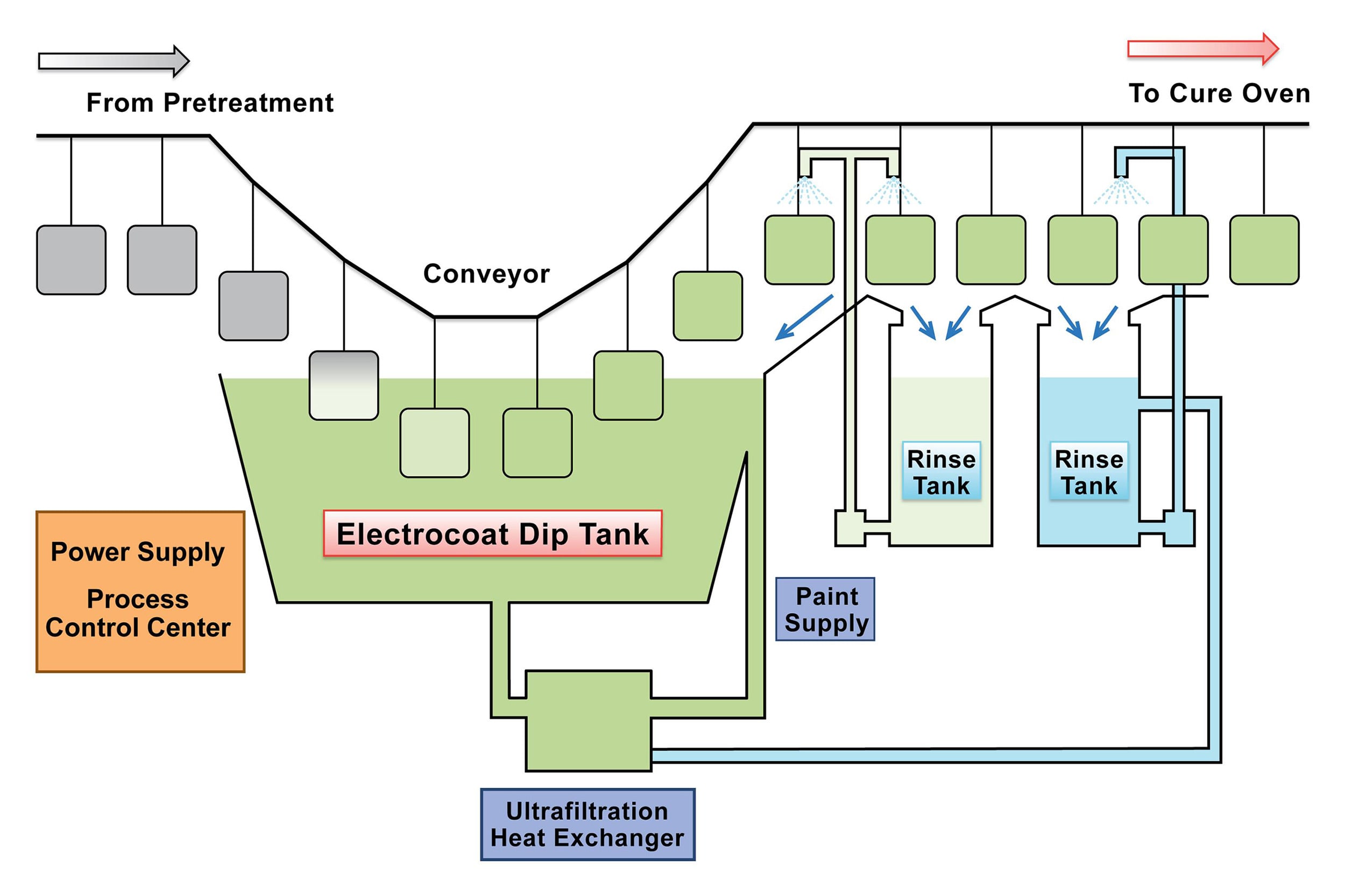
E-coating, short for electrocoating or electrodeposition, uses electrical current to apply a coating to a conductive substrate submerged in a water-based paint bath. The process has been used in the automotive industry for decades.
After pretreatment, the part is put in an electrocoat bath where a charge is applied and the amount of primer needed is deposited onto it. Once coated, the part is rinsed to remove any residual primer, and then it is baked at a temperature “that accommodates the aviation industry’s unique needs.”
Full-time development and qualification of the aerospace application of the e-coat technology were underway for more than 10 years, with primary research done at PPG’s Allison Park, PA, Coatings Innovation Center. PPG adapted the e-coat technology for corrosion resistance from its automotive and industrial businesses to meet unique aerospace requirements, said Bencun. In particular, PPG’s work to adapt e-coat technology for aerospace use focused on meeting the application needs of aircraft parts manufacturing and the unique performance requirements.
In almost all instances, aerospace paint systems are designed for all normal altitude levels up to about 45,000 ft, with military aircraft requiring performance to higher altitude levels. “Aircraft paint systems are designed to address most specifically the increased UV levels found at these altitudes,” Robin Peffer, PPG Global Business Development Manager for Aerocron, told Aerospace Engineering.
“Additionally, they are designed for temperature extremes found in typical aviation applications typically ranging from -60 to +160°F,” said Peffer, who, during her days as a Senior Research Chemist at the Coatings Innovation Center, was instrumental in the development of the primer.
Aircraft primer must provide corrosion resistance for the longer service life of aircraft and withstand the fatigue and stress from temperature fluctuations and the rapidly changing environment under which aircraft operate during flight.
“Aircraft alloys have unique temperature limitations that are well below the standard cure conditions of typical industrial and automotive e-coat technologies available today,” said Peffer. “Aerocron primer had to be formulated to work within those limitations.” The primer is also fully cured in about 30 minutes.
“Aircraft operators also benefit from the reduced coating weight with Aerocron primer, achieving enhanced aircraft fuel economy,” said Peffer. “Weight savings can be about 30% for flat parts and up to 75% on complex-shaped parts.”
Aerocron primer reduces the weight of the applied coating material by maintaining a more uniform film thickness across each coated component—even hidden and recessed areas of a part, says Bencun—when compared with spray-applied systems, thus increasing aircraft fuel efficiency. Fuel savings can depend on many factors, including the type of aircraft, the aircraft’s typical flight mission, and many environmental influences.
However, Peffer says “there is significant information available regarding the weight savings that coatings systems can provide that will lead to fuel savings. Electrocoat primers have demonstrated weight savings in a number of instances and contribute to fuel savings and cost savings when computed on almost any basis.”
The PPG e-coat aerospace primer is qualified to SAE International’s AMS3144 for anodic electrodeposition primer for aircraft applications. Dassault Aviation has qualified Aerocron primer to DGT153703, which enables Dassault subcontractors to produce parts for the aircraft manufacturer using the primer.
Both Dassault and its subcontractors are expected to benefit from increased production capabilities. “The e-coat line can be fully automated, and parts can be coated and cured in just two hours, compared with days to achieve full cure for traditional primers,” said Bencun. “With up to 95% transfer ratio, users will also decrease product waste and related operational costs.”
PPG’s first commercial system in the U.S. for application of the new e-coat aerospace primer to aircraft parts was installed at the U.S. Coast Guard Aviation Logistics Center, Elizabeth City, NC. Confidentiality agreements about other operational systems prevent PPG disclosing them.
“Next steps include continuing to educate customers about the benefits of the process and to assist with product trials,” said Peffer. “Applying e-coat primer in aerospace is a paradigm shift for the industry.”
More From SAE Media Group
Aerospace & Defense Tech Briefs
Hardide Coatings to Construct Two Additional U.S.-Based Reactors
Aerospace & Defense Tech Briefs
Robotic Rotational Molding Creates New Opportunities for Military and Aerospace Applications
Aerospace & Defense Tech Briefs
Electrocoat Primer System
Automotive Engineering
Brunel Pursues Ultrasound for ‘Greener’ Production of Aluminum Alloys
Aerospace & Defense Tech Briefs
Cold Spray Technology
Automotive Engineering
Hardide Coatings Awarded Two Major UK Aerospace Funding Grants
Aerospace & Defense Tech Briefs
Additive Manufacturing Adoption Up, Growing Rapidly in Aerospace
Aerospace & Defense Tech Briefs
Lockheed Martin and Arconic Collaborate on 3D Printing and Advanced Aerospace Materials
Aerospace & Defense Tech Briefs
Weber Metals Unveils New 540-Meganewton Press for Aerospace Components
Aerospace & Defense Tech Briefs
SAE International Launches Aerospace Technology Symposium at Japan Aerospace 2018

Aerospace INSIDER
Advancing Metal Alloy Systems and Processes for Defense Manufacturing
Aerospace & Defense Tech Briefs
Industry Invited to Participate in AeroTech Aerospace and Defense Technical Program
Aerospace & Defense Tech Briefs
Equispheres Accelerates Additive Manufacturing Innovation with $5M from Lockheed Martin
Aerospace & Defense Tech Briefs
SAE International Issues First Technical Standards for Aerospace Additive Manufacturing

Aerospace & Defense Tech Briefs
SAE International Issues, Revises Technical Reports for Aerospace Engineering
Aerospace & Defense Tech Briefs
Biobased Carbon Fibers and Thermosetting Resins for Use in DOD Composites Applications

Aerospace & Defense Tech Briefs
Portable 3D Printing Factory

Aerospace & Defense Tech Briefs
Novel Chromium–Molybdenum Metal Alloy Withstands Extreme Conditions
Aerospace Manufacturing and Machining INSIDER
3D Printing in Combat Zones: A Paradigm Shift for Marine Corps Logistics
Aerospace & Defense Tech Briefs
Boeing Reports on Its Environmental Efforts
Aerospace & Defense Tech Briefs
Additive Manufacturing and Materials a Prime Focus for GKN Aerospace

Defense INSIDER
Army Leverages New Alliance for 3-D Printing Goals
Tech Briefs
Rising Star Awards 2025 Judges
Aerospace & Defense Tech Briefs
Connected Aircraft Technologies Benefit Manufacturers, Airlines, and Travelers
Top Stories
INSIDERManufacturing & Prototyping
 How Airbus is Using w-DED to 3D Print Larger Titanium Airplane Parts
INSIDERManned Systems
 FAA to Replace Aging Network of Ground-Based Radars
NewsTransportation
 CES 2026: Bosch is Ready to Bring AI to Your (Likely ICE-powered) Vehicle
NewsSoftware
 Accelerating Down the Road to Autonomy
EditorialDesign
 DarkSky One Wants to Make the World a Darker Place
INSIDERMaterials
 Can This Self-Healing Composite Make Airplane and Spacecraft Components Last...
Webcasts
Defense
 How Sift's Unified Observability Platform Accelerates Drone Innovation
Automotive
 E/E Architecture Redefined: Building Smarter, Safer, and Scalable...
Power
 Hydrogen Engines Are Heating Up for Heavy Duty
Electronics & Computers
 Advantages of Smart Power Distribution Unit Design for Automotive...
Unmanned Systems
 Quiet, Please: NVH Improvement Opportunities in the Early Design...
