




Additive Manufacturing Adoption Up, Growing Rapidly in Aerospace

The 3D printing materials market will experience high double-digit growth in the aerospace industry through 2024, as manufacturers of aircraft and spacecraft vehicles and components increasingly adopt and reap the benefits of additive manufacturing, market analysts at Frost & Sullivan in Mountain View, California, predict.
“The aerospace industry is moving rapidly toward production, and this will be an interesting trend from the 3D printing perspective,” Frost & Sullivan analysts forecast. “3D printing provides unmatched flexibility of design and materials for part manufacturing and prototyping, at a fraction of the cost and time, and the benefits are set to enhance further as technology progresses.”
Functionality and performance, minimization of carbon footprint, and globalization of manufacturing services are among the key mega trends impacting the aerospace additive manufacturing market, identified in Frost & Sullivan’s “Global 3D Printing Materials Market for Aerospace Industry, Forecast to 2024” research report.

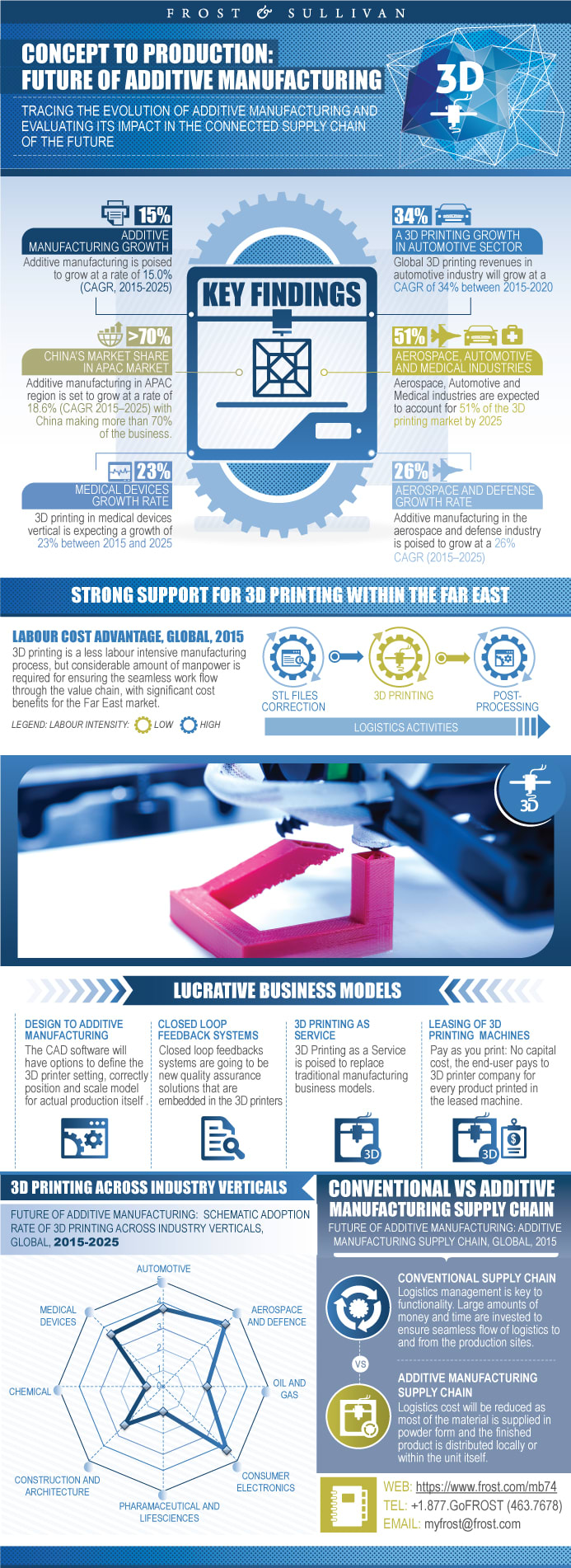
Weight optimization without compromising on structural strength and resilience, nor impacting safety and functionality, is an area of high interest and research for aerospace original equipment manufacturers (OEMs) and makers of myriad critical parts and components alike. Considerably lower material wastage, resulting in a lower carbon footprint for the industry, is another major driver of additive manufacturing adoption.
“Unlike most industries, production is the largest application for 3D printing in the aerospace industry,” analysts say. “Design freedom, quick turnaround time, and ability to produce on demand are the few factors that exert a major influence on the market penetration of 3D printing technology in the aerospace industry.”
Potential impediments to wider adoption of 3D printing technology in aerospace include: lack of clear guidelines and high capital investment; yet, the acceptance and adoption of 3D printing is projected to increase as real-world applications of additive manufacturing in aerospace achieve success. Further, as the industry and its technologies continue to evolve and are produced in higher volumes to meet the demands of various industries, the cost of entry is likely to decrease over time.
North America and Europe have traditionally led the aerospace 3D printing materials market in terms of demand and revenue due to the high research and development (R&D) and presence of leading aircraft manufacturers, as well as system manufacturers, analysts explain. They anticipate that North America will be the most attractive region over the forecast period and lead regional demand in 2024, followed by Europe in demand and revenue The Asia-Pacific region is a nascent market at present, they add, with substantial growth potential.
The Aerospace Material Specification committee on Additive Manufacturing (AMS-AM) at SAE International in Warrendale, Pennsylvania, has released its first suite of Aerospace Material Specifications (AMS) additive manufacturing materials and process specifications. The new aerospace technical standards, now available from SAE, support the certification of critical aircraft and spacecraft parts, providing both a framework to protect the integrity of material property data and traceability within the aerospace supply chain. Learn more: SAE International issues first aerospace additive manufacturing technical standards
The four SAE aerospace additive manufacturing technical standards are:
- AMS7000: Laser-Powder Bed Fusion (L-PBF) Produced Parts, Nickel Alloy, Corrosion and Heat-Resistant, 62Ni - 21.5Cr - 9.0Mo - 3.65Nb Stress Relieved, Hot Isostatic Pressed and Solution Annealed
- AMS7001: Nickel Alloy, Corrosion and Heat-Resistant, Powder for Additive Manufacturing, 62Ni - 21.5Cr - 9.0Mo - 3.65Nb
- AMS7002: Process Requirements for Production of Metal Powder Feedstock for Use in Additive Manufacturing of Aerospace Parts
- AMS7003: Laser Powder Bed Fusion Process
More From SAE Media Group
Aerospace & Defense Tech Briefs
SAE International Issues First Technical Standards for Aerospace Additive Manufacturing
Aerospace & Defense Tech Briefs
SAE International Issues, Revises Technical Reports for Aerospace Engineering
Aerospace & Defense Tech Briefs
Advances in Adhesive Joining of Structural Components Focus of New Book from SAE International
Aerospace & Defense Tech Briefs
Industry Invited to Participate in AeroTech Aerospace and Defense Technical Program
Aerospace & Defense Tech Briefs
SAE International Extends Call for Abstracts, Seeks Submissions for AeroTech Conference
Off-Highway Engineering
NASA Highlights Material and Coating Technology Ready for Commercial Applications
Aerospace & Defense Tech Briefs
Quality Management Experts Provide Guidance on AS9100 Standard, Equipment Calibration
Aerospace & Defense Tech Briefs
Lockheed Martin and Arconic Collaborate on 3D Printing and Advanced Aerospace Materials
Automotive Engineering
Demand up for Composite-Grade, High-Performance Plastics Across Aerospace, Automotive
Aerospace & Defense Tech Briefs
Turn Growing Complexity into Competitive Advantage Through Digitalization -- Focus of AeroTech Keynote Thursday

Aerospace & Defense Tech Briefs
SAE International Anti-Counterfeit Standards Integral to Obsolescence Management
Automotive Engineering
Systems-engineering a New 4x4 Benchmark
Aerospace & Defense Tech Briefs
Lifting 3D Printing to New Heights
Aerospace & Defense Tech Briefs
Centre for Modelling & Simulation to Develop Digital Twins for GKN Aerospace Additive, Composite, and Industry 4.0 Technologies
Aerospace & Defense Tech Briefs
SAE International Launches Aerospace Technology Symposium at Japan Aerospace 2018
Aerospace & Defense Tech Briefs
AIA Predicts Flying Air Taxis, Supersonic Air Travel, and Space Industry for 2050
Aerospace & Defense Tech Briefs
Orbex Debuts Innovative Smallsat Launch Vehicle
Automotive Engineering
Planning for a Digital World
Off-Highway Engineering
Additive Manufacturing Is Transforming Mobility Engineering, Driving the Factory of the Future
Aerospace & Defense Tech Briefs
Ceramic Matrix Composites in Aircraft Engines Projected to Double over Five Years, Stratview Research Predicts
Tech Briefs
Using 3D Printing to Strengthen Jet Engines
Automotive Engineering
Bye Aerospace’s Solar-Electric Prototype Completes First Flight
Tech Briefs
Method 3D-Prints Marine-Grade Stainless Steel
Aerospace & Defense Tech Briefs
Airlines for America and SAE International Recognize Lufthansa Technik, 3D.aero for Nondestructive Testing Innovation
Off-Highway Engineering
Bosch Invested in Large-Scale Metal 3D Printing
Aerospace & Defense Tech Briefs
Additive Manufacturing
Aerospace & Defense Tech Briefs
Barker Approaches Aircraft as System of Systems in Latest SAE International Book
Aerospace & Defense Tech Briefs
Aireon to Launch Free, Real-Time Emergency Aircraft Location Service
Top Stories
NewsSensors/Data Acquisition
 Microvision Aquires Luminar, Plans Relationship Restoration, Multi-industry Push
INSIDERRF & Microwave Electronics
 A Next Generation Helmet System for Navy Pilots
INSIDERWeapons Systems
 New Raytheon and Lockheed Martin Agreements Expand Missile Defense Production
NewsAutomotive
 Ford Announces 48-Volt Architecture for Future Electric Truck
INSIDERAerospace
 Active Strake System Cuts Cruise Drag, Boosts Flight Efficiency
ArticlesTransportation

Webcasts
Aerospace
 Cooling a New Generation of Aerospace and Defense Embedded...
Energy
 Battery Abuse Testing: Pushing to Failure
Power
 A FREE Two-Day Event Dedicated to Connected Mobility
Automotive
 Quiet, Please: NVH Improvement Opportunities in the Early Design Cycle
Electronics & Computers
 Advantages of Smart Power Distribution Unit Design for Automotive &...
Unmanned Systems
 Sesame Solar's Nanogrid Tech Promises Major Gains in Drone Endurance