




IAV Using 3D Printed Pistons for Engine Testing

Engineering services specialist IAV is using 3D printed parts to shorten engine development timelines.
“A 3D printed part is a very fast way to get a new piece to the test stand, so you can compare and analyze variations in part geometry,” said Robert Dolan, Director of Commercial Vehicle and Government Programs for IAV.
Dolan and Kody Klindt, IAV’s Project Development Director for the Powertrain System, spoke with Automotive Engineering at the company’s SAE WCX 2018 exhibit.
IAV recently began 3D printing pistons for engine research and development purposes. The company is producing the parts for customers involved with commercial vehicle diesel engines and passenger vehicle gasoline engines. It also has produced 3D printed cylinder heads for an advanced thermal management system.
The 3D printed pistons “enable us to achieve internal geometries that you can’t get through traditional manufacturing methods,” Dolan said.
In one example, a 3D printed piston designed for a gasoline engine features an internal honeycomb structure under the dome area. “It provides the strength needed to tolerate the cylinder pressure, and it incorporates cooling features,” Dolan explained.
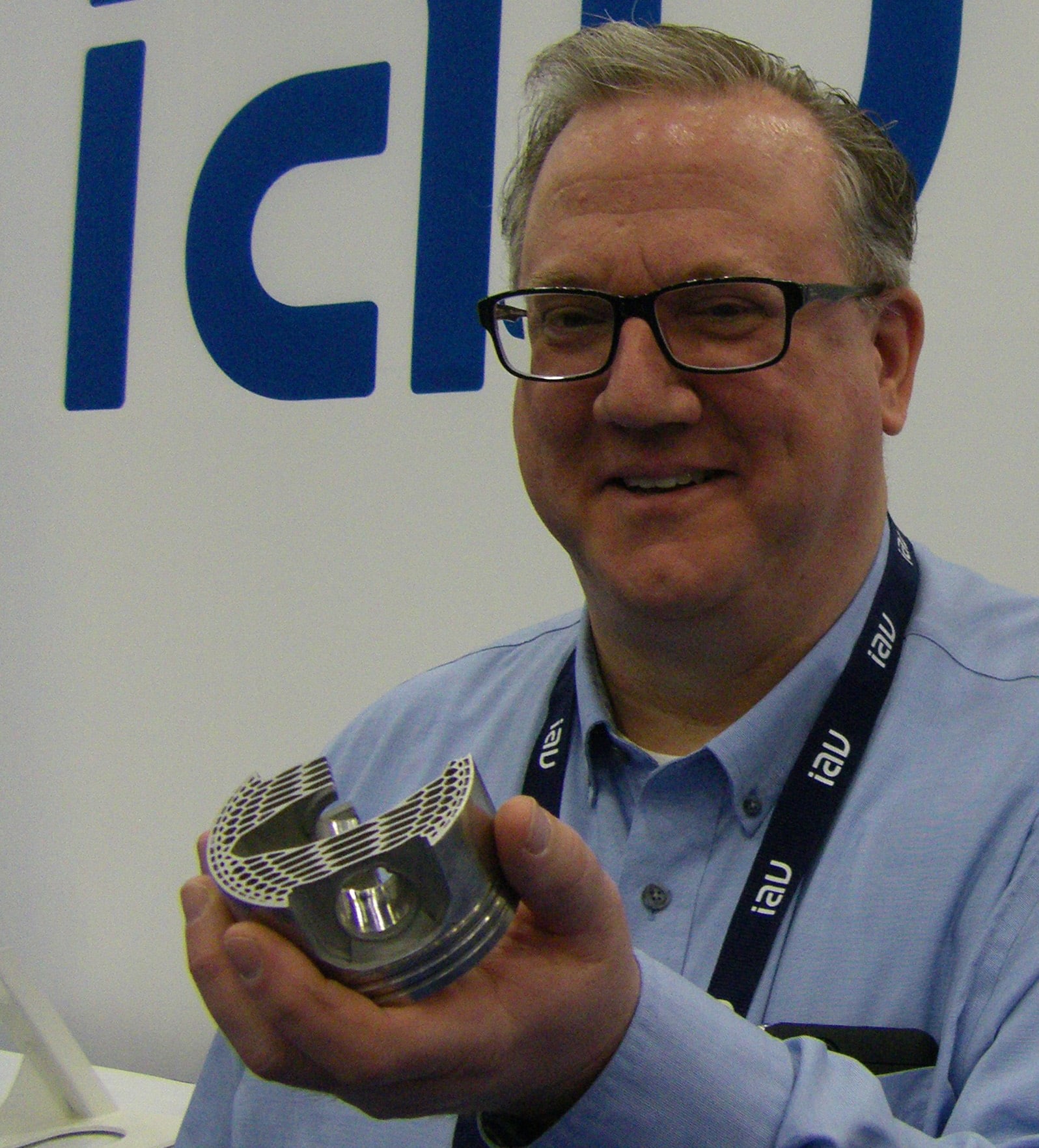
Producing unique piston concepts via additive manufacturing effectively enables engineers to push the boundaries on thermal dynamics. “It’s also means that engineers can push the boundaries as it relates to single cylinder engine development,” Klindt said.
IAV’s 3D printed metal pistons can be up to 25% lighter in weight than pistons produced by conventional manufacturing, said Dolan. He noted that production applications are being investigated.
“It’s likely to happen much sooner with a lower-volume, high-content piston for a diesel engine commercial vehicle before it would happen for a passenger vehicle. And that’s because the boundary conditions are so much more severe with a diesel engine piston,” Dolan said.
Regardless of how soon 3D printed pistons become production reality, testing with 3D printed parts has proven valuable.
“Just put yourself in the middle of an internal combustion engine development program. It’s expensive to operate an engine in a specific test cell, so when you decide that you want to change this or that based on the results, being able to get a 3D printed piston into the test cell in just a day or two days versus several weeks is very appealing,” Dolan noted.
More From SAE Media Group
Automotive Engineering
IAV Debuts New Tools to Speed Engine Development
Off-Highway Engineering
Delphi Injects Life into Diesel
Automotive Engineering
Stanadyne Pumps up the Volume
Automotive Engineering
Functional Rapid Prototype Parts
Off-Highway Engineering
Navistar Updates A26 Engine, Improves FE by 4%
Off-Highway Engineering
MTU Training Facility Helps Keep Complex Engines up and Running
Off-Highway Engineering
Powertrain, Propulsion Lead Tech-Paper Topics at SAE’s WCX 2022
Automotive Engineering
UAV Turbines to Tackle 200-Hp Class UAV Engines for U.S. Army
Off-Highway Engineering
Enhanced Cat 3500 Engine Boosts Power 20%, Trims Fuel Usage by 10%
Aerospace & Defense Tech Briefs
Two-Stroke Engines
Automotive Engineering
EVs Pressure Supplier Value-add
Automotive Engineering
More sting for the STINGRAY
Off-Highway Engineering
Cummins Goes for Big Power, Low Emissions with All-New X-Series Heavy-Duty Diesels
Automotive Engineering
Continental Debuts First Production Aluminum Turbocharger Housing
Automotive Engineering
Schaeffler Builds an E-Motor Powerhouse

Off-Highway Engineering
Electric Mobile Machines Won’t Abandon Hydraulics
Automotive Engineering
Tula DMD Aims for More-Efficient E-Machines
Automotive Engineering
The Inside Story on Rotary Position Sensors for Electric Vehicle Traction Motors
Motion Control & Automation Technology
Feedback Cylinder
Tech Briefs
Videos of the Month
Battery & Electrification Technology
Battery Innovation Key for Commercial and Off-Highway EVs
Automotive Engineering
The Transformative Power of Large-Format Additive Manufacturing for Automotive
Tech Briefs
2025 Award Finalists
Automotive Engineering
Polyamide for Low-Friction Timing System
Tech Briefs
Multi-Power Cylinders
Automotive Engineering
Slick Solutions for Friction Reduction
Automotive Engineering
3D, No Waiting!
Off-Highway Engineering
Liebherr Reveals ‘Hybrid’ CFRP Cylinders and Parallel-Pump Concept
Top Stories
INSIDERManufacturing & Prototyping
 How Airbus is Using w-DED to 3D Print Larger Titanium Airplane Parts
INSIDERManned Systems
 FAA to Replace Aging Network of Ground-Based Radars
NewsTransportation
 CES 2026: Bosch is Ready to Bring AI to Your (Likely ICE-powered) Vehicle
NewsSoftware
 Accelerating Down the Road to Autonomy
EditorialDesign
 DarkSky One Wants to Make the World a Darker Place
INSIDERMaterials
 Can This Self-Healing Composite Make Airplane and Spacecraft Components Last...
Webcasts
Defense
 How Sift's Unified Observability Platform Accelerates Drone Innovation
Automotive
 E/E Architecture Redefined: Building Smarter, Safer, and Scalable...
Power
 Hydrogen Engines Are Heating Up for Heavy Duty
Electronics & Computers
 Advantages of Smart Power Distribution Unit Design for Automotive...
Unmanned Systems
 Quiet, Please: NVH Improvement Opportunities in the Early Design...
