




Repaired Carbon-Fiber Frame Can Be Stronger Than Original Structure
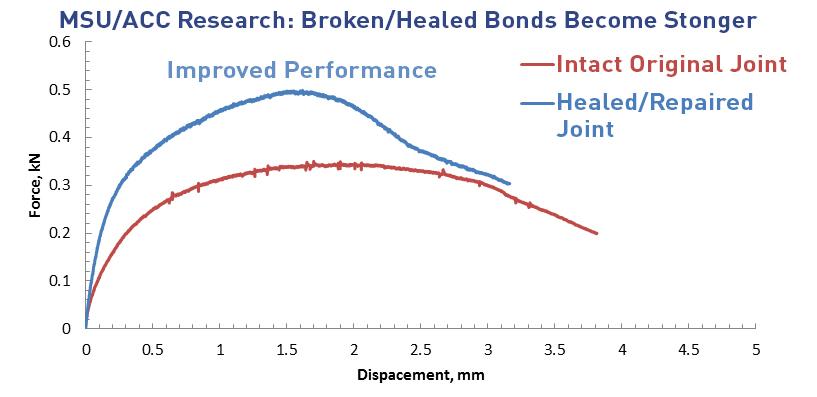
The American Chemistry Council (ACC) and researchers at Michigan State University (MSU) have demonstrated a new “reversible” adhesive for multi-material joining that becomes stronger after use and repair/rebonding—a significant development for the repairability and end-of-life recyclability of CFRP-intensive (carbon-fiber-reinforced polymer) vehicles, for example.

“What the researchers found this year is when you bond it, unbond it, and then rebond, the ‘healed’ new bond actually becomes stronger than the original bonds. That means that a repaired carbon-fiber frame could be stronger in a crash after the repair. This also means getting an auto frame repaired at 50,000 miles can literally mean the car is better than new,” Sandra McClelland, automotive business development manager, Solvay Specialty Polymers USA and presenting chair, ACC Auto Team, said at the Management Briefing Seminars (MBS) in Traverse City, MI.
McClelland described the latest discoveries in multi-material reversible bonding, in collaboration with MSU’s Composite Vehicle Research Center and Dr. Mahmoodul Haq. The alternative adhesive connector attempts to satisfy several auto-industry goals for a joining technology, apart from working in multi-material applications (plastics, steel, aluminum, and polymer composites): reduced weight, binds as robustly as other connectors (ASTM testing for structural efficiency), applies and adheres in 45 seconds and is reversible—meaning the bond can come apart and be “re-joinable” in a local repair shop or at end-of-life for faster and easier recycling of composites.
This “magic glue,” as McClelland referred to it at MBS, was developed through collaboration between ACC and MSU and appears to satisfy these criteria, she said. The thermoplastic adhesive material grips the entire seam of a joint, not just one spot as with some other types of connectors. Spreading stress results in “considerably stronger” joins, which can enable additional weight savings because parts joined can be subsequently thinner and lighter.
Process for ‘reversibility’
The thermoplastic adhesive can melt apart and rebond in less than a minute, the amount of time required in an assembly plant, McClelland noted. The material contains magnetic nanoparticles—iron microspheres that vibrate with electric current and become very hot, 320 to 800°F within seconds, melting the thermoplastic adhesive before the surrounding material heats up. It then can harden in seconds—essentially becoming fast-acting glue that bonds and rebonds on demand.
After MSU researchers apply warm glue to bond the multi-materials, they test the joints to failure and record structural efficiencies by ASTM standards for joint fatigue, strength, shear, impact, flex, creep and modulus. The researchers then use electromagnetic coils to re-melt the adhesive in 30 seconds and establish a new “healed” bond to conduct parallel duplicate tests. The data shows this new re-bond is stronger.
“By melting the adhesive and giving it all that energy, that material becomes more crystalline than it was initially. A more crystalline polymer has better strength,” McClelland said.
The adhesive will be economically feasible and eventually commercially available, she added, but did not state a specific timeframe.
“Strengthening after repair could stand the automotive notion of joint fatigue on its head,” she said.
More From SAE Media Group
Automotive Engineering
Cetim, Momentive Develop Composite Crashbox Concept
Automotive Engineering
Nissan Develops High-Volume, Fully Recyclable Composite Liftgate
Automotive Manufacturing and Machining
More Adhesives Help Stiffen Honda's 2018 Odyssey Structure
Automotive Engineering
Innovations for Lightweighting: Eaton’s “hybrid” materials replace metal
Off-Highway Engineering
High-Performance PEKK-Based 3-D Printing a First
Automotive Engineering
Toho Tenax Develops 'Super-Heat-Resistant' Prepreg for Engine Apps
Automotive Engineering
Graphene: Living in a Stronger Material World?
Off-Highway Engineering
Thermal Shields
Automotive Engineering
Audi Reveals New A8 Technologies, Tightens Links with Porsche
Automotive Engineering
Innovations for Lightweighting: Audi brings CFRP to 2018 A8
Automotive Manufacturing and Machining
Prodrive Process Expands Carbon Fiber’s Manufacturing Potential
Automotive Engineering
High-Strength Sheet Steel That Bends
Automotive Engineering
Altair Honors Lightweight Advances
Automotive Engineering
Plasma Process Could Cut Carbon Fiber Costs
Automotive Engineering
2016 Civic Structure Employs 'First' Partial In-Die Soft Zones
Automotive Engineering
Tesla’s Cybertruck Is Audaciously Austenitic
Automotive Engineering
Rapid-Cure Resin for Carbon-Fiber Blanks
Automotive Engineering
Audi 'Springs' Material Surprises on A6 Model
Automotive Engineering
Hyundai, Ford Pursue Structural Composites Despite Challenges
Aerospace & Defense Tech Briefs
Boeing Examines Expanded Metal Foils for Lightning Protection of Composite Structures
Automotive Engineering
Lightweighting Hinges on the Details
Aerospace & Defense Tech Briefs
Aerospace Composites Experts Will Meet in Wichita This Month, Focusing on Validating Repairs Techniques
Aerospace & Defense Tech Briefs
Researchers Reduce Graphene-Enhanced Composite Development Time Using Neural Networks
Automotive Engineering
High-Strength Aluminum Alloys
Automotive Engineering
The Transformative Power of Large-Format Additive Manufacturing for Automotive
Aerospace & Defense Tech Briefs
Breaking Bonds
Off-Highway Engineering
Nano-Coating for Corrosion Protection
Automotive Engineering
New 'Innovation Institutes' Designed to Strengthen U.S. Manufacturing Capabilities
Automotive Engineering
Five-Piece Hot-Stamped Laser-Welded Door Ring and B-Pillar
Top Stories
INSIDERManufacturing & Prototyping
 How Airbus is Using w-DED to 3D Print Larger Titanium Airplane Parts
INSIDERManned Systems
 FAA to Replace Aging Network of Ground-Based Radars
NewsTransportation
 CES 2026: Bosch is Ready to Bring AI to Your (Likely ICE-powered) Vehicle
NewsSoftware
 Accelerating Down the Road to Autonomy
EditorialDesign
 DarkSky One Wants to Make the World a Darker Place
INSIDERMaterials
 Can This Self-Healing Composite Make Airplane and Spacecraft Components Last...
Webcasts
Defense
 How Sift's Unified Observability Platform Accelerates Drone Innovation
Automotive
 E/E Architecture Redefined: Building Smarter, Safer, and Scalable...
Power
 Hydrogen Engines Are Heating Up for Heavy Duty
Electronics & Computers
 Advantages of Smart Power Distribution Unit Design for Automotive...
Unmanned Systems
 Quiet, Please: NVH Improvement Opportunities in the Early Design...
