




High-Performance PEKK-Based 3-D Printing a First

Oxford Performance Materials Inc. (OPM) launched in December the first two grades of its OXFAB 3-D printing technology—OXFAB-N and OXFAB-ESD—suitable for aerospace and other industrial markets, including transportation, energy, and semiconductor applications.
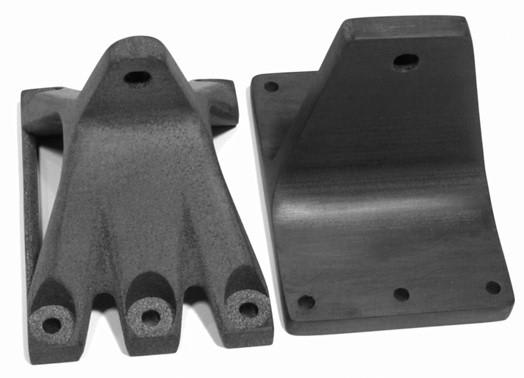
OXFAB is OPM’s proprietary technology platform and formulation of poly-ether-ketone-ketone (PEKK), an ultra-high-performance polymer with improved strength, chemical resistance, low- and high-temperature performance, radiation resistance, enhanced wear properties, and ultra-low outgassing. The technology has been in development at Oxford since 2006, and was first used in the biomedical field in orthopedics.
OPM Aerospace & Industrial employs OXFAB technology to deliver lightweight, 3-D printed thermoplastic parts for commercial and military aircraft, spacecraft, and eventually possibly automotive applications.
“Really anything that moves and would benefit from lightweight, complex structures” would benefit from this technology, shared Scott DeFelice, Founder and CEO of Oxford Performance Materials. “So we imagine automotive will be very interested in time.”
OXFAB-N is composed of unmodified neat PEKK, a material with a very low microwave dielectric constant that is well-suited for radomes and other “unique” electrical applications. OXFAB-ESD is a carbon-filled PEKK compound with enhanced mechanical properties that make it suitable for structural applications.
“Anywhere aluminum is used OXFAB is viable,” DeFelice said. “Complex structures in high fatigue and chemical environments; we are interested in fuel management. OXFAB-N is an excellent electrical insulator so we are also intrigued with EVs [electric vehicles].”
The South Windsor, CT-based company claims that its additive manufacturing technology produces complex parts that equal the performance of traditionally manufactured aluminum and composite components at lighter weight and reduced cost.
“We believe that OXFAB will fundamentally improve the way the world’s aircraft and industrial components are manufactured,” said Paul Martin, President of OPM Aerospace & Industrial. “OPM’s OXFAB products are suited for end-market applications where functional complexity and weight reduction can have a substantial and positive impact on performance, while also yielding cost and energy savings.”
Martin added, “While additive manufacturing with commodity polymers has been taking place for some time now, this is the first time PEKK is being used for 3-D printing in aerospace and industrial applications. Supported by extensive mechanical test data, PEKK is the highest-performance thermoplastic available for 3-D printing fully functional, end-use parts and components. We are fulfilling critical development contracts for 3-D printed parts in a range of applications in commercial and military aircraft, space, and industrial products to deliver significant weight and cost savings.”
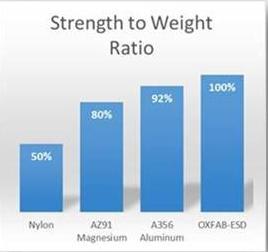
“OXFAB’s strength-to-weight ratio is superior to that of cast aluminum, magnesium, and nylon,” said Larry Varholak, Vice President of Programs, OPM Aerospace & Industrial. (See graphic above for strength-to-weight comparison.) “Due to its inert behavior, OXFAB is highly chemical and heat resistant with the ability to tailor electric properties, which is critical for high-performance aerospace and industrial parts.”
OXFAB is a robust and repeatable production process with other advanced material grades currently under development to meet unique market requirements.
“OPM is market-driven. As such we see demand for higher modulus materials, thermal management, and tuned dielectric,” DeFelice said.
More From SAE Media Group
Aerospace & Defense Tech Briefs
Researchers Reduce Graphene-Enhanced Composite Development Time Using Neural Networks
Aerospace & Defense Tech Briefs
The Next Material Disruption
Aerospace & Defense Tech Briefs
SAE International Issues First Technical Standards for Aerospace Additive Manufacturing

Aerospace & Defense Tech Briefs
Norsk and SAE International Collaborate on World’s First Directed Energy Deposition Specification
Aerospace & Defense Tech Briefs
Additive Manufacturing Adoption Up, Growing Rapidly in Aerospace

Aerospace & Defense Tech Briefs
Breaking Bonds
Aerospace & Defense Tech Briefs
Ensuring Aircraft Safety Requires Right Wheel Inspection Equipment
Automotive Engineering
Toho Tenax Develops 'Super-Heat-Resistant' Prepreg for Engine Apps
Aerospace & Defense Tech Briefs
Sciaky, Aubert & Duval, and Airbus Join Together to Combine High-Power Forging with Additive Manufacturing
Aerospace Manufacturing and Machining INSIDER
Can This Self-Healing Composite Make Airplane and Spacecraft Components Last for Centuries?
Aerospace & Defense Tech Briefs
Boeing Examines Expanded Metal Foils for Lightning Protection of Composite Structures
Aerospace & Defense Tech Briefs
Aerospace Composites Experts Will Meet in Wichita This Month, Focusing on Validating Repairs Techniques
Aerospace Manufacturing and Machining INSIDER
Researchers Push Limits in High-Temp, Polymer Additive Manufacturing
Tech Briefs
Self-Healing, Recyclable, Shape Memory Polymers
Aerospace & Defense Tech Briefs
Advances in Adhesive Joining of Structural Components Focus of New Book from SAE International
Aerospace INSIDER
Lightweight Compression Latch


Aerospace & Defense Tech Briefs
Improving the Surface Finish of Additive Manufactured Parts
Aerospace & Defense Tech Briefs
Lockheed Martin and Arconic Collaborate on 3D Printing and Advanced Aerospace Materials
Aerospace & Defense Tech Briefs
SAE International Issues, Revises Technical Reports for Aerospace Engineering
Defense INSIDER
Scientists Explore Nanoparticles for Future Weapon Systems



Automotive Manufacturing and Machining
Repaired Carbon-Fiber Frame Can Be Stronger Than Original Structure
Defense INSIDER
Navy Chemists Develop Field-Repairable Transparent Armor
Top Stories
INSIDERManufacturing & Prototyping
 How Airbus is Using w-DED to 3D Print Larger Titanium Airplane Parts
INSIDERManned Systems
 FAA to Replace Aging Network of Ground-Based Radars
NewsTransportation
 CES 2026: Bosch is Ready to Bring AI to Your (Likely ICE-powered) Vehicle
NewsSoftware
 Accelerating Down the Road to Autonomy
EditorialDesign
 DarkSky One Wants to Make the World a Darker Place
INSIDERMaterials
 Can This Self-Healing Composite Make Airplane and Spacecraft Components Last...
Webcasts
Defense
 How Sift's Unified Observability Platform Accelerates Drone Innovation
Automotive
 E/E Architecture Redefined: Building Smarter, Safer, and Scalable...
Power
 Hydrogen Engines Are Heating Up for Heavy Duty
Electronics & Computers
 Advantages of Smart Power Distribution Unit Design for Automotive...
Unmanned Systems
 Quiet, Please: NVH Improvement Opportunities in the Early Design...
