




Navy Chemists Develop Field-Repairable Transparent Armor
Research chemists at the U.S. Naval Research Laboratory (NRL) have developed and patented a transparent thermoplastic elastomer armor to reduce weight, inherent in most bullet-resistant glass, while maintaining superior ballistic properties. Thermoplastic elastomers are soft, rubbery polymers converted by physical means, rather than a chemical process, to a solid. Consequently, the solidification is reversible and enables damaged armor surfaces to be repaired ‘on-the-fly’ out in the field.
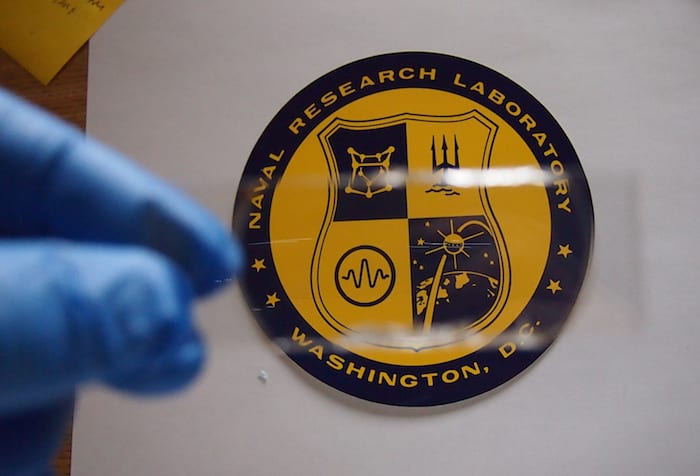
“Heating the material above the softening point, around 100 degrees Celsius, melts the small crystallites, enabling the fracture surfaces to meld together and reform via diffusion,” said Dr. Mike Roland, senior scientist, NRL Soft Matter Physics. “This can be accomplished with a hot plate, akin to an iron, that molds the newly forming surface into a smooth, flat sheet with negligible effect on integrity.”
Up to now, NRL scientists have tested the use of polymeric materials as a coating to achieve improved impact resistance of hard substrates. Applying polyurea and polyisobutylene layers enhance the ballistic performance of armor and helmets, and achieve greater ballistic effectiveness and mitigation of blast waves.
By using a variation of employing thermoplastic elastomers, NRL scientists are able to recreate superior ballistic properties of polyurea and polyisobutylene coatings, with the added benefit of the material being transparent, lighter than conventional bullet-resistant glass, and repairable.
“Because of the dissipative properties of the elastomer, the damage due to a projectile strike is limited to the impact locus. This means that the effect on visibility is almost inconsequential, and multi-hit protection is achieved,” Roland said.
NRL’s transparent thermoplastic elastomer armor technology is covered by U.S. Patent #9,285,191; “Polymer Coatings for Enhanced and Field-Repairable Transparent Armor.”
More From SAE Media Group
Aerospace & Defense Tech Briefs
Designing With Plastics for Military Equipment

Tech Briefs
Healable Carbon Fiber Composite
Automotive Engineering
Lighter, Recyclable Body Seal from Cooper Standard Wins SAA Award
Aerospace & Defense Tech Briefs
Thermal Conductivities of Some Polymers and Composites

Aerospace & Defense Tech Briefs
Fiber-Reinforced Thermoplastic Composites


Tech Briefs
5 Ws of Microlattice Pads for Improved Helmets
Defense INSIDER
Multifunctional Nanofiber Protects Against Explosions
Medical Design Briefs
High-Purity Medical Elastomers
Medical Design Briefs
Innovative Soft Thermoplastic Urethanes for Medical Applications
Medical Design Briefs
Scalable 3D Printing Technique Produces Stretchable, Flexible Soft Plastics
Aerospace Manufacturing and Machining INSIDER
Researchers Push Limits in High-Temp, Polymer Additive Manufacturing
Tech Briefs
Glass Injection Molding
Medical Design Briefs
Product of the Month
Medical Design Briefs
High-Performance Crosslinkable Thermoplastic Elastomers for Medical Applications

Aerospace & Defense Tech Briefs
Faster, Lighter, Stronger: Aerospace Composites Join Together Advanced Materials
Automotive Engineering
Weaving a New Future for Composites



Aerospace INSIDER
Air Force Explores Use of Thermoplastic Fin for F-16
Tech Briefs
New Process Breaks Down Polystyrene

Aerospace Manufacturing and Machining INSIDER
Thermoplastic Drive Shaft System Developed for Aerospace Applications
Aerospace & Defense Tech Briefs
Towards Sustainable Recycling of Epoxy-Based Polymers: Approaches and Challenges of Epoxy Biodegradation
Top Stories
NewsSensors/Data Acquisition
 Microvision Aquires Luminar, Plans Relationship Restoration, Multi-industry Push
INSIDERRF & Microwave Electronics
 A Next Generation Helmet System for Navy Pilots
INSIDERWeapons Systems
 New Raytheon and Lockheed Martin Agreements Expand Missile Defense Production
NewsAutomotive
 Ford Announces 48-Volt Architecture for Future Electric Truck
INSIDERAerospace
 Active Strake System Cuts Cruise Drag, Boosts Flight Efficiency
ArticlesTransportation

Webcasts
Aerospace
 Cooling a New Generation of Aerospace and Defense Embedded...
Energy
 Battery Abuse Testing: Pushing to Failure
Power
 A FREE Two-Day Event Dedicated to Connected Mobility
Automotive
 Quiet, Please: NVH Improvement Opportunities in the Early Design Cycle
Electronics & Computers
 Advantages of Smart Power Distribution Unit Design for Automotive &...
Unmanned Systems
 Sesame Solar's Nanogrid Tech Promises Major Gains in Drone Endurance