




Ford to Make Pursuit-Rated HEV Police Car in 2018

Ford plans to further expand its role in the police-vehicle market with the availability of a new model in 2018: the Police Responder Hybrid, a sedan based on the standard Fusion Hybrid that Ford says not only should save police departments significant fuel cost but also is the first-ever hybrid model to earn a “pursuit” rating.
Police departments using the new Police Responder Hybrid could reap fuel savings of nearly $3,900 annually based on a police duty-cycle formula that reckons a typical vehicle idles more than 60% of the time it’s operating during about 20,000 miles of annual driving.
“Operating costs are a big deal,” said Joe Hinrichs, Ford president for the Americas, at a New York unveiling of the Police Responder Hybrid prior to the New York auto show.
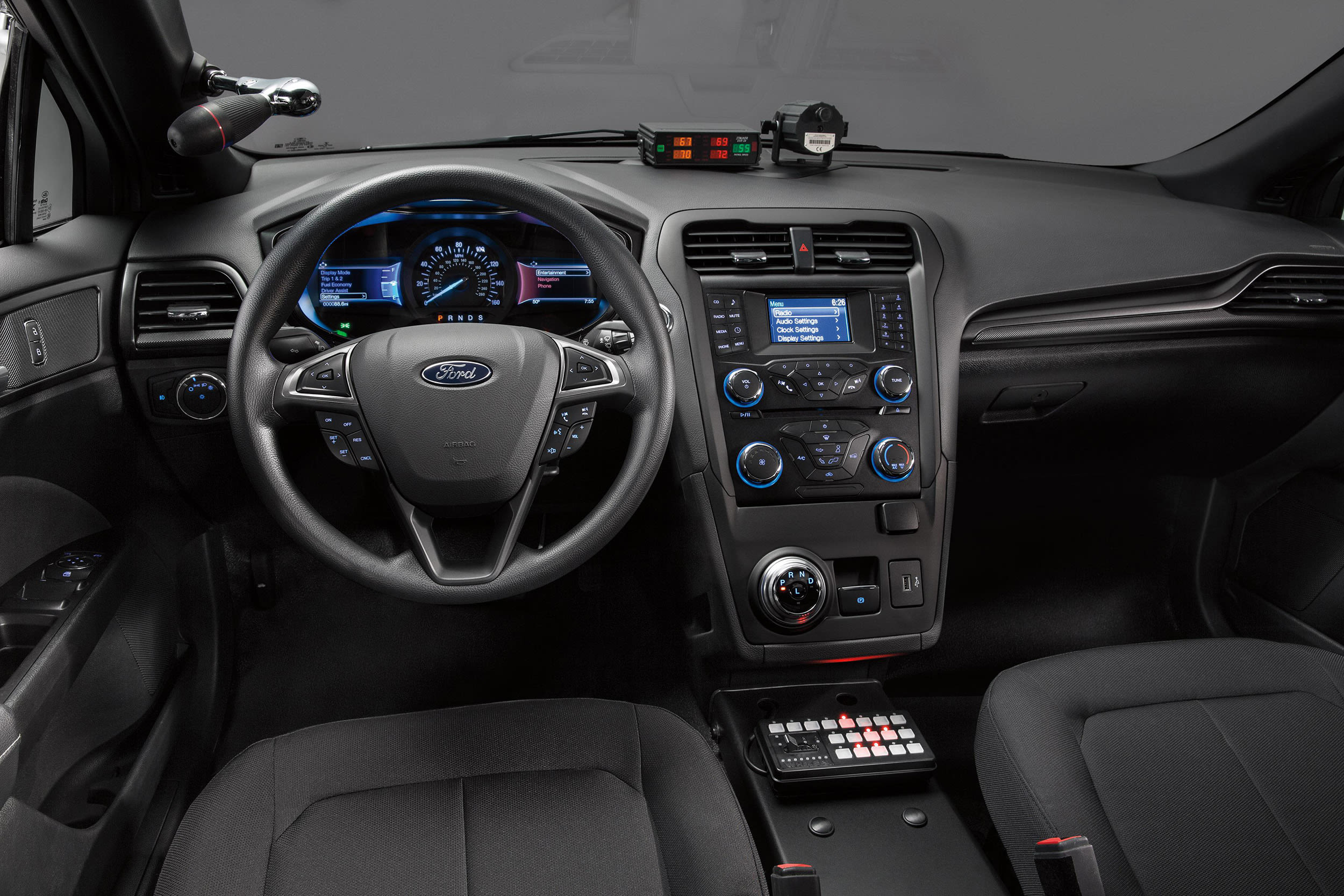
The Police Responder Hybrid counts as one of the 13 new electrified vehicles Ford has famously promised to add to its global lineup in the next five years. The company also announced earlier this year that it will by 2020 develop hybrid-electric variants of two high-profile nameplates—the F-150 pickup and the Mustang musclecar.
Arie Groenveld, Ford chief program engineer for police programs, said the Police Responder Hybrid’s powertrain is unchanged from the standard Fusion Hybrid; the front wheels are driven by a 2.0-L gasoline engine and permanent-magnet AC synchronous motor that combine for 188 total horsepower, while a 1.4-kW lithium-ion battery pack supplies the drive motor and receives energy recovered from braking. He said the pursuit rating entails different programming regimes for transmission shift points and battery recharging.
Although Ford said the Police Responder Hybrid is the first HEV to earn a pursuit rating, the standards for pursuit may not be as demanding as one might imagine. The car’s projected 0-60 mph (0-97 km/h) time is about 8.9 s—roughly the same as the circa 2011 Crown Victoria, once a mainstay of police forces across the nation—but it’s not expected to be good for sustained speed much in excess of 100 mph (161 km/h).
There is more to pursuit that acceleration and speed, however: Ford said that its collaboration with police-testing programs run by the Michigan State Police and the Los Angeles County Sheriff’s department requires vehicles to withstand impacts with 8-in (20-cm) curbs and to traverse railroad tracks at 30 mph (48 km/h) and flooded intersections with water depths up to 18 in (46 cm). Heavy-duty suspension and 17-in brake rotors also help bring the vehicle to police standards; Groenveld said police testing does not dictate a minimum ride height to achieve the performance and durability goals, but noted the vehicle does have a 0.5 in (1.3-cm) increased ride height.
Groenveld said the Police Responder Hybrid suspension modifications are “very similar to what we do with the standard Police Interceptor.” He added that the base vehicle is built in its home assembly plant then is shipped to a secondary location for police-duty modification.
Downplaying pursuit characteristics, Ford said its newest police vehicle is “ideal for urban patrolling.” In that role, the vehicle appears ready-made for cost-cutting. The company said the Police Responder Hybrid’s EPA combined fuel economy rating is 38 mpg, better than twice the 17-mpg combined rating of today’s Taurus-based Police Interceptor sedan. That kind of upgrade in fuel economy brings a cost payback for the new Police Responder Hybrid to just about one year, said Hinrichs, as well as enabling more vehicle “uptime” thanks to fewer trips to the fuel pump.
“We’re proud of this (police) business,” said Hinrichs. “And as long as you’re not riding in one, they look great,” he added. Ford said it currently supplies about 63% of the country’s law-enforcement vehicle demand.
More From SAE Media Group
Automotive Engineering
Packaging Honda’s all-new Insight
Automotive Engineering
Audi Shows Design, Fuel-Cell Directions
Automotive Engineering
TRD Spells Capability for Toyota’s Latest Tundra
Off-Highway Engineering
Work Trucks Strive to Curtail Addiction to Fuel
Automotive Engineering
2020 Corolla Hybrid
Automotive Engineering
ICE and Hybrid-Electric Propulsion Show Staying Power
Automotive Engineering
Lotus Breaks out with New Eletre Electric SUV
Automotive Engineering
Volvo’s Polestar Powerhouse Plug-In Hybrid
Off-Highway Engineering
Lightning EMotors Announces EChassis for Commercial EVs
Automotive Engineering
New Ford S-Max to Get Class-Leading Driver Assistance Features
Automotive Engineering
2016 Malibu Sheds 300 lb, Adds New Hybrid System
Automotive Engineering
Extending the ICE Age: Ford’s Dave Filipe Has Some Powerful Choices to Make
Automotive Engineering
2019 Toyota Avalon Hybrid
Automotive Engineering
Ford Amped for New Phase of Hybrid-Electric Offensive
Automotive Engineering
2026 Toyota RAV4 Review: All Hybrid, All the Time
Automotive Engineering
5 More HP for 2026 Kia Sportage: First Drive
Automotive Engineering
Ford’s Market 'Fusion' Creates Mondeo for Europe
Automotive Engineering
Ford Unveils 2019 Mustang Bullitt, Promises Performance EV
Automotive Engineering
Mercedes Board Member Demonstrates Upgrades for New C-Class
Automotive Engineering
Kia Reveals Electric AWD Trail'ster Concept
Automotive Engineering
Kia's 2017 Niro Hybrid CUV Targets Sub-90 G/km CO2 Emissions
Automotive Engineering
Mercedes Doubles down on Electric Vans, Considers Fuel Cells
Automotive Engineering
Volvo's New Plug-In XC90 Is Really a Tri-Motor
Off-Highway Engineering
Kia Takes Aim at Commercial Vans with PBV Concepts
Automotive Engineering
Kia’s PBV Concepts Expand Commercial Possibilities
Automotive Engineering
Toyota Stretches SUV Line-Up with World Debut of Grand Highlander
Off-Highway Engineering
F-150 and Mustang Hybrids Part of Ford's Global Electrified Vehicles Plan
Automotive Engineering
2026 Nissan Leaf First Drive: Fun and More Efficient
Off-Highway Engineering
ZM Trucks Starts Production in Fontana, California
Top Stories
INSIDERManufacturing & Prototyping
 How Airbus is Using w-DED to 3D Print Larger Titanium Airplane Parts
INSIDERManned Systems
 FAA to Replace Aging Network of Ground-Based Radars
NewsTransportation
 CES 2026: Bosch is Ready to Bring AI to Your (Likely ICE-powered) Vehicle
NewsSoftware
 Accelerating Down the Road to Autonomy
EditorialDesign
 DarkSky One Wants to Make the World a Darker Place
INSIDERMaterials
 Can This Self-Healing Composite Make Airplane and Spacecraft Components Last...
Webcasts
Defense
 How Sift's Unified Observability Platform Accelerates Drone Innovation
Automotive
 E/E Architecture Redefined: Building Smarter, Safer, and Scalable...
Power
 Hydrogen Engines Are Heating Up for Heavy Duty
Electronics & Computers
 Advantages of Smart Power Distribution Unit Design for Automotive...
Unmanned Systems
 Quiet, Please: NVH Improvement Opportunities in the Early Design...
