




Fresh Air for the Passenger Experience

When considering environmental factors in commercial aerospace, the most familiar themes focus on the reduction of emissions, noise, and fuel consumption. These design factors are interlinked and present a substantial technical challenge for designers and manufacturers, who must also ensure that aircraft are attractive to operators and their customers.

Some firms focus on modifying factors less-obvious than weight and emission; factors that can nevertheless make a difference as a bi-product of introducing an enhanced cabin environment for passengers. Countering internal condensation with a humidification system is one such example.
Sweden-based CTT Systems works with major commercial aircraft manufacturers and many specialist completion and maintenance companies around the world in providing humidity-control products and anti-condensation systems. These systems are designed to prevent moisture issues in aircraft and to enhance the in-flight comfort of crew and passengers.
In for the long haul

The human body can tolerate wide variations in humidity, but on a long-haul journey, flying at a high altitude, the air quality in a passenger jet cabin can deteriorate very quickly. Cabin air can reach desert-like, arid conditions within an hour after takeoff and the effects can often be noticed soon after the aircraft levels off into its cruise phase, typically at 35,000 to 40,000 ft. Symptoms often include dry skin and eyes, difficulty sleeping, and cold or allergy symptoms as the linings of the mouth and nose dry out.
As the flight continues, the body undergoes general fatigue and discomfort, with a varying degree of jetlag lasting well after arrival. While seemingly counterintuitive, the fewer the number of people onboard the aircraft, the more noticeable the effects are. Breath exhaled by a larger number of passengers in an economy cabin helps keep the cabin air moisture at an acceptable level, typically around 12%. In a business jet cabin, or in the business or first-class section of a large jet, the relative humidity may be as low as 5%.
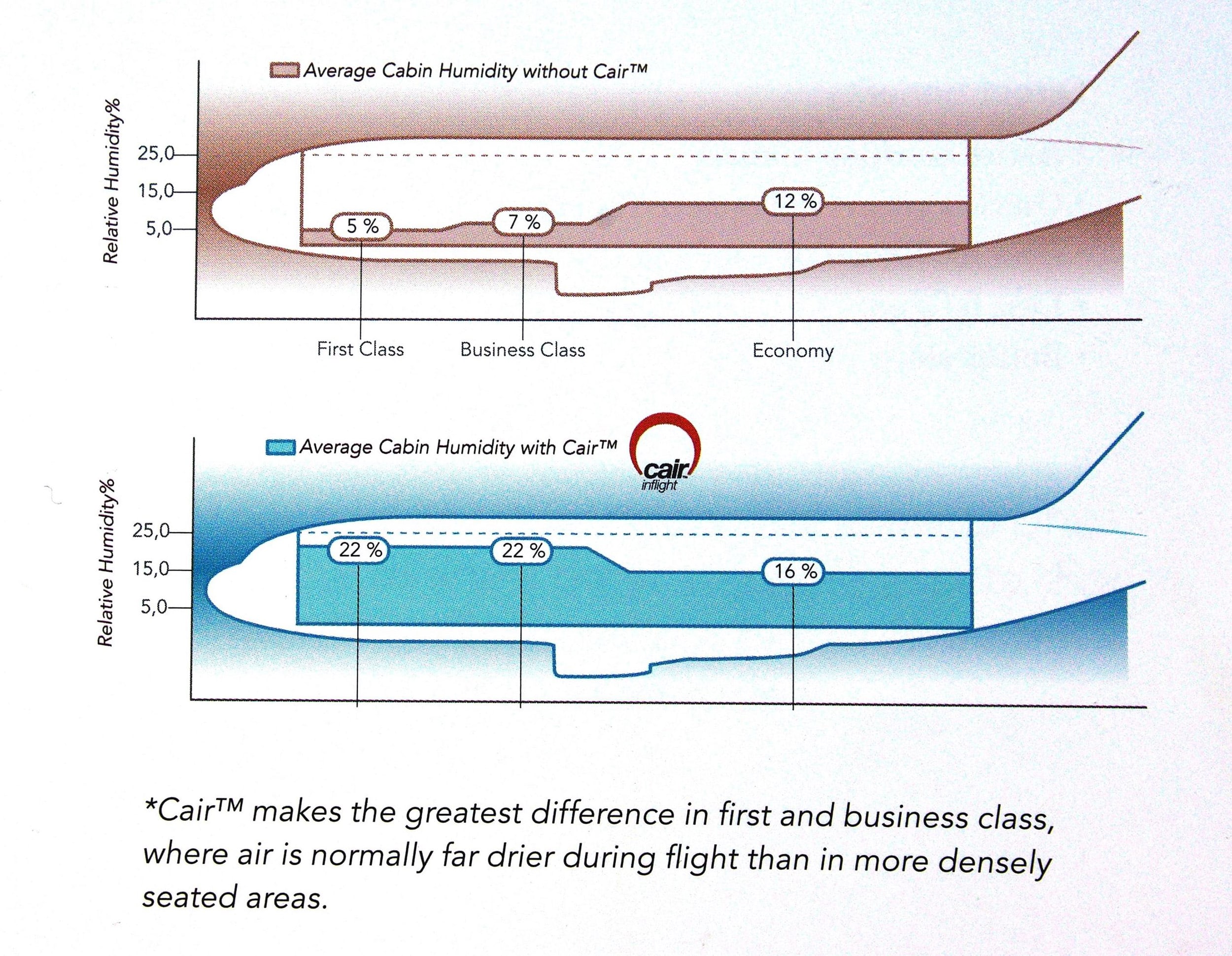
Humidifiers designed by CTT are based on evaporative cooling technology that improves air quality and effectively precludes the transfer of bacteria by reducing particles in the cabin air.
Dramatic condensation can occur as each passenger exhales an average of 100 gm of water per hour. If this condensed water is not drained from the aircraft, the effect can be noticed by passengers during takeoff and landing when water on top of ceiling panels seeps down into the cabin, causing “rain in the plane.” An extreme form of this phenomenon was a familiar feature in some earlier generation Russian-built commercial aircraft, where a sudden, damp fog would envelop the passenger cabin as the aircraft descended.

When water works its way into the cabin insulation panels, the insulation effect is reduced and the weight of a large aircraft can increase by over half a ton, depending on the aircraft type, passenger load, and other operational factors, such as climate. This results in higher fuel consumption and associated environmental impacts.
Water between the fuselage skin structure and the inner lining may cause other issues as many electrical wires and system equipment is located in this space. Moisture can trigger warning signals or even short circuits in sensitive items.
Corrosion related to moisture can affect electrical connectors and is most commonly found around features like window and door openings, antenna locations, and floor beams. Inspecting these out-of-sight areas and replacing components can be an expensive exercise for airlines and such activities usually occur during D-checks (the most extensive and exhaustive type maintenance checks).
Additionally, damp insulation material encourages fungal growth, which can cause allergic reactions in passengers, as well as potential damage. Drying out or replacing insulation adds to maintenance costs and requires additional down time. If moisture levels can be reduced or eliminated, airframe corrosion and corrective work can be minimized, extending the overall life cycle of the aircraft.
Clearing the air

According to CTT, providing moisture removal systems that use established industry technology can address the root causes of in-flight condensation. The CTT Zonal Drying System removes cabin air moisture by directing air from the crown area or cargo spaces to zonal drying units located at strategic points in the aircraft. Special ducting then circulates this dry air between the outer skin and cabin. This lowers the dew point in the crown area preventing the condensation process from taking place and keeps the insulating blankets dry.
A four-pole inlet fan feeds two separate airstreams into a rotor impregnated with silica gel, which absorbs humidity from one of the air streams and processes it before releasing it as dry air. Electric heaters warm up the second air stream before it enters the rotor. As it passes through the slow-moving rotor the heated air absorbs humidity collected from the processed air. The regenerated air is then fed into the aircraft re-circulation system, or dumped through an outflow valve. The system is activated when the aircraft is powered up.
CTT's CAIR system offers higher levels of passenger comfort through providing fresher air, which can deliver an edge in a highly competitive global airline market. The introduction of such features as flat-bed seats, on-demand TV, and internet access has provided additional benefits to attract premium customer loyalty, but enhancing the supply of fresh air is a very tangible improvement that more discerning frequent fliers are now appreciating.
In the early promotional history of Boeing’s 787 Dreamliner, high air quality and a passenger cabin pressurized at a simulated lower altitude became a major feature. Today, these features are regarded by many passengers as a reason to fly on this particular aircraft for long-haul flights. Every 787 has a Zonal Drying System as standard equipment, with the airline option of fitting humidifiers in crew rest areas and the flight deck. This latter option allows pilots and flight attendants better quality sleep during rest periods, which reduces fatigue and recovery periods after a long flight.
The CAIR system first appeared in 2001 and was fitted to Boeing and Airbus corporate jets including the 737 BBJ and A320 CRJ. Subsequently the systems were ordered for use in larger VIP aircraft including corporate versions of five Boeing and three Airbus models. The cabin humidifier system has been installed by many large completion centers and is certified as part of the complete STC (supplemental type certificate) for the interior. The system equipment is also available as a standalone fit for retrofit programs.
More From SAE Media Group
Aerospace INSIDER
How Aerospace Manufacturers are Adjusting to Ongoing Tariff Changes
Aerospace & Defense Tech Briefs
Aerospace Composites Experts Will Meet in Wichita This Month, Focusing on Validating Repairs Techniques
Aerospace & Defense Tech Briefs
Latest Boeing Business Jets 777X VIP Cabin Concept Debuts at MEBAA in Dubai
Aerospace & Defense Tech Briefs
Boeing Completes Assembly of the First 777X
Aerospace & Defense Tech Briefs
International Airlines Group Will Buy 200 Boeing 737 MAX Aircraft
Aerospace & Defense Tech Briefs
Mitsubishi Heavy Industries Will Acquire Bombardier’s Regional Jet Program

Aerospace & Defense Tech Briefs
Weber Metals Unveils New 540-Meganewton Press for Aerospace Components
Aerospace & Defense Tech Briefs
FLYHT and Spectralux Avionics Integrate Systems to Deliver FANS-Over-Iridium Satellite Communications to Airlines
Aerospace & Defense Tech Briefs
Airbus, U.S. Airline Flight Test GKN Aerospace Hydrophobic Coating for Cockpit Windows
Aerospace & Defense Tech Briefs
Connected Aircraft Technologies Benefit Manufacturers, Airlines, and Travelers
Aerospace & Defense Tech Briefs
Early Growing Pains Have Not Stopped Pratt & Whitney’s GTF Engine Orders
Aerospace INSIDER
German Air Force Starts Flight Testing New Heron ISR Drone
Aerospace & Defense Tech Briefs
Boeing’s Next EcoDemonstrator Test Bed Will Be a 777
Aerospace INSIDER
Navy Completes 73-Hour Nonstop Flight of Solar-Powered UAS
Aerospace & Defense Tech Briefs
A400M DIRCM Upgrades
Aerospace INSIDER
Can Microvanes Improve Fuel Efficiency for Legacy Air Force Aircraft?
Aerospace & Defense Tech Briefs
Excalibur Flight Test and Modification
Aerospace INSIDER
Paris Air Show: New Aerospace Technologies, Updates and Research
Aerospace INSIDER
New DARPA X-Plane Will Have No Moving Control Surfaces
Aerospace & Defense Tech Briefs
Boeing Delivers First Airplane from New 737 Completion and Delivery Center in Zhoushan, China
Aerospace & Defense Tech Briefs
Airbus Bring Four Dimensions to Airspace
Aerospace & Defense Tech Briefs
FAA, SAE International Focus on Engine Fire Protection System Standards for Aerospace
Aerospace & Defense Tech Briefs
Government, Industry Invest $450M to Advance U.K. Civil Aerospace Research, Technology, Manufacturing
Aerospace & Defense Tech Briefs
Ceramic Matrix Composites in Aircraft Engines Projected to Double over Five Years, Stratview Research Predicts
Aerospace & Defense Tech Briefs
Flight Testing Microvanes and Riblets

Aerospace INSIDER
Airbus Starts Operating 'Historic' First C295 Assembly Line in India
Top Stories
INSIDERManufacturing & Prototyping
 How Airbus is Using w-DED to 3D Print Larger Titanium Airplane Parts
NewsAutomotive
 Microvision Aquires Luminar, Plans Relationship Restoration, Multi-industry Push
INSIDERAerospace
 A Next Generation Helmet System for Navy Pilots
INSIDERDesign
 New Raytheon and Lockheed Martin Agreements Expand Missile Defense Production
ArticlesAR/AI
 CES 2026: Bosch is Ready to Bring AI to Your (Likely ICE-powered) Vehicle
Road ReadyDesign

Webcasts
Semiconductors & ICs
 Advantages of Smart Power Distribution Unit Design for Automotive...
Unmanned Systems
 Quiet, Please: NVH Improvement Opportunities in the Early Design...
Electronics & Computers
 Cooling a New Generation of Aerospace and Defense Embedded...
Power
 Battery Abuse Testing: Pushing to Failure
AR/AI
 A FREE Two-Day Event Dedicated to Connected Mobility
