




NAIAS 2017: Yanfeng Shows Concept Interior for Autonomous Driving
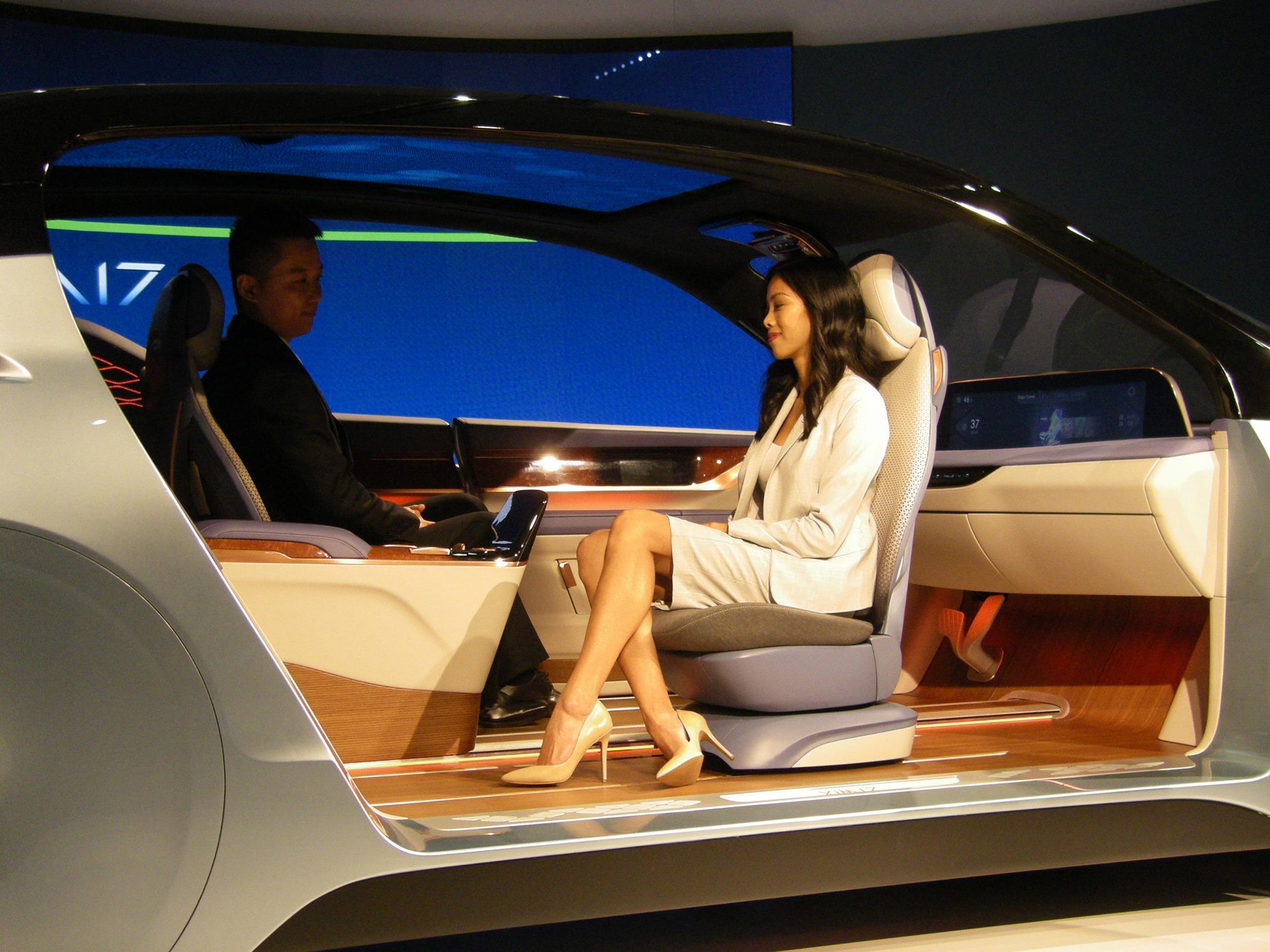
The driver's experience of being in a vehicle—but not driving—means opportunities for working or relaxing as envisioned in a vehicle cabin concept from the world's largest supplier of automotive interiors.
It was a two-year development process for the Experience in Motion concept demonstrator 2017 (XiM17) from Yanfeng Automotive Interiors, a joint venture between Yanfeng Automotive Trim Systems and Adient, the largest automotive seating supplier in terms of sales.
“This concept really enables a completely new and unique customer experience of space, features, and functions,” Han Hendriks, chief technology officer at Yanfeng Automotive Interiors, said at the demonstrator’s reveal at the 2017 Detroit auto show.

The electric-drivetrain concept vehicle’s four seats and floor console are the main elements within a large, flat-floor interior. By selecting one of four modes (driving, family, meeting, lounge), the seating and floor console are automatically powered into specific positions.
“Our last concept show car interior was biased toward [SAE] Level 3 autonomous, but we’re referring to this [latest] concept interior as a Level 3.5,” David Muyres, Executive Director of Research & Advanced Development for Yanfeng Global Automotive Interior Systems, said in an interview with Automotive Engineering.
For the XiM17’s driving mode, the two rear and two front seats face forward. The driver accesses the stop-start button and PRND selector on an overhead console.
The other three modes are for autonomous driving.
In the family mode, the front seatbacks rotate 16 degrees inward to allow the driver and front passenger to interact more easily with rear seat occupants. The rear console moves forward and the rear seats come together.
The meeting mode moves the driver's seat to the back of the vehicle, while the passenger seat moves forward and rotates 180º. Rear seats fold and stow in the rear panel.
With the lounge mode, the front seats move to the rearmost position.
The XiM17 concept features more than 30 innovations, the company said. “And most are ready to manufacture for the next-generation of vehicles,” claimed Hendriks.
More From SAE Media Group
Automotive Engineering
Hyundai Controls CO2 Level Inside Genesis Cabin
Automotive Engineering
Ford Expands ‘Split-View’ Camera Applications in SUVs, Trucks
Automotive Engineering
Magna Safety Systems Give Parents "Eyes in the Back of Their Heads"
Automotive Engineering
Car Sickness, Occupant Seating and Politics Will Shape Autonomous Vehicle Interiors
Automotive Engineering
Google Goes Hands- and Feet-Free in Pursuit of Driverless Cars
Automotive Engineering
Integrated Electronic Stability Control
Automotive Engineering
SAE Publishes Terminology Standard for Automated Driving Systems
Automotive Engineering
Autonomous Vehicle Challenge Ramps up Competition at Convergence
Automotive Engineering
Daimler and Uber Team up to Bring More Self-Driving Cars to the Road

Automotive Engineering
ZF and Hella Launch Sensor-Systems Development Partnership
Automotive Engineering
2017 Ford Escape Gains Major NVH, Powertrain, Connectivity Upgrades
Off-Highway Engineering
Mercedes Improves 2015 Sprinter with 4x4 Option, Cross Wind Assist
Automotive Engineering
Nissan's ProPILOT Assist Is More Than Lane-Keeping
Automotive Engineering
SAE Eye on Engineering Quick Take: Selling Vehicle Data

Automotive Engineering
AT&T, Airbiquity Team up for Connected-Vehicle Services
Automotive Engineering
Volvo's 2017 S90 Has Standard Semi-Autonomous Driving System
Automotive Engineering
Luminar Expands into Automotive LiDAR with $250 Million in Fundraising
Automotive Engineering
CES 2017: Automotive Suppliers Eclipsing OEMs in Advanced Tech
Automotive Engineering
CES 2017: Faraday Future Shows Its First Vehicle—the FF 91
Automotive Engineering
‘Supercars’ and Character Are Critical in the Autonomous Future
Automotive Engineering
Toyota Sticking with Measured, ‘Teammate’ Approach to Autonomous Development
Automotive Engineering
Continental Shows Next-Generation Highly Automated Car
Automotive Engineering
OEMs Continue to Diversify MaaS, Expand UX
Automotive Engineering
SAE Convergence 2016: Automakers, Suppliers Firm That Autonomous Driving Not Decades Away
Automotive Engineering
Chrysler 200 Sport Mode Balances Performance with Safety
Automotive Engineering
New Alliance to Bring Android Platform to the Car
Automotive Engineering
Autoliv, Seeing Machines Team up to Develop Driver Monitoring Systems
Off-Highway Engineering
Peloton Develops a Level 4 Automated Platooning System, but Keeps the Driver in Charge
Top Stories
INSIDERManufacturing & Prototyping
 How Airbus is Using w-DED to 3D Print Larger Titanium Airplane Parts
INSIDERManned Systems
 FAA to Replace Aging Network of Ground-Based Radars
NewsTransportation
 CES 2026: Bosch is Ready to Bring AI to Your (Likely ICE-powered) Vehicle
NewsSoftware
 Accelerating Down the Road to Autonomy
EditorialDesign
 DarkSky One Wants to Make the World a Darker Place
INSIDERMaterials
 Can This Self-Healing Composite Make Airplane and Spacecraft Components Last...
Webcasts
Defense
 How Sift's Unified Observability Platform Accelerates Drone Innovation
Automotive
 E/E Architecture Redefined: Building Smarter, Safer, and Scalable...
Power
 Hydrogen Engines Are Heating Up for Heavy Duty
Electronics & Computers
 Advantages of Smart Power Distribution Unit Design for Automotive...
Unmanned Systems
 Quiet, Please: NVH Improvement Opportunities in the Early Design...
