




NAIAS 2017: Power and More Underscore 2018 Toyota Camry
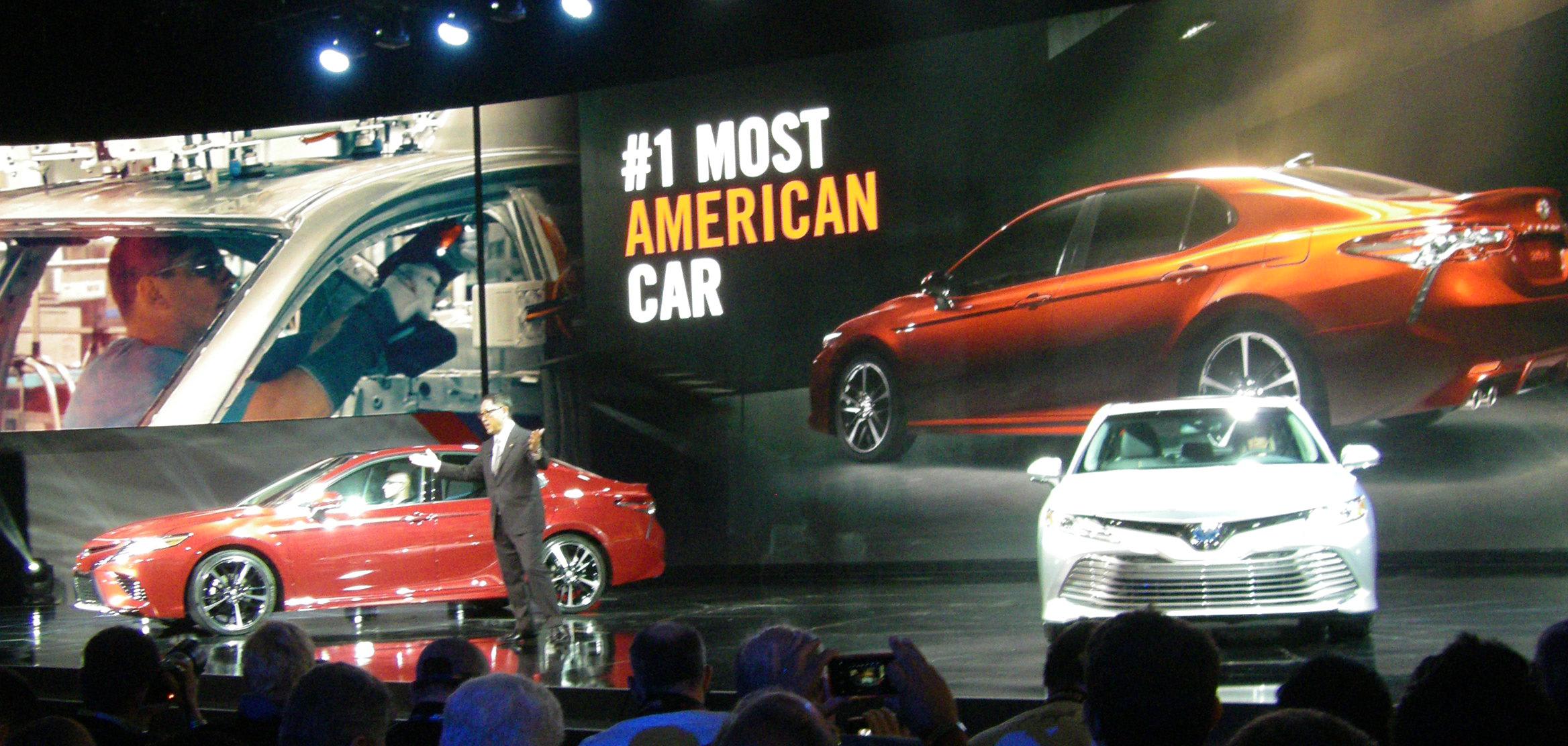
The best-selling car in America for the past 15 years breaks its mold with a new platform and powertrains. Things have changed with Toyota’s 8th-generation flagship sedan and the legacy of being simply a "standard sedan" has been blown up.

“We don’t want to just stay in that [standard sedan] position, so that was our driver to make an unprecedented change,” Masato Katsumata, global chief engineer of the 2018 Camry, said in an interview with Automotive Engineering following the car’s world debut at the NAIAS 2017.
Creating a car that would elicit fun and excitement for the driver was a key goal.
“This was not just another typical, conventional full model change,” Katsumata said about the approach of the engineers who had a hand in developing a midsize car with more advanced technology—and unexpectedly performance—than the current Camry.

The Toyota New Global Architecture (TNGA) set the stage for a highly revamped Camry. With TNGA, said Toyota Motor Corp. President Akio Toyoda, “Our engineers were able to accommodate the new design’s low center of gravity and the extreme sculpting of the sheetmetal.”
Primary vehicle dimensions are a 111.2-in (2824-mm) wheelbase, 191.3-in (4859-mm) overall length, 56.7-in (1440) overall height and 72.4-in (1839-mm) overall width. All but the height dimension have increased in comparison to the current Camry.
Camry will be offered with an all-new 2.5-L "Dynamic Force" 4-cylinder gasoline engine paired with an equally new Direct Shift 8-speed automatic transmission. This next-generation 4-cylinder spotlights higher torque, higher power and lower fuel consumption in the "total-use" range. And this high-output powerplant is reported to have 40% thermal efficiency, a claim Toyota also recently made about the 4-cylinder engine powering the Prius hybrid. See SAE Technical Paper .
The 2018 car also will be available with a 3.5-L V6 with D-4S fuel injection, as well as a next-generation Toyota Hybrid System variant. Unlike the current Camry Hybrid’s trunk-located battery pack, the 2018 model’s power pack is under the rear seat. The hybrid system’s CVT offers a new Sport Mode setting that enables the driver to feel smooth, quick simulated "gearshifts" via the simulated 6-speed sequential shift transmission.
The 2018 Camry is slated to reach dealerships in late summer 2017.
More From SAE Media Group
Automotive Engineering
Toyota Stretches SUV Line-Up with World Debut of Grand Highlander
Automotive Engineering
Toyota’s Multi-Pathway Future on Full Display
Automotive Engineering
Mazda’s 2024 CX-90 Offers Turbo I-6, PHEV Propulsion
Automotive Engineering
NAIAS 2017: The 2018 Lexus LS Gets Twin-Turbo V6, 10-Speed and Shiatsu
Automotive Engineering
2016 Los Angeles Auto Show: Mazda’s All-New CX-5 to Include Diesel Engine for North America
Automotive Engineering
Nissan Variable-Compression Engine Gets First Shot at Volume with New 2019 Altima
Automotive Engineering
With 2017 Fusion Sport, Ford Pushes Further Toward Audi
Automotive Engineering
New BMW 5 Series Adds PHEV, Touring, XDrive M5
Automotive Engineering
Chevy, Honda Join U.S. Subcompact Crossover Market
Automotive Engineering
Volvo XC90 Line-Up Keeps Hybrid Futures Safe
Automotive Engineering
2022 Toyota Tundra: V8 Out, Twin-Turbo Hybrid Takes Over
Automotive Engineering
Nissan Debuts Tech-Laden 2022 Ariya EV SUV
Automotive Engineering
All-New 2019 Ram 1500 Launches with a Bed-Load of Innovations
Automotive Engineering
What We’re Driving: 2018 BMW M5
Automotive Engineering
2017 Lincoln MKZ Gets Exclusive 400-Hp Twin-Turbo V6, Torque-Vectoring AWD
Automotive Engineering
Renault Reboots Espace with Crossover Leanings
Automotive Engineering
New York Auto Show 2016: Toyota Prius Prime Amps up Plug-In Capabilities
Automotive Engineering
Cadillac Reveals 2025 CT5-V and CT5-V Blackwing with More Tech
Automotive Engineering
Dana’s Twin-Clutch Axle Boosts Bronco Sport’s Off-Road Cred
Automotive Engineering
2019 Chevrolet Blazer: Sharply Styled and Right-Sized for the Voracious SUV Market
Automotive Engineering
Chicago Auto Show: Dodge Puts 375-Hp Hemi V8 in Durango SRT
Automotive Engineering
2017 Porsche Boxster Loses Cylinders, Gains Power, Adds Frugality
Automotive Engineering
What We’re Driving: 2020 Lincoln Aviator Reserve
Automotive Engineering
Nissan's New Direct-Injection V6 Muscles 2017 Pathfinder to 6000-Lb Towing Crown
Automotive Engineering
2018 Ford F-150 Diesel Aims to Beat 30 Mpg
Automotive Engineering
Musclecar Godzilla: Dodge Reveals 840-Hp Challenger SRT Demon
Automotive Engineering
Volvo S90: Niche for Now, But…
Automotive Engineering
FCA Turbocharges the 2019 Jeep Cherokee
Automotive Engineering
Schaeffler Tech Demonstrator Achieves 15% CO2 Reduction
Automotive Engineering
Mercedes-Benz Replaces M-Class with GLE, Adds Plug-In Hybrid
Top Stories
INSIDERManufacturing & Prototyping
 How Airbus is Using w-DED to 3D Print Larger Titanium Airplane Parts
INSIDERManned Systems
 FAA to Replace Aging Network of Ground-Based Radars
NewsTransportation
 CES 2026: Bosch is Ready to Bring AI to Your (Likely ICE-powered) Vehicle
NewsSoftware
 Accelerating Down the Road to Autonomy
EditorialDesign
 DarkSky One Wants to Make the World a Darker Place
INSIDERMaterials
 Can This Self-Healing Composite Make Airplane and Spacecraft Components Last...
Webcasts
Defense
 How Sift's Unified Observability Platform Accelerates Drone Innovation
Automotive
 E/E Architecture Redefined: Building Smarter, Safer, and Scalable...
Power
 Hydrogen Engines Are Heating Up for Heavy Duty
Electronics & Computers
 Advantages of Smart Power Distribution Unit Design for Automotive...
Unmanned Systems
 Quiet, Please: NVH Improvement Opportunities in the Early Design...
