




CES 2017: Schaeffler Surprises CES with 'Bio-Hybrid' Minicar for Urban Use
By 2050, urban populations worldwide will have risen by 2.5 billion, according to the United Nations. But “infrastructure expansion is not keeping pace with population growth, resulting in enormous traffic problems,” said Peter Gutzmer, Deputy CEO and CTO at the Schaeffler Group, at the 2017 CES. “Intermodal traffic in areas where space is at a premium and the ability to change smoothly from one means of transport to another will be highly significant,” he noted, adding that these areas “will require the smallest possible traffic footprint with the maximum mobility."

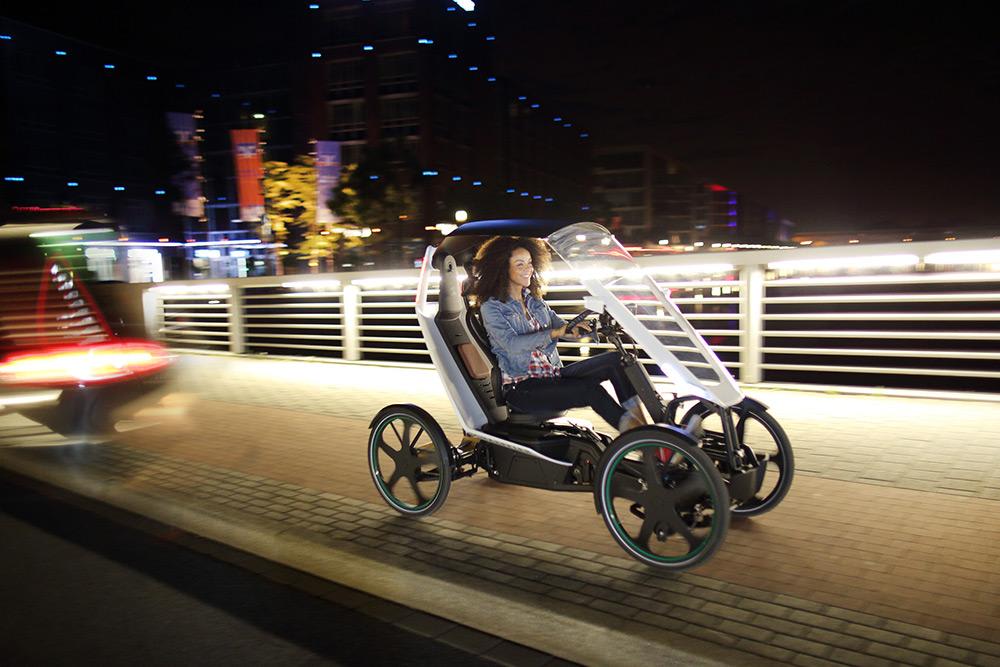
This disquieting prospect has Schaeffler engineers—best known for their clutch, stop-start, 48-V, roller bearing and other technologies—pondering new vehicle designs that could help meet the challenge, particularly for vehicles that occupy "the space between pedestrians and small cars,” Gutzmer said. The first result is the Bio-Hybrid, a compact urban vehicle prototype that is intended to operate on bicycle paths and downsized roadways that are expected to proliferate in newly-built cities in China, Korea and Arabia, and in renovated existing cities in Europe and America.
The four-wheel, pedal-electric-powered mini-vehicle is intended to be a capable single-passenger runabout for congested urban areas. Bio-Hybrid, which has a retractable roof to provide some protection from the elements, occupies minimal space with a length just over 2 m (6.6 ft) and a width of 85 cm (33 in)—sufficiently narrow for use on most cycle paths.

The vehicle's electric drivetrain is adapted from an e-bike, Gutzmer explained, so the driver does not have to rely entirely on pedal power to get around town. The e-motor recaptures braking energy and stores the power in the battery, which provides a range of 50 to 100 km (31 to 62 mi). When the battery runs low, it can be removed and recharged from any socket, he noted. The prototype also features an integrated mobile phone capability.
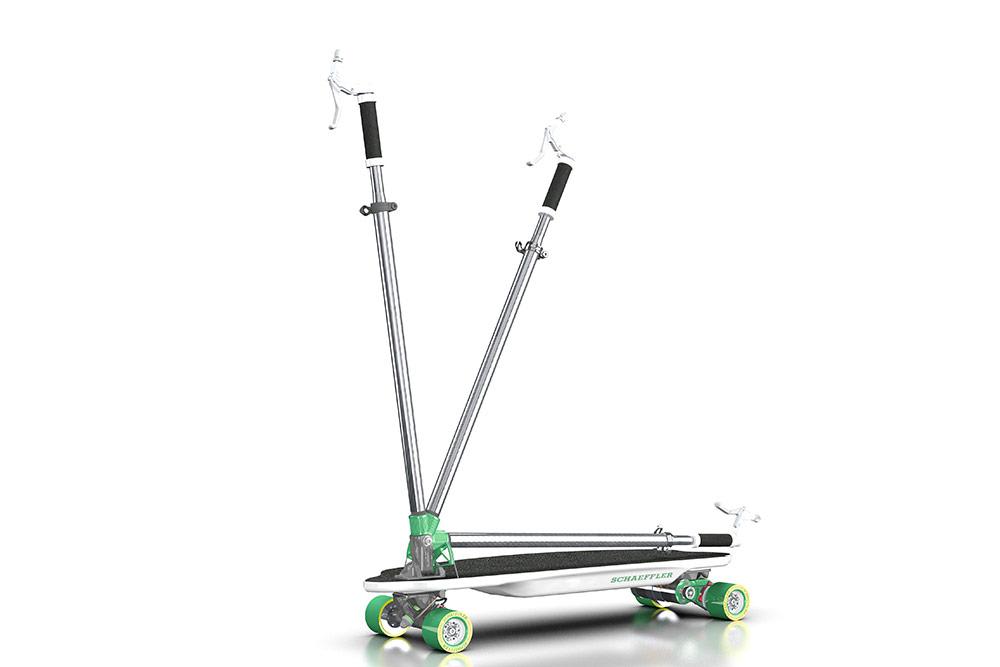
The car's lightweight metal space frame and plastic panel structure can take various forms, including a three-wheel variant that resembles an auto rickshaw. It can also be retrofitted with a child seat or a compartment for carrying luggage or packages. Future versions may also incorporate an electric kickboard scooter that is designed for the so-called ‘last mile’ to make it easier for people to make use of public transport and car sharing, Gutzmer noted.
The Bio-Hybrid is intended as a directional program and an inspiration for Schaeffler engineers when considering new forms of mobility,” Gutzmer said. However, he expects to see its use in pilot projects within five years.
More From SAE Media Group
Automotive Engineering
Automakers and Suppliers Crank up Their Interest in Electric Bikes
Automotive Engineering
OEMs Continue to Diversify MaaS, Expand UX
Aerospace & Defense Tech Briefs
AeroMobil Debuts Special Edition Sky Dragon Personal Transport Aircraft Targeted at Fast-Growing Market in China
Autonomous Vehicle Engineering
Why Car Washes Threaten Automated Vehicles
Automotive Engineering
NHTSA’s V2V Rollout Plan Gets Support, Questions
Automotive Engineering
‘Supercars’ and Character Are Critical in the Autonomous Future
Automotive Engineering
Automakers Expanding 48-V Production Plans, Says AVL Electrification Chief
Automotive Engineering
Why Audi Boss Stadler Believes in a Hands-Off Future
Automotive Engineering
Car Sickness, Occupant Seating and Politics Will Shape Autonomous Vehicle Interiors
Automotive Engineering
BMW, Honda and Yamaha Form Connected Motorcycle Consortium
Automotive Engineering
Continental Shows Next-Generation Highly Automated Car
Off-Highway Engineering
A Secure Technology Future Underscores U.S. Army's R&D Work
Automotive Engineering
Broader Data Sharing for Connected Transportation Will Require Widespread Collaboration
Automotive Engineering
Polestar CEO Aims to “Democratize” Performance EVs
Off-Highway Engineering
Peloton Develops a Level 4 Automated Platooning System, but Keeps the Driver in Charge
Automotive Engineering
CES 2017: Faraday Future Shows Its First Vehicle—the FF 91
Automotive Engineering
Delphi Launches Driverless Pilot Program in Singapore, Aims for Level 4 Operation by 2019
Automotive Engineering
Panasonic Enters Market with Reduced-Size Heads-Up Display
Aerospace & Defense Tech Briefs
Personal Air Transport Drives Need for Advanced VTOL Technologies, Standards
Automotive Engineering
Nissan's ProPILOT Assist Is More Than Lane-Keeping
Automotive Engineering
Ford Promises Full-Autonomous Car in 2021
Automotive Engineering
Denso Shows Readiness for V2X and Smart City
Automotive Engineering
Honda Introduces 'Industry First' Intelligent Adaptive Cruise Control
Automotive Engineering
Google's Krafcik Talks Self-Driving Vehicle Development
Automotive Engineering
Congestion, Autonomy, and Connectivity Key Issues for MY 2054 Cars
Automotive Engineering
Researching the Green Zone of Plug-In Hybrid Electric Driving
Automotive Engineering
The Ever-Changing Mobility Landscape
Automotive Engineering
Autonomous Vehicle Challenge Ramps up Competition at Convergence
Automotive Engineering
Planning for a Digital World
Automotive Engineering
OEMs, China Are Targets of Many Taiwanese Manufacturers
Top Stories
INSIDERManufacturing & Prototyping
 How Airbus is Using w-DED to 3D Print Larger Titanium Airplane Parts
INSIDERManned Systems
 FAA to Replace Aging Network of Ground-Based Radars
NewsTransportation
 CES 2026: Bosch is Ready to Bring AI to Your (Likely ICE-powered) Vehicle
NewsSoftware
 Accelerating Down the Road to Autonomy
EditorialDesign
 DarkSky One Wants to Make the World a Darker Place
INSIDERMaterials
 Can This Self-Healing Composite Make Airplane and Spacecraft Components Last...
Webcasts
Defense
 How Sift's Unified Observability Platform Accelerates Drone Innovation
Automotive
 E/E Architecture Redefined: Building Smarter, Safer, and Scalable...
Power
 Hydrogen Engines Are Heating Up for Heavy Duty
Electronics & Computers
 Advantages of Smart Power Distribution Unit Design for Automotive...
Unmanned Systems
 Quiet, Please: NVH Improvement Opportunities in the Early Design...
