




Volvo's 2017 S90 Has Standard Semi-Autonomous Driving System

An important next step toward the self-driving car was taken at the 2016 North American International Auto Show with the introduction of the all-new 2017 Volvo S90—a production car with a semi-autonomous driving system as standard equipment.
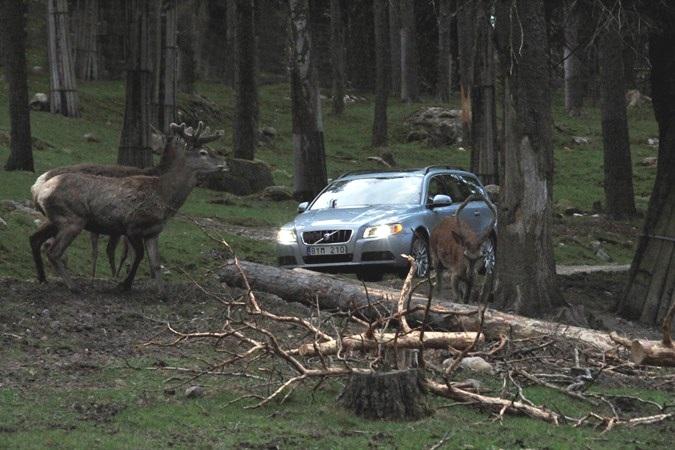
Built on Volvo's scalable product architecture (SPA), it combines the latest version of the company's Pilot Assist with the XC90's low-speed driver assistance with auto braking system. Capable of operating at up to 80 mph (130 kph), the new system is claimed to detect large animals such as deer and horses and has full day-or-night functionality. It can provide steering inputs to keep the car in lane, and unlike the XC90, can hold the course and lane even without a vehicle ahead to track.
The S90's software goes well beyond that of the XC90, which operates only up to 30 mph ( 50kph), but the key hardware pieces are carried over. They are multiple radar and camera arrays, including an optional 360º camera system for driving and parking in tight quarters, and auto parking.
However, the Pilot Assist operation is based on a forward-looking laser radar from Mahle/Delphi and the newest Mobileye camera. Both have a 140º angle of view, explained Thomas Mueller, Vice President of Electrical and Electronics Systems at Volvo R&D.
Evolution of image detection
Image detection is key, of course, and Volvo introduced pedestrian identification in 2010, followed by operation in darkness in 2012. Volvo's new software, developed with Mobileye but validated by Volvo in road testing, with threshold values set by Volvo, has evolved over the last several years.
The "night vision" learned in 2010 was followed by nighttime pedestrian detection, then by identification of bicyclists. And there is work ongoing beyond even the large animal detection, to identify sudden appearance of fixed objects in the road that could pose a hazard, such as a stack of bricks or a sofa, Mueller said.
The software uses the inputs of the standard array of sensors and cameras, plus a premium-accuracy GPS, to create a high definition 3D digital map of the area surrounding the car, with some measurements claimed by Volvo to be accurate to the millimeter level.
In addition, Volvo employs a new, continuous road traction identification algorithm for the S90. This enables the control system to adjust for the road surface itself, plus the performance of the brakes and tires, Mueller said.
Because the hardware is carried over from the XC90, the S90 Pilot Assist is backwards-compatible to that model, and Volvo soon will make a reflash available and upgrade the production system on that vehicle. There are tweaks that are necessary for the XC90, Muller noted, specifically pointing to the difference in windshield rake affecting the heads-up-display.

Volvo's confidence in the high-speed system was reflected in this statement, "We will take responsibility for any accidents in autonomous mode."
Leaf spring rear suspension
The SPA has a fixed front wheel center-to-firewall dimension and from that point the chassis can be set to a desired width and length. The S90 is very close in size to the XC90, with a wheelbase of 115.8-in (2941 mm), an overall length of 195.7-in (4963 mm). Curb weight is 1800-2150 kg (3968-4740-lb), with the weight increasing in part according to powertrain. \
Volvo's U.S. powertrain lineup is gasoline-only, and with a 2.0-L four. The S90's base engine is turbocharged and rated at 240 hp (179 kW). A twin-charged (turbo and supercharger) version is rated at 320 hp (239 kW). A high-performance plug-in hybrid, with a range of about 30 mi (50 km) is rated at 400 hp (298 kW). All use an Aisin-sourced AWF8F35 8-speed automatic transaxle.
Like the XC90, the new S90 sedan has a rear leaf spring suspension. While this may sound very SUV-like, it's a convex fiberglass spring mounted transversely, similar to the configuration long used on the Chevrolet Corvette. Front suspension is double wishbone with coil springs. Volvo does offer an optional four-corner air suspension for both models, and the one for the S90 is tuned specifically, so it's likely to provide a smoother ride.
The S90 will be marketed opposite such European sport sedans as the BMW 5-Series. It features "Thor's Hammer" T-shaped headlights and a concave grille reminiscent of the Volvo P1800 sports coupe produced in 1961-73.
More From SAE Media Group
Automotive Engineering
‘Supercars’ and Character Are Critical in the Autonomous Future
Automotive Engineering
CES 2017: Faraday Future Shows Its First Vehicle—the FF 91
Automotive Engineering
Renault Reveals Zoe EV Racecar Concept with 340-KW Output.
Automotive Engineering
Drive Me, Paint Me: Volvo Accelerates Its Tech Trajectory
Automotive Engineering
NAIAS 2017: Yanfeng Shows Concept Interior for Autonomous Driving
Automotive Engineering
2017 Ford Escape Gains Major NVH, Powertrain, Connectivity Upgrades
Automotive Engineering
Designing for Downforce
Automotive Engineering
Voltage Spike at 2017 Frankfurt Auto Show
Automotive Engineering
Polestar CEO Aims to “Democratize” Performance EVs
Automotive Engineering
Nissan's ProPILOT Assist Is More Than Lane-Keeping
Automotive Engineering
Porsche Practices the Art of Updating with the Eighth-Generation 911
Automotive Engineering
700 Miles, Hands-Free!
Automotive Engineering
Williams Presents Lightweight EV Platform
Automotive Engineering
Renault's New Zoe Vies for EV Range Crown
Automotive Engineering
U.K. Hipercar Project Delivers High Performance with Low Emissions
Automotive Engineering
Jaguar Unveils Twin-Motor I-Pace Battery-Electric Crossover
Off-Highway Engineering
Mercedes Improves 2015 Sprinter with 4x4 Option, Cross Wind Assist
Automotive Engineering
Delphi's RACam Integrated Radar-Vision System Enables Active-Safety Suites
Off-Highway Engineering
Mercedes-Benz Bills 3rd-Gen Sprinter as First Holistic Mobility Solution
Automotive Engineering
Google Goes Hands- and Feet-Free in Pursuit of Driverless Cars
Automotive Engineering
GKN's New Two-Speed EAxle Powers BMW I8
Automotive Engineering
Researching the Green Zone of Plug-In Hybrid Electric Driving
Tech Briefs
Product of the Month
Automotive Engineering
Hyundai Controls CO2 Level Inside Genesis Cabin
Automotive Engineering
Continental Demonstrates New Sensing Technologies for SAE Level 4 Capability
Automotive Engineering
Android, CarPlay Alter Taiwanese Companies' Strategies
Automotive Engineering
Magna Safety Systems Give Parents "Eyes in the Back of Their Heads"
Automotive Engineering
ZF and Hella Launch Sensor-Systems Development Partnership
Automotive Engineering
Integrated Electronic Stability Control
Automotive Engineering
Ford Promises Full-Autonomous Car in 2021
Top Stories
INSIDERManufacturing & Prototyping
 How Airbus is Using w-DED to 3D Print Larger Titanium Airplane Parts
INSIDERManned Systems
 FAA to Replace Aging Network of Ground-Based Radars
NewsTransportation
 CES 2026: Bosch is Ready to Bring AI to Your (Likely ICE-powered) Vehicle
NewsSoftware
 Accelerating Down the Road to Autonomy
EditorialDesign
 DarkSky One Wants to Make the World a Darker Place
INSIDERMaterials
 Can This Self-Healing Composite Make Airplane and Spacecraft Components Last...
Webcasts
Defense
 How Sift's Unified Observability Platform Accelerates Drone Innovation
Automotive
 E/E Architecture Redefined: Building Smarter, Safer, and Scalable...
Power
 Hydrogen Engines Are Heating Up for Heavy Duty
Electronics & Computers
 Advantages of Smart Power Distribution Unit Design for Automotive...
Unmanned Systems
 Quiet, Please: NVH Improvement Opportunities in the Early Design...
