




Aerion Progresses on the AS2 with Help from Airbus, and Announces First Fleet Customer

The joint engineering efforts that Aerion and Airbus Group have dedicated to the AS2 supersonic business jet since 2014 has taken on even more importance as it was announced in mid-November that aircraft has received its first firm order for 20 from Flexjet.

Carrying eight to 12 passengers, the AS2 will have an intercontinental-capable range of 4750 nmi at supersonic speed, saving three hours across the Atlantic vs. subsonic aircraft and more than six hours on longer trans-Pacific routes. The three-engine jet will make its first flight in 2021 and enter service in 2023.
“We see Aerion's technology and the AS2's performance capabilities as potential game-changers for business travel,” said Flexjet Chairman Kenn Ricci. Flexjet offers fractional jet ownership and leasing. Aerion and Flexjet will work together to design the interiors for the AS2s


In terms of Airbus and Aerion working together, the two companies have been proceeding “quietly, but steadily” on the Mach 1.5 AS2 since the first joint engineering team meeting in 2014.
Airbus Defense & Space out of Spain has made progress in the engineering of airframe structures, the AS2’s fly-by-wire flight control system, its integrated fuel system, and landing gear. Some of the company’s accomplishments include preliminary designs for a 10-spar carbon fiber wing structure, fuselage and empennage structures, an articulating main landing gear system that minimizes space requirements in the fuselage when stowed/retracted, and a fuel system that is integrated with the digital fly-by-wire system for control of center of gravity.
The aircraft’s flight control design will take advantage of small, powerful actuators that can be housed in the AS2’s thin flying surfaces. To supplement the design process, Airbus D&S built a sample titanium wing leading-edge section for evaluation and is testing composite material specimens to optimize material properties.
Aerion is the lead for other systems, such as avionics, electrical, environmental control, hydraulics, and auxiliary power. In conjunction with Airbus D&S, Aerion had made preliminary space allocations for every system with weight and balance considerations in mind. Candidate suppliers have been identified and the supplier selection process has begun.
This past September, senior engineering staff from Aerion, Airbus D&S, Airbus Group, and other Tier 1 equipment suppliers gathered at Aerion headquarters in Reno for a four-day technical and program review, covering engineering accomplished to date on all structures and aircraft systems.
“The take-away from the design review and the effort this past year is that we have moved out of the conceptual design phase into commercializing Aerion technology,” said Aerion Senior Vice President for Aircraft Development Mike Hinderberger, “We are doing the engineering work today that will allow us to build and fly a supersonic jet at the turn of the next decade.”
As it stands, the engine will be the pacing element for the first flight of the AS2 in 2021. The original design specified the JT8D engine from Pratt & Whitney, and the engineers are now looking at more modern engines.

“We are targeting the first half of 2016 to select a propulsion system, which will enable us to formally launch the program shortly thereafter,” said Doug Nichols, Aerion CEO.
Aerion has identified existing core engines suitable for adaptation to the needs of supersonic flight.
“We will proceed with an engine that allows us to meet our performance goals with the minimum changes required,” said Nichols. “Aerion is focused on an engine solution that meets Stage 4 noise standards while preserving long-range supersonic performance. This is a significant challenge with a low-bypass supersonic engine, but solutions are in sight with today’s engine technology.”

Aerion says the jet will operate efficiently within the current regulatory environment, including rules regarding supersonic flight over land. This takes advantage of the ability of the AS2 to operate efficiently just below the speed of sound at Mach 0.95 to 0.98, and at speeds up to Mach 1.5 over water and other areas where supersonic flight is permitted. “This is a very good airplane at subsonic or supersonic speeds,” said Hinderberg, adding that he considers the aircraft “almost more like a fighter than a commercial airliner.”
When the partnership began, Airbus was particularly interested in Aerion's proprietary laminar flow software tool for analyzing high-speed airflow and for airframe optimization. In fact, said, Hinderberg, the program’s “two top goals were optimizing for natural laminar flow and optimizing for wave drag.”

“This is Aerion’s jet and Aerion’s program, with substantial benefits for Airbus Group,” said Ken McKenzie, Senior Vice President for Strategy and Corporate Development at Airbus Group. “We gain new technology and tools, and through our collaboration will be expanding engineering knowledge and refining processes such as digital manufacturing. The AS2 program will be an incubator for innovation in design, engineering, and manufacturing.”
Nichols says that “Aerion has begun a formal search for a U.S. manufacturing location” for the AS2.
“We’re looking for a state-of-the art campus of more than 100 acres on a major airport with a minimum 9000-ft runway, and other special geophysical requirements,” he said. Among them will be a location within 200 nmi of a supersonic flight test area, most likely one offshore.
Aerion will evaluate numerous factors including: airport suitability, road and rail infrastructure, proximity to a deep-water port for shipped structures and equipment, local aerospace workforce, state and local regulations, quality of life, and regional educational institutions.
The company expects to announce the location of the assembly site in the first half of 2016 upon formal launch of the AS2 program, and break ground in 2018.
Airbus Group will provide major components and Aerion will conduct final assembly. Both companies envision a long-term relationship for ongoing technical support. Aerion will draw on expertise from Airbus Group for establishing the new Aerion production facility.
More From SAE Media Group
Aerospace & Defense Tech Briefs
Aerion Progresses on the Supersonic AS2 with Help From Airbus
Motion Design INSIDER
Tailless Jet Flies Free with Novel Control Technique
Aerospace & Defense Tech Briefs
Boom Aims to Conquer Concorde by 2023
Aerospace & Defense Tech Briefs
Aerion and Honeywell Collaborate on Revolutionary Flight Deck for Supersonic Bizjet
Aerospace & Defense Tech Briefs
GE, Lockheed Martin Commit to Aerion's Supersonic Bizjet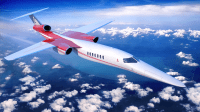
Aerospace & Defense Tech Briefs
HondaJet Goes on Show
Aerospace & Defense Tech Briefs
Embraer's First E190-E2 Jet Takes off Early
Aerospace & Defense Tech Briefs
Embraer Debuts Its KC-390 Military Transport Aircraft
Aerospace & Defense Tech Briefs
NASA Vocal About Sharing Technologies to Reduce Noise, Emissions
Aerospace & Defense Tech Briefs
Boeing Completes Assembly of the First 777X
Aerospace & Defense Tech Briefs
Spike Aerospace Validates Supersonic Aero Design with Subsonic Demonstrator
Aerospace & Defense Tech Briefs
Sikorsky’s All-New Raider Helicopter Prototype Is Ready to Fly
Aerospace & Defense Tech Briefs
Lockheed Martin Offering Its 'Production Ready' T-50A for USAF Trainer Competition
Aerospace & Defense Tech Briefs
Gulfstream Makes Progress on G600 and G500 Programs, the Latter Completing First Flight
Aerospace & Defense Tech Briefs
Bizjets Hope to Get a Lift from New Technology
Aerospace & Defense Tech Briefs
NASA Takes a Respectable-Sized Step Toward Supersonic Flight
Aerospace & Defense Tech Briefs
Light Attack Reconnaissance Helicopter Secures Vertical Lift Dominance
Aerospace & Defense Tech Briefs
Lockheed Martin LM-100J Starts Taking (A Similar) Shape
Aerospace & Defense Tech Briefs
Airbus Launches A321neo with ‘True Transatlantic Capability’
Aerospace & Defense Tech Briefs
Boeing's Pegasus Makes First Refueling Flight
Aerospace & Defense Tech Briefs
Boeing and Embraer Take Relationship to Next Level
Aerospace INSIDER
Autonomous Black Hawk® Flies Missions Without Pilots on Board
Aerospace INSIDER
Lockheed Martin Delivers 500th C-130J Super Hercules Airlifter
Aerospace INSIDER
KC-46A Pegasus Approved to Refuel 97% of Joint Force Receivers
Aerospace & Defense Tech Briefs
Sierra Nevada Breathes Life into D328, Determined to Make It Fly Again, and Evolve
Aerospace & Defense Tech Briefs
Dassault Aviation Rolls Out, Preps Falcon 8X for First Flight
Aerospace & Defense Tech Briefs
Sikorsky’s S-97 Takes Successful First Flight
Defense INSIDER
Sikorsky Converts Black Hawk into U-Hawk Autonomous Helicopter
Aerospace Manufacturing and Machining INSIDER
Bell and U.S. Army Advance V-280 Valor Development and Aviation Modernization
Top Stories
INSIDERManufacturing & Prototyping
 How Airbus is Using w-DED to 3D Print Larger Titanium Airplane Parts
INSIDERManned Systems
 FAA to Replace Aging Network of Ground-Based Radars
NewsTransportation
 CES 2026: Bosch is Ready to Bring AI to Your (Likely ICE-powered) Vehicle
NewsSoftware
 Accelerating Down the Road to Autonomy
EditorialDesign
 DarkSky One Wants to Make the World a Darker Place
INSIDERMaterials
 Can This Self-Healing Composite Make Airplane and Spacecraft Components Last...
Webcasts
Defense
 How Sift's Unified Observability Platform Accelerates Drone Innovation
Automotive
 E/E Architecture Redefined: Building Smarter, Safer, and Scalable...
Power
 Hydrogen Engines Are Heating Up for Heavy Duty
Electronics & Computers
 Advantages of Smart Power Distribution Unit Design for Automotive...
Unmanned Systems
 Quiet, Please: NVH Improvement Opportunities in the Early Design...
