




Design Software Targets Germs, Dry Air
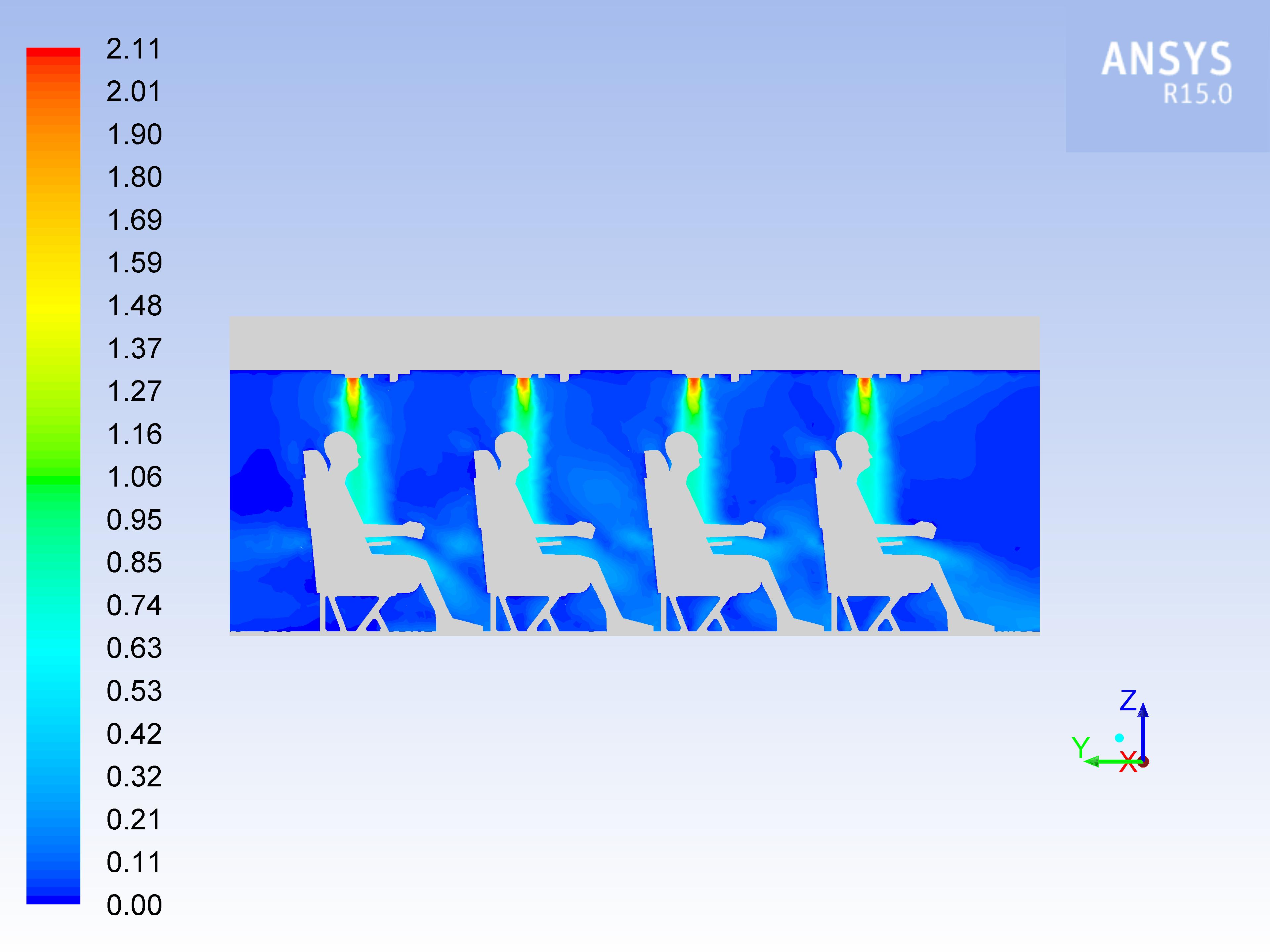
Concerns about airborne diseases and flu pandemics coupled with increasing passenger concerns about environmental conditions are prompting some aircraft designers to take a closer look at ventilation systems. In many instances, improvements in air quality and cleanliness are being expedited by using design tools such as computational fluid dynamics (CFD).
Ansys is responding to this increased interest by upgrading its CFD tools to let aircraft engineers look at 3-D environments as well as 2-D technologies such as electronics and ductwork simultaneously. Ansys 15, unveiled late last year, also claims to handle larger problems and complete analysis runs in short times. That could help ventilation experts improve air quality.
“With CFD software, you can look not just at airflow, but also at temperature distribution and humidity,” said Rob Harwood, Aerospace and Defense Industry Director at Ansys. “Our new tool lets users track particulates like viruses to see how they move and how they can be removed. Users can also look at deliberate threats to see what happens if someone releases contaminants on a plane.”
The need to combine 2-D and 3-D files highlights the complex nature of airflow management. Air quality is impacted by the efficiency of motors, ductwork design, and the capabilities of electronic controllers that manage air movement, as well as the number and position of passengers.
“Engineers can look at different ductwork designs to see how they can eliminate losses,” Harwood said. “Nozzles also play a major role when designers are trying to develop more efficient systems that draw less power. Designers want to reduce the amount of power drawn from engines.”
Electronic controls are central components, since they determine when fans will cycle on and off while also managing temperature and humidity levels. Ansys has expanded its software capabilities to improve efficiency of these controls.
“We’re doing more with automatic code generation,” Harwood said. “Users can describe their requirements at the functional level and the system generates code that meets FAA standards.”
Harwood noted that increased use of CFD tools highlights the trend for aircraft design to increasingly rely on modeling and simulation.
“We’re going into an era when designs can be optimized throughout the process,” he said. “Engineers can run simulations at any stage to see how minor tweaks impact complex designs.”
More From SAE Media Group


Tech Briefs
Embracing Agile Product Development
Aerospace & Defense Tech Briefs
Mentor Graphics Updates CFD Tool for Improved Productivity
Aerospace & Defense Tech Briefs
Software for Additive Design, Manufacturing Evolves Quickly
Aerospace & Defense Tech Briefs
Surviving the Challenge of Thermal Design in Aerospace Electronics
Aerospace Manufacturing and Machining INSIDER
Argonne and Raytheon to Collaborate on Aircraft Engine Design
Aerospace & Defense Tech Briefs
CAD-CAM-CNC System
Aerospace & Defense Tech Briefs
Aerion Taps Siemens’ Xcelerator Portfolio to Enable Next-Generation Global Transportation Networks

Aerospace & Defense Tech Briefs
NASA Embraces CFD to Replace Cancelled Flight Tests
Aerospace & Defense Tech Briefs
MathWorks Rolls out Major Update to Aerospace Blockset
Aerospace & Defense Tech Briefs
AGI and ANSYS Partner to Integrate Next-Gen Digital Modeling into Engineering Design
Aerospace & Defense Tech Briefs
Airbus’ Quantum Computing Challenge May Fundamentally Change Aircraft Development
Aerospace & Defense Tech Briefs
Designing Quieter Aircraft Via Acoustic Simulation
Aerospace & Defense Tech Briefs
A Supercomputer for Aerospace and Defense Systems Modeling and Simulation
Aerospace & Defense Tech Briefs
Industry Invited to Participate in AeroTech Aerospace and Defense Technical Program
Aerospace & Defense Tech Briefs
Turn Growing Complexity into Competitive Advantage Through Digitalization -- Focus of AeroTech Keynote Thursday
Aerospace & Defense Tech Briefs
3D Scanning Provides Key Weapon for Aerospace and Defense Manufacturing
Aerospace & Defense Tech Briefs
Centre for Modelling & Simulation to Develop Digital Twins for GKN Aerospace Additive, Composite, and Industry 4.0 Technologies
Aerospace & Defense Tech Briefs
3D Optical Scanner
Off-Highway Engineering
Advanced Simulation Techniques Drive Powertrain Design

Aerospace & Defense Tech Briefs
Embracing the Digital Transformation in Aerospace & Defense
Aerospace INSIDER
New Web-Based Software Enables Quick Drone Design
Aerospace & Defense Tech Briefs
A 'STEP' Forward for Product Lifecycle Management
Aerospace INSIDER
Production Ready B-21 Bomber on Track for First Flight This Year
Aerospace & Defense Tech Briefs
Sensuron Enables Real-Time Structural Health Monitoring Onboard NASA’s X-56 UAV
Aerospace & Defense Tech Briefs
High-Performance Enclosure Systems for Aerospace and Defense Applications: Preparing for What’s Next
Aerospace & Defense Tech Briefs
Air Mobility Innovations Take Center Stage at Aerospace Systems and Technology Conference
Top Stories
INSIDERManufacturing & Prototyping
 How Airbus is Using w-DED to 3D Print Larger Titanium Airplane Parts
INSIDERManned Systems
 FAA to Replace Aging Network of Ground-Based Radars
NewsTransportation
 CES 2026: Bosch is Ready to Bring AI to Your (Likely ICE-powered) Vehicle
NewsSoftware
 Accelerating Down the Road to Autonomy
EditorialDesign
 DarkSky One Wants to Make the World a Darker Place
INSIDERMaterials
 Can This Self-Healing Composite Make Airplane and Spacecraft Components Last...
Webcasts
Defense
 How Sift's Unified Observability Platform Accelerates Drone Innovation
Automotive
 E/E Architecture Redefined: Building Smarter, Safer, and Scalable...
Power
 Hydrogen Engines Are Heating Up for Heavy Duty
Electronics & Computers
 Advantages of Smart Power Distribution Unit Design for Automotive...
Unmanned Systems
 Quiet, Please: NVH Improvement Opportunities in the Early Design...
