




NASA Embraces CFD to Replace Cancelled Flight Tests
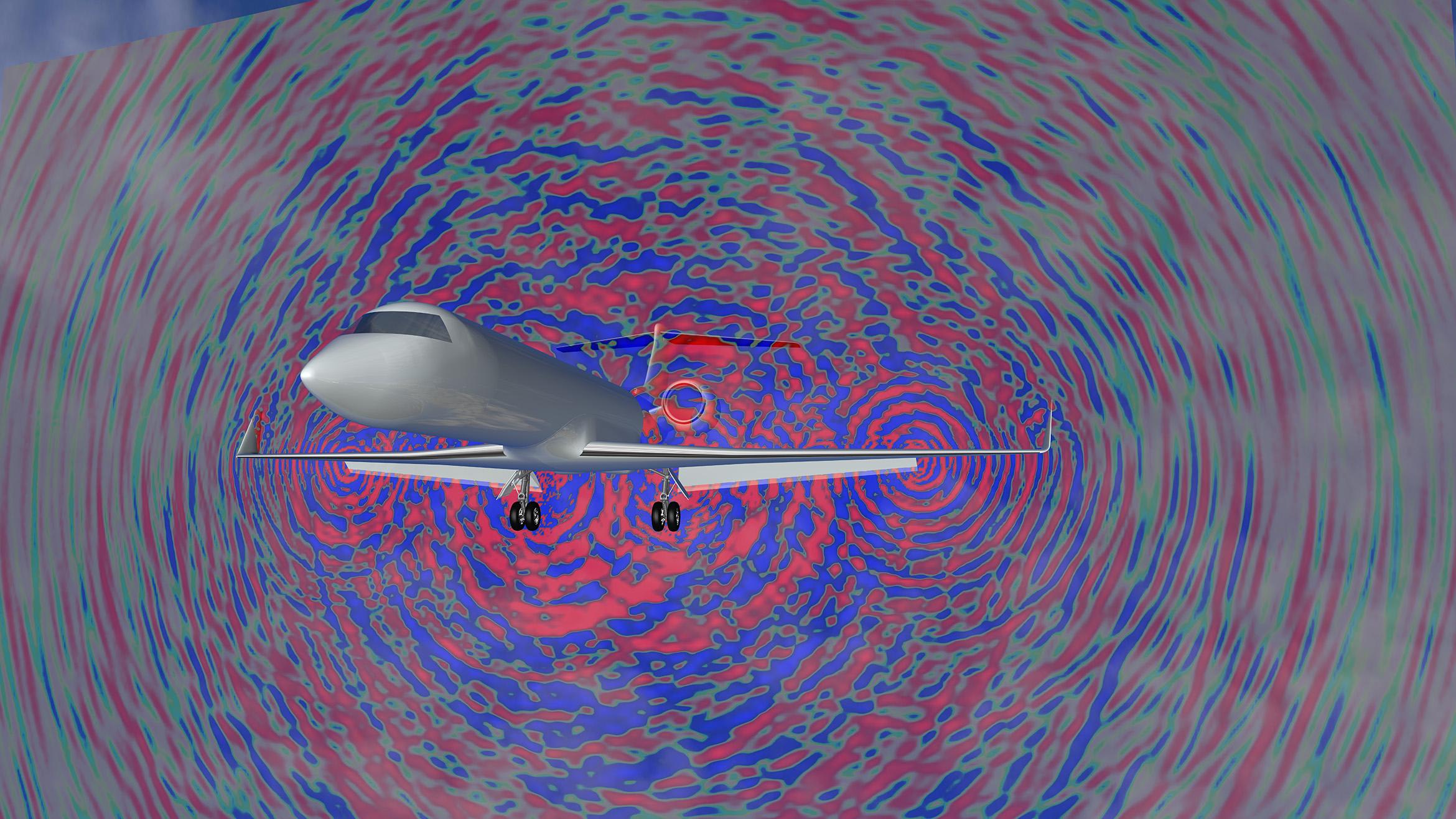
NASA has expanded its use of Exa's PowerFLOW software for the simulation of concepts to reduce aircraft noise within NASA's Environmentally Responsible Aviation (ERA) project.
“The goal of NASA’s ERA project is to reduce the noise footprint of aircraft during landing,” said Dr. Swen Noelting, Vice President, Aerospace, Exa Corp. in an email to Aerospace Engineering. “With engine jets having become much quieter over the last two decades, the noise from high-lift wings and landing gears (generally called ‘airframe noise’) has become the main contributor to noise heard on the ground.”
The reduction of noise generated by landing gear and high-lift wings is critical to meet the lower community noise targets of the future.
PowerFLOW predictions were successfully validated against high-fidelity wind-tunnel tests in 2013, and now, after the cancellation of a planned flight test due to budget constraints, NASA is using PowerFLOW simulations of a full-scale aircraft with flap and landing gear noise treatments to reach the original airframe noise objectives of the project.
“The simulations of the full-scale aircraft with noise-reduction concepts will help recover a significant part of the loss of the flight test. In addition, the simulations provide valuable insight into the sources of airframe noise," said Mehdi Khorrami, Senior Research Engineer at NASA Langley Research Center.
“The simulations capture every relevant detail of the fuselage, wing with extended flaps, and landing gears of the full-scale business jet, down to components of less than 1 mm in size on an aircraft with 28-m wingspan,” said Noelting.
Using simulation to test realistic noise-reduction concepts is an extremely challenging task for CFD, Noelting added. It is difficult to accurately predict the noise heard on the ground. The entire aircraft has to be simulated because of complex interactions between landing gear, wings, and other parts of the aircraft. In addition, the highly complex geometry of the landing gear has to be represented exactly in the simulation since even small geometry details can have significant impact on community noise.
"With these simulations—some of which are running on more than 10,000 cores—we are truly pushing the boundaries of CFD for industrial applications," said Noelting. “These are unsteady simulations, unlike typical CFD simulations that produce only steady-state (averaged) flow results. This enables us to directly capture flow fluctuations that are the cause of noise.
“From the fluctuating flow close to the aircraft and the resulting noise, we can calculate the noise heard on the ground from an airplane flying hundreds of meters overhead, enabling us to assess the impact and efficiency of noise-reduction concepts mounted on the wing and landing gear.”
The accuracy of the previous simulations during an extensive wind tunnel campaign at NASA Langley occurred during "a completely blind test (in fact, the simulations were carried out many months before the wind tunnel test)," said Noelting.
“The simulations use up to 8 billion cells—a world record for commercial CFD tools (to the best of my knowledge),” said Noelting. “They are being executed on NASA’s Pleiades Cluster (currently number 11 on the top 500 list of the world’s fastest computers) on up to 18,000 cores. PowerFLOW is the only software (commercial or otherwise) that can execute productive, industrial simulations on a cluster of this size despite of claims from other codes to have run on 30,000 cores. These are clearly one-off tests and not productive simulations producing real results.”
More From SAE Media Group
Aerospace & Defense Tech Briefs
Designing Quieter Aircraft Via Acoustic Simulation
Aerospace & Defense Tech Briefs
3D Optical Scanner
Aerospace & Defense Tech Briefs
Boeing’s EcoDemonstrator 757 Used to Get the Bugs Out
Aerospace & Defense Tech Briefs
NASA to Test Quiet Thump Supersonic Propulsion Technique, Measure Sound Levels and Community Response
Aerospace & Defense Tech Briefs
Aerion Taps Siemens’ Xcelerator Portfolio to Enable Next-Generation Global Transportation Networks
Aerospace & Defense Tech Briefs
Lockheed Martin and Arconic Collaborate on 3D Printing and Advanced Aerospace Materials
Aerospace & Defense Tech Briefs
Boeing and NASA Unveil Lightweight, Ultra-Thin, More Aerodynamic Transonic Truss-Braced Wing Concept

Aerospace & Defense Tech Briefs
Unleashing AI in Aviation Will Accelerate Move to Zero-Pilot Cargo and Passenger Aircraft
Aerospace & Defense Tech Briefs
Embracing the Digital Transformation in Aerospace & Defense
Aerospace & Defense Tech Briefs
Additive Manufacturing, Virtual Reality Add to Aerospace Design Repertoire
Tech Briefs
Embracing Agile Product Development
Aerospace & Defense Tech Briefs
MagniX and AeroTEC to Fly All-Electric ECaravan May 28
Aerospace & Defense Tech Briefs
NASA and AeroVironment Are Building a Helicopter for Mars

Aerospace & Defense Tech Briefs
Aeroacoustic Simulation Delivers Breakthroughs in Aircraft Noise Reduction
Aerospace & Defense Tech Briefs
Probing Ways to Dampen Sonic Boom
Aerospace INSIDER
Production Ready B-21 Bomber on Track for First Flight This Year
Aerospace & Defense Tech Briefs
Industry Invited to Participate in AeroTech Aerospace and Defense Technical Program
Aerospace & Defense Tech Briefs
ANSYS Will Help Airbus Develop AI-Enabled Flight Controls for the FCAS Program’s Autonomous Wingmen
Aerospace & Defense Tech Briefs
MathWorks Rolls out Major Update to Aerospace Blockset
Aerospace & Defense Tech Briefs
Airbus’ Quantum Computing Challenge May Fundamentally Change Aircraft Development
Aerospace & Defense Tech Briefs
Air Mobility Innovations Take Center Stage at Aerospace Systems and Technology Conference
Aerospace INSIDER
New Web-Based Software Enables Quick Drone Design
Aerospace & Defense Tech Briefs
SAE International Launches Aerospace Technology Symposium at Japan Aerospace 2018
Aerospace & Defense Tech Briefs
Textron Systems, Textron Aviation Defense Demonstrate Simulated Manned-Unmanned Teaming Capability

Aerospace & Defense Tech Briefs
The Future of Better Drones Is for the Birds
Aerospace & Defense Tech Briefs
Researchers Develop Multiphysics Model for Electro-Thermal Analysis of UAV
Aerospace & Defense Tech Briefs
Rolls-Royce Optimizes Maintenance, Service, Product Development with IFS Maintenix, Real-Time Data
Top Stories
INSIDERManufacturing & Prototyping
 How Airbus is Using w-DED to 3D Print Larger Titanium Airplane Parts
INSIDERManned Systems
 FAA to Replace Aging Network of Ground-Based Radars
NewsTransportation
 CES 2026: Bosch is Ready to Bring AI to Your (Likely ICE-powered) Vehicle
NewsSoftware
 Accelerating Down the Road to Autonomy
EditorialDesign
 DarkSky One Wants to Make the World a Darker Place
INSIDERMaterials
 Can This Self-Healing Composite Make Airplane and Spacecraft Components Last...
Webcasts
Defense
 How Sift's Unified Observability Platform Accelerates Drone Innovation
Automotive
 E/E Architecture Redefined: Building Smarter, Safer, and Scalable...
Power
 Hydrogen Engines Are Heating Up for Heavy Duty
Electronics & Computers
 Advantages of Smart Power Distribution Unit Design for Automotive...
Unmanned Systems
 Quiet, Please: NVH Improvement Opportunities in the Early Design...
