




Toyota Engineers 'Dramatic' Cost Reduction in Fuel-Cell Technology, Plans 2015 Vehicle Launch

Because its engineers have made faster progress than expected, Toyota will offer a fuel-cell car in the U.S. in 2015—earlier than it had planned—the company announced Jan. 6 at the Consumer Electronics Show in Las Vegas. Hyundai and Honda were first to announce 2015 launch dates for their fuel-cell vehicles. The Toyota vehicle's name and price will be announced later, as will more details about its technologies, said Bob Carter, Senior Vice President, Automotive Operations, Toyota Motor Sales U.S.A. The vehicle will be a four-door midsize car with a range of about 300 mi (483 km). Fuel-cell stack output will be more than 100 kW. Acceleration from 0-100 mph (161 km/h) will be in the 10 s range. Rapid technological developments have enabled the company to reduce cost of the car's fuel-cell powertrain and hydrogen storage tanks by an estimated 95% compared with those used on the original Highlander fuel-cell demo vehicle in 2002. A key advance is an improved converter that triples system voltage from the fuel cell to the electric motor, saving weight, space, and "considerable cost," Carter said. A study by Toyota and the University of California-Irvine shows that only 68 hydrogen fueling stations would be needed statewide to accommodate 10,000 or more fuel-cell vehicles concentrated in five urban areas.
More From SAE Media Group
Automotive Engineering
Toyota Announces Access to Fuel-Cell Patents at CES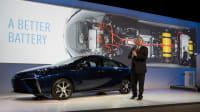
Automotive Engineering
Can Toyota’s Mirai Be the Next Prius?
Automotive Engineering
Toyota Targets 2015 for First Fuel-Cell Car
Automotive Engineering
Increasing the Pace of Fuel-Cell Expansion
Automotive Engineering
Engineering ‘Electron Guzzlers’
Tech Briefs
Videos of the Month
Off-Highway Engineering
SAE WCX 2022: Paving the Way for the Hydrogen Highway
Off-Highway Engineering
Cummins and Isuzu Announce Battery-electric Truck Collaboration
Automotive Engineering
DOE Issues RFI on Fuel Cells as Range-Extenders for EV Fleets
Automotive Engineering
GM Fuel Cell Powers U.S. Navy Sub as Collaboration with Honda Aims for Cars by 2020
Automotive Engineering
The Soft Underbelly of The EV Transition
Battery & Electrification Technology
Putting a New ‘Charge’ in EV Recharging
Automotive Engineering
Wide Collaborations Aim to Advance the Fuel-Cell Future
Automotive Engineering
SAE WCX 2022: Sustainability Is a Lifecycle Mindset
Automotive Engineering
GM Pushes for Industry Standards as It Readies More EVs, AVs
Automotive Engineering
BMW I3 Battery Replacement Is $16,000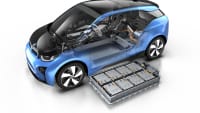
Automotive Engineering
Faraday Future Unveils Exotic “Testbed” for New Range of EVs
Automotive Engineering
Toyota Promising Big Battery, EV Action, but Circumspect on Absolutes
Automotive Engineering
Nissan Sees 2023 "Tipping Point" for EV Costs
Automotive Engineering
Sales of Light-Duty Natural-Gas Vehicles to Reach 40 Million by 2023, Forecaster Says


Automotive Engineering
Fuel-Economy and Greenhouse-Gas Emissions Rules Debated
Off-Highway Engineering
A Bevy of Battery and Fuel-Cell Electric Truck Reveals
Automotive Engineering
MY2012 Was Record-Breaking for Fuel Economy and CO2 Emissions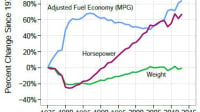

Automotive Engineering
Analyst Firm Doubtful of Tesla Gigafactory Value
Automotive Engineering
Making over the World’s Leading Hybrid
Tech Briefs
Hyliion Trucks Onward
Automotive Engineering
Next Steps for Fuel Cell Technology
Top Stories
NewsSensors/Data Acquisition
 Microvision Aquires Luminar, Plans Relationship Restoration, Multi-industry Push
INSIDERRF & Microwave Electronics
 A Next Generation Helmet System for Navy Pilots
INSIDERWeapons Systems
 New Raytheon and Lockheed Martin Agreements Expand Missile Defense Production
NewsAutomotive
 Ford Announces 48-Volt Architecture for Future Electric Truck
INSIDERAerospace
 Active Strake System Cuts Cruise Drag, Boosts Flight Efficiency
ArticlesTransportation

Webcasts
Aerospace
 Cooling a New Generation of Aerospace and Defense Embedded...
Energy
 Battery Abuse Testing: Pushing to Failure
Power
 A FREE Two-Day Event Dedicated to Connected Mobility
Automotive
 Quiet, Please: NVH Improvement Opportunities in the Early Design Cycle
Electronics & Computers
 Advantages of Smart Power Distribution Unit Design for Automotive &...
Unmanned Systems
 Sesame Solar's Nanogrid Tech Promises Major Gains in Drone Endurance