




Rechargeable Cement-Based Batteries
An entire 20-story concrete building could store energy like a giant battery.
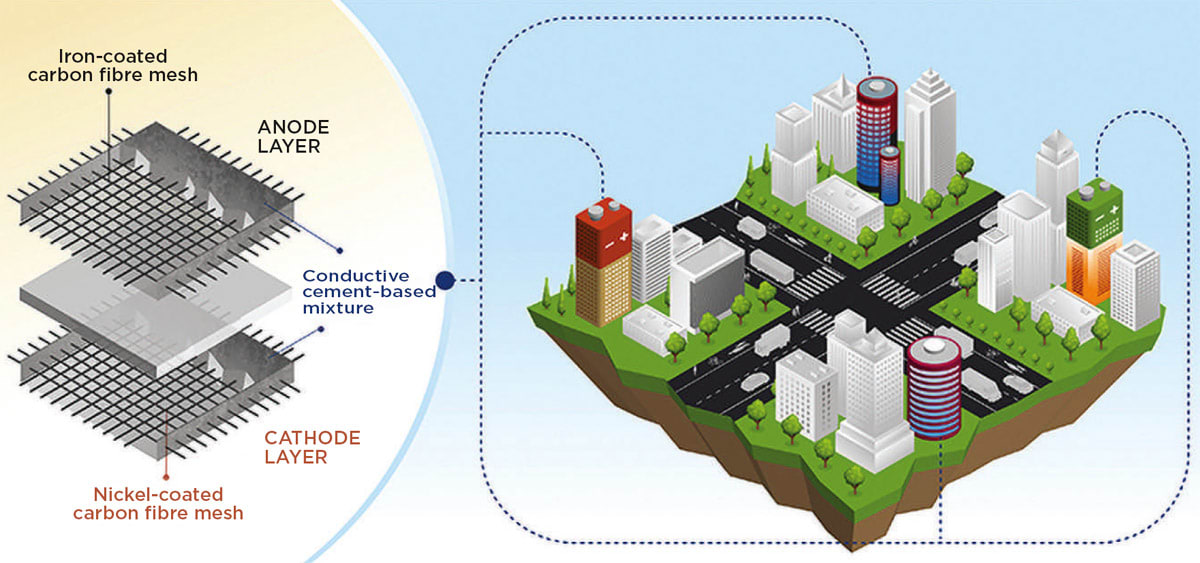
Researchers developed a concept for rechargeable batteries made of cement. The concept starts with a cement-based mixture with small amounts of short carbon fibers added to increase the conductivity and flexural toughness. Then, embedded within the mixture is a metal-coated carbon fiber mesh — iron for the anode and nickel for the cathode.
The team produced a rechargeable cement-based battery with an average energy density of 7 Watt-hours per square meter (or 0.8 Watt-hours per liter). Energy density is used to express the capacity of the battery and a modest estimate is that the performance of the new battery could be more than 10 times that of earlier attempts at concrete batteries. The energy density is still low in comparison to commercial batteries but this limitation could be overcome thanks to the huge volume at which the battery could be constructed when used in buildings.
The fact that the battery is rechargeable is its most important quality. Energy storage is an obvious application, as is monitoring. The researchers see applications that include powering LEDs, providing 4G connections in remote areas, and cathodic protection against corrosion in concrete infrastructure. It could also be coupled with solar cell panels to provide electricity and become the energy source for monitoring systems in highways or bridges, where sensors operated by a concrete battery could detect cracking or corrosion.
The concept of using structures and buildings in this way could be revolutionary because it would offer an alternative solution to the energy crisis by providing a large volume of energy storage. Concrete, which is formed by mixing cement with other ingredients, is the world’s most commonly used building material.
The technology could allow for whole sections of multi-story buildings to be made of functional concrete. Since concrete infrastructure is usually built to last 50 or even 100 years, the batteries would need to be refined to match that lifecycle or to be easier to exchange and recycle when their service life is over.
For more information, contact Professor Luping Tang at
More From SAE Media Group
Medical Design Briefs
Flexible High-Energy Textile Lithium Battery Designed for Wearables
Battery & Electrification Technology
Enhancing the Performance of All-Solid-State Batteries
Battery Technology
Hybrid Membrane Doubles the Lifetime of Rechargeable Batteries
Battery Technology
Semi-Liquid Metal Anode
Battery & Electrification Technology
A New Way to Enhance Durability of Lithium Batteries
Aerospace & Defense Tech Briefs
Rolls-Royce and Superdielectrics Explore Supercapacitor Technology
Battery & Electrification Technology
Recyclable ‘Water Batteries’ That Won’t Catch Fire
Battery & Electrification Technology
An Alternative to Lithium-Ion Batteries
Automotive Engineering
Niobium: Magic Metal for Battery Anodes?
Tech Briefs
Stable, Efficient, Anode-Free Sodium Battery


Battery Technology
Doubling Battery Performance with Lithium Metal

Battery & Electrification Technology
Iron Could Be Key to Less Expensive, Greener Lithium-Ion Batteries
Battery Technology
Tough, Solid Electrolyte Battery Component
Battery Technology
New Materials Move Li-Ion Batteries Toward the Solid-State Endgame
Battery Technology
Nanostructured Alloy for Battery Anodes
Battery & Electrification Technology
Sodium Battery Is Capable of Rapid Charging in Just a Few Seconds
Battery Technology
Sustainable Aluminum-Anode Batteries
Automotive Engineering
Novelis Creates First Aluminum Sheet Battery Enclosure for Mass Electric Vehicle Production
Off-Highway Engineering
Breakthroughs in 3D-Printing Give Way for Promising Textile Lithium Battery Technology
Battery Technology
Low-Cost, Fast Production of Solid-State Batteries
Automotive Engineering
Clarios to Build Supercapacitor Plant in U.S.
Automotive Engineering
NAWA Aims for 5-Minute EV Charge


Battery & Electrification Technology
Oxygen-Ion Battery: A Solution for Large Energy Storage Systems
Battery & Electrification Technology
A Sodium-Aluminum Battery Aims to Integrate Renewables for Grid Resiliency
Automotive Engineering
Constellium Develops New Alloys for EV Battery Enclosures
Top Stories
INSIDERDefense
 New Raytheon and Lockheed Martin Agreements Expand Missile Defense Production
NewsAutomotive
 Ford Announces 48-Volt Architecture for Future Electric Truck
INSIDERManufacturing & Prototyping
 Active Strake System Cuts Cruise Drag, Boosts Flight Efficiency
ArticlesTransportation
 Accelerating Down the Road to Autonomy
INSIDERMaterials
 How Airbus is Using w-DED to 3D Print Larger Titanium Airplane Parts
Road ReadyTransportation

Webcasts
Electronics & Computers
 Cooling a New Generation of Aerospace and Defense Embedded...
Power
 Battery Abuse Testing: Pushing to Failure
Connectivity
 A FREE Two-Day Event Dedicated to Connected Mobility
Automotive
 Quiet, Please: NVH Improvement Opportunities in the Early Design Cycle
Transportation
 Advantages of Smart Power Distribution Unit Design for Automotive &...
Aerospace
 Sesame Solar's Nanogrid Tech Promises Major Gains in Drone Endurance