




Tool Will Help Military Vehicles Fight Fires Using Less Harmful Chemicals
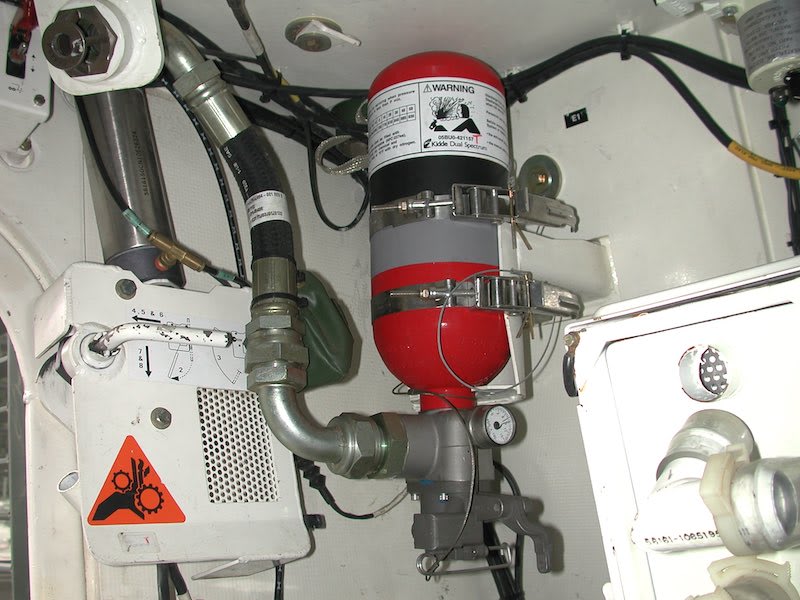
Researchers at the National Institute of Standards and Technology (NIST) have developed a new, interactive spreadsheet that will help the U.S. military extinguish aircraft and vehicle fires using the latest environmentally friendly chemicals. While it may sound old-school, the spreadsheet is actually an upgrade of a NIST computer program that has helped protect valuable military assets and lives for several decades, despite being based on the vintage operating system MS-DOS.
Fire protection is a major issue for military vehicles, which carry flammable fluids and can incur significant damage and casualties in accidents or combat. These vehicles carry hand-held fire extinguishers among other fire-suppression systems. A challenge is filling the bottles in such a way that the heat of a fire does not boost the pressure to the point of explosion. Calculations are needed to safely combine a fire suppressant agent with the nitrogen that expels and disperses the chemical. Another challenge is what agent to use. Efforts are underway to identify fire suppression agents with low or no global warming potential (GWP).
In the 1990s, NIST researchers developed a computer program for bottle-filling calculations called PROFISSY (PROperties of FIre Suppressant SYstems), which was distributed informally and has been widely used. But the old source code made it difficult to add new fluids. NIST has now replaced PROFISSY with a spreadsheet that has additional functionality and fluids and also links to NIST’s REFPROP database, which contains properties of many additional chemicals and mixtures. REFPROP has been widely adopted as a standard in the refrigerants community and also contains fire suppressing agents, including environmentally preferable alternatives to halons that deplete Earth’s protective ozone layer and hydrofluorocarbons that contribute to global warming.
“We've been using PROFISSY for many years to facilitate design of fire extinguishers for test and evaluation, especially with non-halon and low-GWP fire suppression agents where off-the-shelf products are not available,” said Steven Hodges of the U.S. Army’s Ground Vehicle Systems Center Fire Protection Team.
“PROFISSY is an invaluable tool when we are working with developmental materials because it gives us a basis to believe that we are testing extinguishers that can be viable products, that is, meet environmental requirements such as being able to safely operate at temperature extremes,” Hodges added. “The original DOS-based PROFISSY has been an indispensable workhorse; the new PROFISSY tool adds capability, improves accuracy, and is much easier to use, expand and maintain.”
The Army is evaluating several environmentally friendly, low-GWP chemicals as potential fire- extinguishing agents for its vehicles, a continuation of research conducted for ground and aviation weapon systems, Hodges said.
More From SAE Media Group



Aerospace & Defense Tech Briefs
Testing Services
Defense INSIDER
AI-FORGE Robot Demonstrates Incremental Metal Forming
Tech Briefs
'P-Flash' Uses A.I. to Fight Fires



Aerospace & Defense Tech Briefs
Design Guidelines for Military and Aerospace PCBs
Aerospace & Defense Tech Briefs
Zwick Roell Provides Flexible Materials Testing over a Wide Temperature Range

Motion Design INSIDER
Physics-Aware Neural Networks Improve Camera-Based Machines
Electronics & Sensors INSIDER
Sensors that Operate at High Temperatures and in Extreme Environments



Aerospace Manufacturing and Machining
Aerospace Work Platforms — More than Meets the Eye
Defense INSIDER
Army Hopes to Use AI to Create More-Efficient Fuel Cells
Tech Briefs
Cryogenic Oxygen Storage Modules (COSM)
Tech Briefs
Cryogenic Flux Capacitor
Robotics & Automation INSIDER
New Imaging Technique Reconstructs the Shapes of Hidden Objects
Electronics & Sensors INSIDER
Careful Heating Unlocks Unprecedented Sensitivity to Pressure in Semiconductor Materials

Aerospace & Defense Tech Briefs
pH-Dependent Spin State Population and ¹⁹F NMR Chemical Shift Via Remote Ligand Protonation in An Iron(II) Complex

Medical Design Briefs
Winter 2022 Resource Guide
Automotive Engineering
Environmental Testing Preps for Tighter Regulations
Top Stories
INSIDERManufacturing & Prototyping
 How Airbus is Using w-DED to 3D Print Larger Titanium Airplane Parts
INSIDERManned Systems
 FAA to Replace Aging Network of Ground-Based Radars
NewsTransportation
 CES 2026: Bosch is Ready to Bring AI to Your (Likely ICE-powered) Vehicle
NewsSoftware
 Accelerating Down the Road to Autonomy
EditorialDesign
 DarkSky One Wants to Make the World a Darker Place
INSIDERMaterials
 Can This Self-Healing Composite Make Airplane and Spacecraft Components Last...
Webcasts
Defense
 How Sift's Unified Observability Platform Accelerates Drone Innovation
Automotive
 E/E Architecture Redefined: Building Smarter, Safer, and Scalable...
Power
 Hydrogen Engines Are Heating Up for Heavy Duty
Electronics & Computers
 Advantages of Smart Power Distribution Unit Design for Automotive...
Unmanned Systems
 Quiet, Please: NVH Improvement Opportunities in the Early Design...
