




Army Hopes to Use AI to Create More-Efficient Fuel Cells
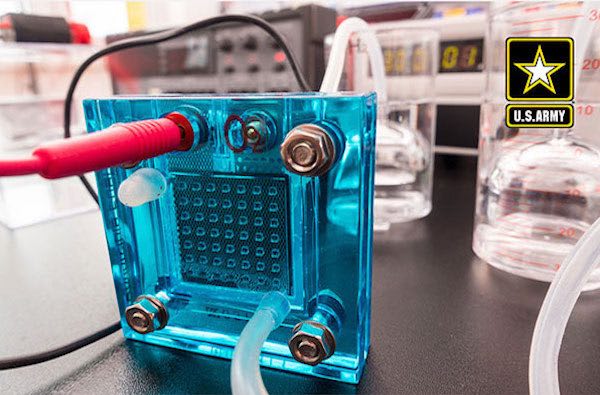
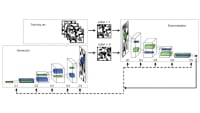
As part of an effort to address the gap the U.S. Army faces in its need for long-lasting power and batteries for warfighters, an Army-funded research team has developed an artificial intelligence (AI) system that officials say identifies a promising material for creating more-efficient fuel cells. Researchers said the system, developed at Cornell University, is a potential breakthrough in both materials science and machine learning. It relies on a collective of algorithmic bots, each performing a distinct task and sifting through hundreds to thousands of combinations of elements to create a map of phases—arrangements of atoms in relation to each other—that humans can then use to determine which might work as a new material.
Researchers seeking to improve fuel cells for cars are searching for a catalyst that would allow them to replace hydrogen, which is difficult to store, with methanol, which could be far more efficient. But because no known materials are efficient catalysts for methanol oxidation, a new material is needed, said John Gregoire, Ph.D., a staff scientist at the California Institute of Technology.
"If a viable catalyst exists, it's going to need to be discovered by combining elements of the periodic table, and the number of combinations is so vast that it can't be done with traditional experimentation," Gregoire said.
Researchers also need to understand the crystal structure, or phase, of the material, because solids may have multiple phase structures and each one behaves differently as a catalyst.
"Humans can solve the phase map for simple composition systems containing two elements," Gregoire said, "but whenever there are more than two elements, it's too much information for humans to process, and we need AI to assist."
Existing machine learning approaches, however, were not well-suited for the strict constraints of scientific discovery, whereby solutions must not only be plausible but also must obey the laws of physics and chemistry, according to Dr. Carla Gomes, professor of computer science and director of the Institute for Computational Sustainability.
To meet the challenge, Gomes and her colleagues developed a system called CRYSTAL for crystal phase mapping, in which multiple bots each take on a different part of the problem, from predicting the phase structures of various combinations to making sure those predictions obey the rules of thermodynamics. Gomes said CRYSTAL was inspired partly by the IBM Watson supercomputer, which used a community of AI agents coming up with different possible solutions to beat human champions at "Jeopardy!"
Using the system, researchers were able to identify a unique catalyst, composed of three elements crystallized into a certain structure, that is effective for methanol oxidation and could be incorporated into methanol-based fuel cells.
"This is an important discovery that challenges our understanding of catalysis, and an important research direction toward designing the next generation of catalysts," Gregoire said.
More From SAE Media Group



Power Management INSIDER
Breathing New Life into Fuel Cells
Tech Briefs
Facility Focus: Ames Laboratory


Tech Briefs
Creating 2D All-Organic Perovskites
Battery & Electrification Technology
Designing Safer, Higher-Performance Lithium Batteries

Automotive Engineering
Fuel-Cell Nanoparticle Clusters May Cut Platinum Catalyst Costs

Tech Briefs
AI Discovers Stiff and Tough Microstructures

Defense INSIDER
Army Discovers New Energy Source
Power Electronics INSIDER
New Perovskite Solar Cell Has a Commercially Viable Lifetime
Defense INSIDER
NRL Researchers’ Golden Touch Enhances Quantum Technology
Aerospace & Defense Tech Briefs
Machine Learning Unlocks Secrets to Advanced Alloys
Defense INSIDER
Thin Explosive Films Provide Snapshot of How Detonations Start

Battery & Electrification Technology
AI Breakthrough Unlocks ‘New’ Materials to Replace Lithium-Ion Batteries
Tech Briefs
Products of Tomorrow
Power Electronics INSIDER
Substrate Engineering to Improve Power Electronics

Defense INSIDER
A Quantum Leap for Defense Computing Applications
Tech Briefs
How AI Can Find the Next Groundbreaking Polymer
Power Management INSIDER
New fuel cell concept brings biological design to better electricity generation
Top Stories
INSIDERManufacturing & Prototyping
 How Airbus is Using w-DED to 3D Print Larger Titanium Airplane Parts
INSIDERManned Systems
 FAA to Replace Aging Network of Ground-Based Radars
NewsTransportation
 CES 2026: Bosch is Ready to Bring AI to Your (Likely ICE-powered) Vehicle
NewsSoftware
 Accelerating Down the Road to Autonomy
EditorialDesign
 DarkSky One Wants to Make the World a Darker Place
INSIDERMaterials
 Can This Self-Healing Composite Make Airplane and Spacecraft Components Last...
Webcasts
Defense
 How Sift's Unified Observability Platform Accelerates Drone Innovation
Automotive
 E/E Architecture Redefined: Building Smarter, Safer, and Scalable...
Power
 Hydrogen Engines Are Heating Up for Heavy Duty
Electronics & Computers
 Advantages of Smart Power Distribution Unit Design for Automotive...
Unmanned Systems
 Quiet, Please: NVH Improvement Opportunities in the Early Design...
