




“Circulatory” Air Conditioning Could Keep Planes Cooler

The complex network of veins that keeps us cool during the heat of summer has inspired engineers to create novel thermal management systems. A new computer program could be key to mimicking the body’s evolution-optimized cooling system in functional materials.
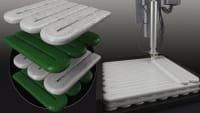
Microvascular fiber-composites are currently being developed to cool everything from electric vehicles to next-generation aircraft, where increasingly higher performance is turning up the heat they generate.
A microvascular carbon-fiber composite was created using 3D printing. After heating the carbon-composites to a maximum temperature, liquid coolant was pumped through each vascular network to begin the cooling process.
More From SAE Media Group
Tech Briefs
Layered Composite Insulation
Tech Briefs
Composite Panel with Integrated Thermal Control
Aerospace & Defense Tech Briefs
Thermal Management Techniques in Avionics Cooling
Aerospace INSIDER
Using Ultrabright X-Rays to Test Materials for Ultrafast Aircraft
Tech Briefs
Thin Heat Shield for Superfast Aircraft
Tech Briefs
Aerogel-Reinforced Composites
Aerospace & Defense Tech Briefs
Acceleration Resistant HiK Heat Spreader

Aerospace INSIDER
Chillers and Heat Exchangers

Aerospace INSIDER
Ceramic Matrix Composites Offer Lighter, More Durable Engine Parts
Aerospace Manufacturing and Machining INSIDER
Researchers Push Limits in High-Temp, Polymer Additive Manufacturing
Aerospace INSIDER
Air Force Explores Use of Thermoplastic Fin for F-16
Tech Briefs
Calibration System for Automated Fiber Placement
Aerospace & Defense Tech Briefs
‘Nanostitches’ Enable Lighter and Tougher Composite Materials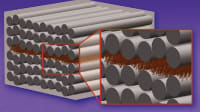
Aerospace & Defense Tech Briefs
New Cryogenic Shape Memory Alloy Designed for Outer Space

Aerospace INSIDER
NASA Develops Unique Materials for Next Generation Aircraft
Aerospace & Defense Tech Briefs
Molded RF Materials for Hypersonic Sensors and Seekers
Aerospace & Defense Tech Briefs
Aerospace Production: Overcoming Challenges in Composite Machining
Aerospace & Defense Tech Briefs
European Researchers Leverage AI in Manufacturing Rocket Parts
Aerospace & Defense Tech Briefs
More Bang for the Buck: A New Design and Manufacturing Method for Deep Penetrating Bomb Cases
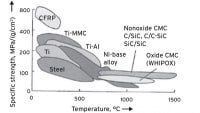

Aerospace INSIDER
Polymer Material Decreases Mass of Aircraft

Tech Briefs
Compact, Lightweight, CMC-Based Acoustic Liner
Aerospace & Defense Tech Briefs
Advanced CT Inspection and Data Analysis
Aerospace INSIDER
New Heat Conduction Method for More Efficient Aircraft
Top Stories
INSIDERManufacturing & Prototyping
 How Airbus is Using w-DED to 3D Print Larger Titanium Airplane Parts
INSIDERManned Systems
 FAA to Replace Aging Network of Ground-Based Radars
NewsTransportation
 CES 2026: Bosch is Ready to Bring AI to Your (Likely ICE-powered) Vehicle
NewsSoftware
 Accelerating Down the Road to Autonomy
EditorialDesign
 DarkSky One Wants to Make the World a Darker Place
INSIDERMaterials
 Can This Self-Healing Composite Make Airplane and Spacecraft Components Last...
Webcasts
Defense
 How Sift's Unified Observability Platform Accelerates Drone Innovation
Automotive
 E/E Architecture Redefined: Building Smarter, Safer, and Scalable...
Power
 Hydrogen Engines Are Heating Up for Heavy Duty
Electronics & Computers
 Advantages of Smart Power Distribution Unit Design for Automotive...
Unmanned Systems
 Quiet, Please: NVH Improvement Opportunities in the Early Design...
