




MAPS-Enabled Countermeasures Defeat Threats in U.S. Army Field Tests
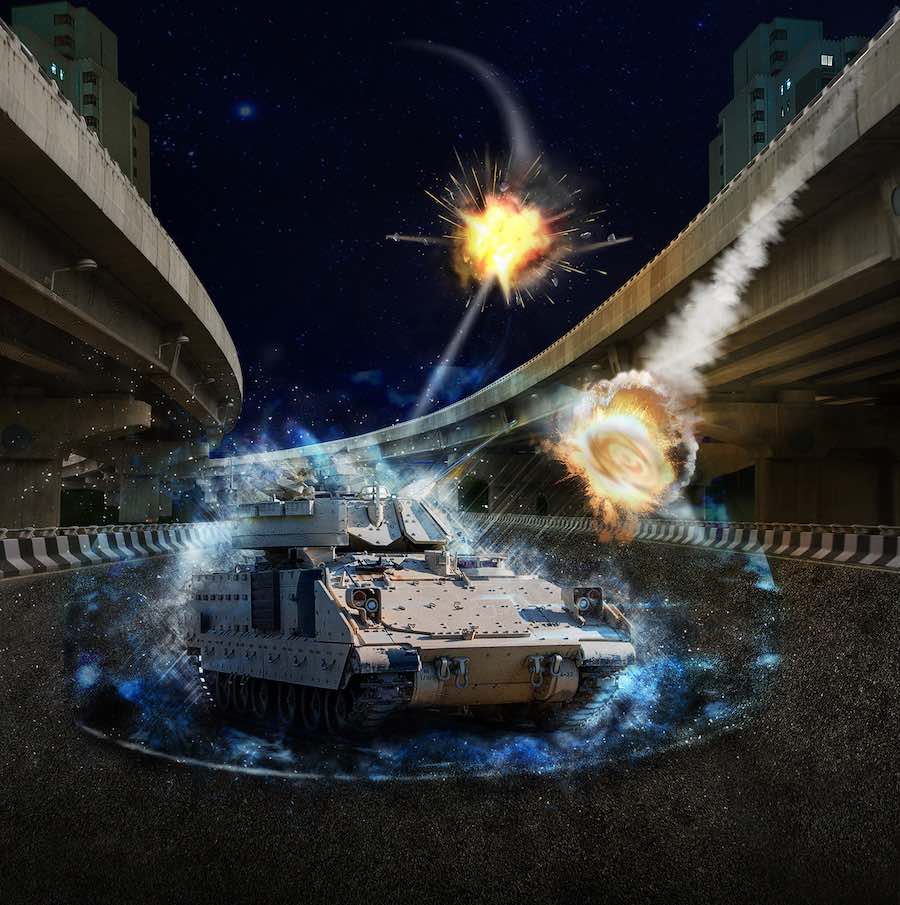
In a series of live-fire tests, systems equipped with MAPS-enabled countermeasures defeated 15 out of 15 anti-tank guided missiles by jamming their signals, causing them to fly off-target.
“The success of the Army’s testing shows the effectiveness of an active protection system that can rapidly refresh with new components to meet specific mission and platform requirements,” said Michael Williamson, vice president of Sensors & Global Sustainment at Lockheed Martin.
Lockheed Martin engineers led hardware and software integration of an Ariel Photonics countermeasure into the MAPS framework ahead of the tests. They also supported U.S. Army Combat Capabilities Development Command Ground Vehicle Systems Center efforts with BAE Systems and Northrop Grumman in integrating two other countermeasures and a cueing sensor. Lockheed Martin was awarded the initial MAPS prototype controller contract in 2014 and continues to manufacture and deliver base kits to MAPS stakeholders.
The Modular Active Protection System (MAPS) base kit is the backbone of the U.S. Army’s MAPS framework that offers automatic, next-generation survivability for combat vehicles and crews. The base kit integrates sensors and countermeasures in an open, common framework to detect, track, classify and defeat existing and emerging threats like rocket-propelled grenades and anti-tank guided missiles. It is designed to protect current combat vehicles, as well as support future vehicle protection system capabilities.
The open-architecture controller at the core of the base kit offers modularity and scalability to support upgrades and future vehicle protection system capabilities. Other components include a user interface, power management distribution system, network switch and application software.
The MAPS base kit is reusable and refreshable. Its open-architecture design enables users to selectively upgrade sensor and countermeasure components across all MAPS-enabled platforms. Upgrading at the component level reduces life cycle costs and promotes best-of-breed solutions. Most importantly, it reduces the time required to respond to emerging threats.
More From SAE Media Group
Defense INSIDER
U.S. Army Orders Next-Generation Missile Warning Systems

Aerospace & Defense Tech Briefs
Handheld Targeting System
Defense INSIDER
Creating Cross-Domain Kill Webs in Real Time
Defense INSIDER
USSF Awards Missile Track Custody Prototype Effort
Defense INSIDER
Army to Purchase Additional Soldier Borne Sensor Systems

Defense INSIDER
Army Aviation Team Achieves Software Success in Live Fire Test
Aerospace & Defense Tech Briefs
Aircraft Protection Systems

Aerospace & Defense Tech Briefs
WMD Detection Technology
Defense INSIDER
AgilePod Flies on U.S. Air Force MQ-9 Reaper
Defense INSIDER
Northrop Grumman Assembles First Manta Ray UUV Prototype
Aerospace INSIDER
ATHENA Sensor Brings Generational Leap to Airborne MANPAD Protection
Aerospace Manufacturing and Machining INSIDER
Northrop Grumman Developing Next Generation F-35 Radar Upgrade
Aerospace INSIDER
F-22 Pilot Controls Drone With Tablet
Defense INSIDER
Lab-Designed Instrumentation Flies Aboard Unarmed Missile
Podcasts
A.I. in the Air
Aerospace & Defense Tech Briefs
Five Missile-Tracking Satellites Launched
Defense INSIDER
Mounted Troops to Get High-Tech Situational Awareness Tools
Aerospace & Defense Tech Briefs
Vehicle Active Protection System
Defense INSIDER
Army to Get New IED Detector Technology
Aerospace & Defense Tech Briefs
Playing Defense — Uncertain Regulations Stall the Implementation of Counter-UAS Technology in The U.S.

Aerospace & Defense Tech Briefs
Perimeter Security Sensor System
Aerospace & Defense Tech Briefs
High-Speed Data Cables for Fighter Aircraft
Aerospace & Defense Tech Briefs
Missile Defense Battle Manager
Defense INSIDER
New Serenity Payload Detects Hostile Fire
Aerospace INSIDER
Germany's New Military Surveillance Jet Completes First Flight
Top Stories
NewsRF & Microwave Electronics
 Microvision Aquires Luminar, Plans Relationship Restoration, Multi-industry Push
INSIDERAerospace
 A Next Generation Helmet System for Navy Pilots
INSIDERDesign
 New Raytheon and Lockheed Martin Agreements Expand Missile Defense Production
INSIDERMaterials
 How Airbus is Using w-DED to 3D Print Larger Titanium Airplane Parts
NewsPower
 Ford Announces 48-Volt Architecture for Future Electric Truck
ArticlesAR/AI

Webcasts
Electronics & Computers
 Cooling a New Generation of Aerospace and Defense Embedded...
Automotive
 Battery Abuse Testing: Pushing to Failure
Power
 A FREE Two-Day Event Dedicated to Connected Mobility
Unmanned Systems
 Quiet, Please: NVH Improvement Opportunities in the Early Design Cycle
Automotive
 Advantages of Smart Power Distribution Unit Design for Automotive &...
Energy
 Sesame Solar's Nanogrid Tech Promises Major Gains in Drone Endurance