




New Serenity Payload Detects Hostile Fire
Two government-developed sensors are working together to increase the security of deployed soldiers. The Firefly and Serenity sensors employ government developed algorithms, software, and hardware to locate hostile fire around a base. The technology, a joint effort between the Army Aviation Research, Development and Engineering Center, or AMRDEC, and the Army Research Lab, referred to as ARL, has been under development for more than a decade.
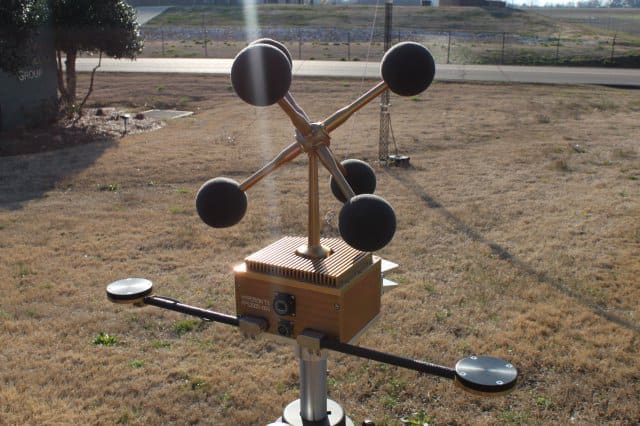
"Once the Serenity locates hostile fire, the system then communicates the shooter’s point of origin in Universal Transverse Mecator coordinates to the tactical Operations Center using cursor-on-target protocol," said Timothy Edwards, chief scientist with Force Protection Technologies. "Threat cueing and classification information allows the soldier manning an AMRDEC-developed Containerized Weapon System or other defensive system to give prompt attention to the hostile threat," he said.
The Serenity payload, developed jointly by AMRDEC and ARL, has been deployed to theater in the Middle East with additional deployments planned for other areas of the world. The Serenity payload provides 360-degree hemispherical surveillance coverage, has self-contained power and is deployed on the Lockheed Martin Persistent Threat Detection System aerostat, or PTDS. The Serenity payload includes the FireFly acoustic sensor coupled with an electro optical array (EO) of cameras, according to Lamar Auman, AMRDEC associate director for Modeling and Simulation.
"The Serenity system allows operators to see attacks as they happen, or access digital video recorder forensic playback if necessary," Auman said. "Serenity's combined EO and acoustic capabilities provide the Army with the eyes and ears needed to detect rocket and mortar flash-boom events at launch and detonation. This capability, combined with complex sensor data fusion software, make the Serenity Payload uniquely suited to protect forward- deployed bases."
Serenity's net-centric autonomous cueing capability can be used to direct the PTDS payload sensor to a specific location or focus the attention of a Containerized Weapon System (CWS) operator to a potential threat. This capability greatly increases the probability of hostile threat detection and allows the operator to concentrate on other tasks associated with base defense Auman added.
The AMRDEC-developed FireFly acoustic/EO sensor can operate jointly with the Serenity or be deployed as a stand-alone unit. FireFly was designed to support small installations, independent of installation power. The cost of the FireFly sensor is small enough that systems are considered disposable if a failure occurs, yet its government-owned algorithms are sophisticated enough to group threats into classifications of small arms fire, heavy machine gun or rockets artillery and mortar and geo-locate the threat with a high degree of spatial accuracy.
Source :
More From SAE Media Group
Defense INSIDER
Mounted Troops to Get High-Tech Situational Awareness Tools
Aerospace INSIDER
Egypt’s Apache Helicopter Fleet to Get Upgraded Sensor Systems
Aerospace & Defense Tech Briefs
Drone-Elimination Fire Control System
Aerospace & Defense Tech Briefs
Panoramic Thermal Imaging Technology
Defense INSIDER
Army Aviation Team Achieves Software Success in Live Fire Test
Defense INSIDER
Army Receives First Next Generation Precision Strike Missile
Tech Briefs
Ultra-Thin Sensor for Smart Contact Lenses
Aerospace & Defense Tech Briefs
Counter-UAS Technology
Aerospace INSIDER
ATHENA Sensor Brings Generational Leap to Airborne MANPAD Protection
Photonics & Imaging Technology INSIDER
European Defense Fund Project to Produce Strategic Electronics for Next Generation Infrared Sensors
Motion Design
Vision Sensors in Factory Automation
Aerospace & Defense Tech Briefs
Unmanned Ground Vehicles
Defense INSIDER
Army to Get New IED Detector Technology
Medical Design Briefs
2020 Product Buyer's Guide
Photonics & Imaging Technology
New Products

Aerospace & Defense Tech Briefs
Perimeter Security Sensor System
Aerospace & Defense Tech Briefs
Low-Cost Ground Sensor Network for Intrusion Detection
Aerospace & Defense Tech Briefs
Missile System Team Trainer
Aerospace & Defense Tech Briefs
EO/IR Maritime Payload
Photonics & Imaging Technology
Detecting Threats Beyond the Limits of Human, Sensor Sight
Photonics & Imaging Technology
Standard Digital Camera and AI to Monitor Soil Moisture

Aerospace & Defense Tech Briefs
Nano-UAV Systems
Aerospace & Defense Tech Briefs
WMD Detection Technology
Defense INSIDER
Army Researchers Enable Night Lethality
Top Stories
INSIDERManufacturing & Prototyping
 How Airbus is Using w-DED to 3D Print Larger Titanium Airplane Parts
INSIDERManned Systems
 FAA to Replace Aging Network of Ground-Based Radars
NewsTransportation
 CES 2026: Bosch is Ready to Bring AI to Your (Likely ICE-powered) Vehicle
NewsSoftware
 Accelerating Down the Road to Autonomy
EditorialDesign
 DarkSky One Wants to Make the World a Darker Place
INSIDERMaterials
 Can This Self-Healing Composite Make Airplane and Spacecraft Components Last...
Webcasts
Defense
 How Sift's Unified Observability Platform Accelerates Drone Innovation
Automotive
 E/E Architecture Redefined: Building Smarter, Safer, and Scalable...
Power
 Hydrogen Engines Are Heating Up for Heavy Duty
Electronics & Computers
 Advantages of Smart Power Distribution Unit Design for Automotive...
Unmanned Systems
 Quiet, Please: NVH Improvement Opportunities in the Early Design...
