




Scientists Join Effort to 3D Print Parts for U.S. Navy
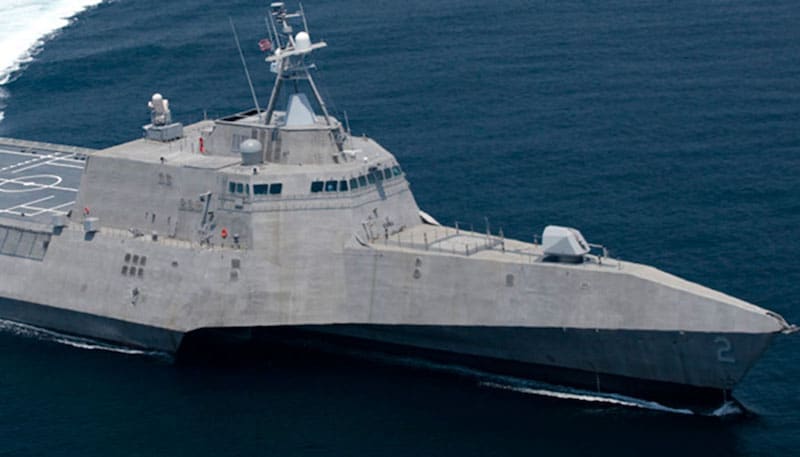
Researchers at Lawrence Livermore National Laboratory (LLNL) are lending their expertise in metal additive manufacturing to a new collaboration aimed at 3D printing critical replacement parts for the U.S. Navy.
The Office of Naval Research recently announced an award of $9 million to fund a collaboration led by GE Global Research and aimed at developing a rapid process for creating exact digital models of replacement or newly designed parts for naval, marine and aviation assets. The collaboration involves scientists and engineers from LLNL, GE’s aviation and additive divisions, Honeywell, Penn State University, the Nuclear National Lab (NNL) and the National Center for Defense Manufacturing and Machining (NCDMM).
The goal over the four-year project will be to build “digital twins” from model and sensor-based data, enabling scientists and engineers to dramatically speed up the qualification and certification process of metal 3D printed parts. Researchers hope to someday replace traditional manufacturing processes and produce legacy replacement parts no longer manufactured by conventional methods.
LLNL will contribute its ongoing development of an intelligent, computational “feed forward” design process, which relies heavily on advanced modeling and simulation, as well as experimental analysis, to predict and teach 3D printers to efficiently create parts without defects.
“We’ve come up with a methodology and we think we’ve made some significant progress in part qualification,” said Wayne King, head of LLNL’s Accelerated Certification of Additively Manufactured Metals (ACAMM) project. “We’re training the machines to build parts right the first time, every time, and building the confidence of our physicists and project engineers that they are high-quality.”
The four-year “Quality Made” program will initially focus on underlying software and hardware developments and move toward developing a complete system demonstrating rapid and robust creation of a part’s digital model or digital twin. The project will culminate in the printing of parts for the Navy using a 3D Direct Metal Laser Melting (DMLM) printer.
More From SAE Media Group


Aerospace & Defense Tech Briefs
3D Printing Parts for Ships, Submarines and Underwater Vehicles

Aerospace Manufacturing and Machining INSIDER
Navy Uses Stratasys F-900 to 3D Print F/A-18 Jet’s Button Plug

Aerospace & Defense Tech Briefs
Reusable Rapid Prototyped Blunt-Impact Simulator
Aerospace & Defense Tech Briefs
3D Printing Metal Parts on a Ship
Medical Design Briefs
Siemens Expands U.S. Additive Manufacturing Initiatives

Aerospace & Defense Tech Briefs
Portable 3D Printing Factory
Aerospace & Defense Tech Briefs
Centre for Modelling & Simulation to Develop Digital Twins for GKN Aerospace Additive, Composite, and Industry 4.0 Technologies

Defense INSIDER
3D-Printed Temporary Use Parts Reduce Downtime for Army Vehicles
Aerospace & Defense Tech Briefs
Software for Additive Design, Manufacturing Evolves Quickly
Tech Briefs
Optimizing a CubeSat with Architected Materials
Aerospace & Defense Tech Briefs
SAE International Issues, Revises Technical Reports for Aerospace Engineering

Aerospace Manufacturing and Machining INSIDER
Meeting the Demands of Defense Production and Sustainment Through Additive Manufacturing
Defense INSIDER
3D Printing Parts for Ships, Submarines and Underwater Vehicles
Aerospace Manufacturing and Machining INSIDER
How the Navy is Using Additive Manufacturing to Protect Submarine Hatch Bolts
Aerospace & Defense Tech Briefs
Embracing the Digital Transformation in Aerospace & Defense
Aerospace Manufacturing and Machining INSIDER
Army Seeks to Expand 3D Printing to the Tactical Edge
Defense INSIDER
New 3D-Printed Antenna Designs Reduce Cost, Weight and Size
Aerospace Manufacturing and Machining INSIDER
3D Printing in Combat Zones: A Paradigm Shift for Marine Corps Logistics
Aerospace & Defense Tech Briefs
Handheld Targeting System

Aerospace & Defense Tech Briefs
Reclaiming Readiness: Advancing US Defense Through Scalable Additive Manufacturing
Aerospace & Defense Tech Briefs
Nadcap at 35 Still Defining Excellence in Aviation, Defense and Space Manufacturing

Top Stories
INSIDERDefense
 New Raytheon and Lockheed Martin Agreements Expand Missile Defense Production
NewsAutomotive
 Ford Announces 48-Volt Architecture for Future Electric Truck
INSIDERManufacturing & Prototyping
 Active Strake System Cuts Cruise Drag, Boosts Flight Efficiency
ArticlesTransportation
 Accelerating Down the Road to Autonomy
INSIDERMaterials
 How Airbus is Using w-DED to 3D Print Larger Titanium Airplane Parts
Road ReadyTransportation

Webcasts
Electronics & Computers
 Cooling a New Generation of Aerospace and Defense Embedded...
Power
 Battery Abuse Testing: Pushing to Failure
Connectivity
 A FREE Two-Day Event Dedicated to Connected Mobility
Automotive
 Quiet, Please: NVH Improvement Opportunities in the Early Design Cycle
Transportation
 Advantages of Smart Power Distribution Unit Design for Automotive &...
Aerospace
 Sesame Solar's Nanogrid Tech Promises Major Gains in Drone Endurance