




Navy Researchers Work to Lighten, Strengthen Warfighter Armor
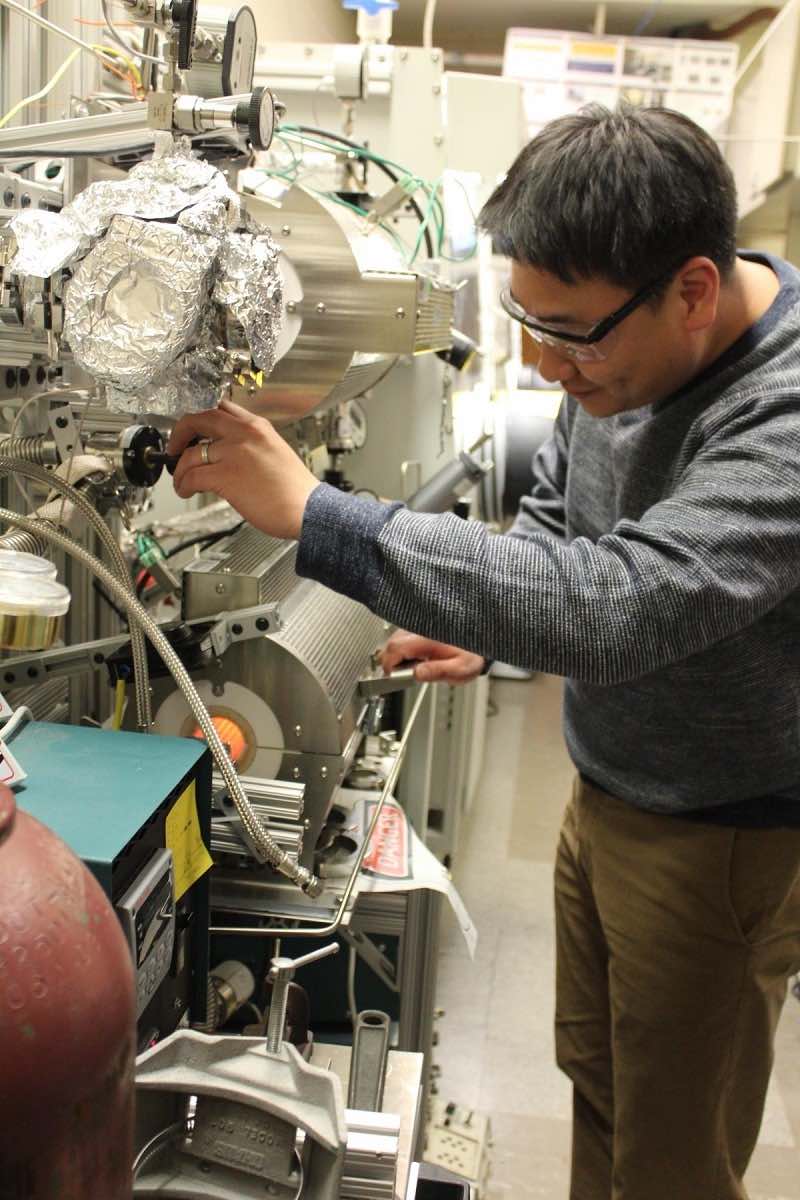
A multi-disciplinary team of researchers at the U.S. Naval Research Laboratory pushed grain size engineering to the limit and recently discovered previously unseen behaviors in nanocrystalline ceramics that could lead to the design of better performing ceramic armor. The discovery, a continuation of NRL research published in 2014, was made possible by a cutting-edge nanosintering technique, which is the process of essentially bonding nano-sized particles together.
“A few years ago, NRL was the first to show that if you decrease the grain size of ceramics to tens of nanometers, the hardness and strength increase,” said Dr. James Wollmershauser, a materials research engineer in NRL’s Materials Science and Technology Division. “Our current work takes this much further. We decreased the grain size of fully dense ceramics to record breaking single digits, and analyzed the elasticity, hardness, energy dissipation and fracture behavior in ceramics with a wide range of nanosize grains.”
Dr. Heonjune Ryou, a postdoctoral fellow in NRL’s Chemistry Division, characterized the mechanics of the nanocrystalline ceramics and found that they accommodate mechanical energy in a unique way. This aspect had never been seen before in bulk nanocrystalline ceramics and may revolutionize the design of ceramic armor.
“NRL was the first to see the increase of energy dissipation in single digit nano-grain ceramics,” said Dr. Boris Feygelson, a materials research engineer in NRL’s Electronics Science and Technology Division, leading the team’s efforts in nanosintering. “The better the material can accommodate mechanical energy, the better it can stop an incoming threat.”
The key to unlocking these materials and their phenomenon is NRL’s unique approach to forming large-scale nanostructured solids. The unparalleled nanosintering approach is called Environmentally Controlled Pressure Assisted Sintering (EC-PAS). It allowed NRL to break the world record for the smallest grain size in dense ceramics at 3.6 nanometers, which is about 30,000 times smaller than the width of a human hair.
By pushing the boundaries of nanosintering science, NRL researchers showed that it may be possible to one day design a lightweight, nanocrystalline ceramic material that can better dissipate mechanical energy, say from a sharp projectile, absorbing more damage while retaining its very high hardness. This discovery could pave the way for more efficient armor for sailors and marines.
More From SAE Media Group
Defense INSIDER
Researchers Develop Harder Ceramic for Armor Windows


Aerospace & Defense Tech Briefs
Portable 3D Printing Factory


Defense INSIDER
Multifunctional Nanofiber Protects Against Explosions

Defense INSIDER
NRL Researchers’ Golden Touch Enhances Quantum Technology
Aerospace & Defense Tech Briefs
UCLA Researchers Develop New Strong and Lightweight Metal Nanocomposite
Aerospace & Defense Tech Briefs
University of Virginia and Virginia Tech Join Rolls-Royce UTC Network
Aerospace Manufacturing and Machining INSIDER
Can This Self-Healing Composite Make Airplane and Spacecraft Components Last for Centuries?
Defense INSIDER
Scientists Explore Nanoparticles for Future Weapon Systems
Aerospace & Defense Tech Briefs
Researchers Reduce Graphene-Enhanced Composite Development Time Using Neural Networks
Aerospace & Defense Tech Briefs
Cold Spray Technology

Aerospace & Defense Tech Briefs
Molecular Engineering for Mechanically Resilient and Stretchable Electronic Polymers and Composites
Aerospace Manufacturing and Machining INSIDER
Cracking in Harsh Environments Needs Both Stress and Corrosion
Aerospace INSIDER
A New Quantum Materials Research System


Aerospace & Defense Tech Briefs
Nanotechnology May Lead to Huge Advances in Engines of the Future
Tech Briefs
Self-Healing, Recyclable, Shape Memory Polymers
Aerospace Manufacturing and Machining
Optimizing Plasma Treatments to RESOLVE Challenging Adhesion Issues
Tech Briefs
Material Combination Strengthens Body Armor
Aerospace INSIDER
Composites Self-Heal at Very Low Temperatures
Top Stories
INSIDERManufacturing & Prototyping
 How Airbus is Using w-DED to 3D Print Larger Titanium Airplane Parts
INSIDERManned Systems
 FAA to Replace Aging Network of Ground-Based Radars
NewsTransportation
 CES 2026: Bosch is Ready to Bring AI to Your (Likely ICE-powered) Vehicle
NewsSoftware
 Accelerating Down the Road to Autonomy
EditorialDesign
 DarkSky One Wants to Make the World a Darker Place
INSIDERMaterials
 Can This Self-Healing Composite Make Airplane and Spacecraft Components Last...
Webcasts
Defense
 How Sift's Unified Observability Platform Accelerates Drone Innovation
Automotive
 E/E Architecture Redefined: Building Smarter, Safer, and Scalable...
Power
 Hydrogen Engines Are Heating Up for Heavy Duty
Electronics & Computers
 Advantages of Smart Power Distribution Unit Design for Automotive...
Unmanned Systems
 Quiet, Please: NVH Improvement Opportunities in the Early Design...
