




High-Tech UAV Performs Recon, Defends Brigade
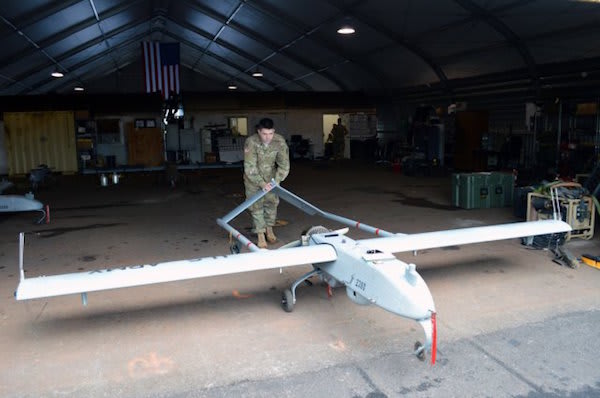
Soldiers assigned to the Tactical Unmanned Aircraft System (TUAS) Platoon, Company D, 29th Brigade Engineer Battalion, 3rd Brigade Combat Team, 25th Infantry Division, perform daily checks on their RQ-7B Shadow unmanned aerial vehicle, a small, lightweight UAV that provides invaluable service for the battalions of the 3rd BCT.
"It's designed to do tactical reconnaissance, so it can do full motion video with color and (infrared) at night," said 1st Lt. Sara M. Downing, TUAS platoon leader. "It can also do a communication relay package encrypted, so it acts like a giant relay in the sky."
According to Downing, the UAV can laser designate from man/unmanned teams with the ability to work with the AH-64 Apache or other aircraft that use the AGM-114 Hellfire air-to-surface missiles. "It can point onto a target with a laser, and then the Hellfire missile locks on to that laser, guiding it right on the target," she said.
The TUAS platoon doesn't use the nimble aircraft just to perform an offensive role; the Shadow can stay in the sky for several consecutive hours to perform an active reconnaissance role. "For training missions, we do a lot of convoy tracking," said Spc. Connor Rawlings, unmanned aircraft systems operator, TUAS platoon, Company D, 29th BEB. "We'll follow the convoy and scout ahead."
The operators, depending on their task, also conduct passive reconnaissance when the mission requires it. "We'll do straight target watching," Rawlings said. "If division or brigade wants us to watch a target -- they see an individual in a certain area they know of -- but they don't know exactly where he is in a compound."
The operators themselves work as two-man teams with the UAV during preflight checks and in flight.
"Typically, for a launch, you'll have an assigned operator," said Sgt. Kenneth Vierk, unmanned aircraft systems operator, Company D, 29th BEB. "We're going to have one managing the aircraft itself, and then the other personnel will strictly be operating the payload." According to Vierk, the second operator manages the radio calls and everything else, so the first operator can monitor the Shadow while in flight.
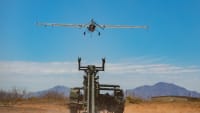
The repairers, while performing preflight checks, communicate via radio with the operators to ensure the Shadow is good to go before being placed on a hydraulic rail launcher for takeoff. "I crew chief the bird," said Spc. Dennis Blozen, unmanned aircraft systems repairer, Company D. "Which means, when they're doing their preflight checks, I'm the guy on the ground next to the bird making sure it's doing what they're telling it to do in their control shelter." Blozen personally found the system easy to use and maintain, rapid to set up, and quick to get in the air to support the mission.
More From SAE Media Group
Aerospace INSIDER
Navy Completes 73-Hour Nonstop Flight of Solar-Powered UAS
Aerospace & Defense Tech Briefs
Autonomous Collaborative Platform
Aerospace INSIDER
GA-ASI Announces Gray Eagle 25M for Multi-Domain Operations
Aerospace & Defense Tech Briefs
Remotely Piloted Air Systems
Aerospace INSIDER
New Anduril, Skydio Drones Start Field Testing in Romania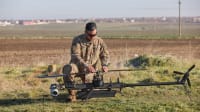

Aerospace & Defense Tech Briefs
Mobile Counter Unmanned Aircraft System
Aerospace & Defense Tech Briefs
Unmanned Aircraft System Offers Superior Surveillance Imagery
Aerospace & Defense Tech Briefs
Autonomous Helicopters
Aerospace & Defense Tech Briefs
Vertical Takeoff and Landing Drone
Aerospace & Defense Tech Briefs
Counter-Drone Technology
Aerospace & Defense Tech Briefs
101st Combat Aviation Brigade Makes History with First MUOS Connectivity in a Helicopter
Aerospace & Defense Tech Briefs
Maritime Unmanned Aircraft System
Aerospace & Defense Tech Briefs
Loitering Precision Strike Missile
Aerospace & Defense Tech Briefs
High-Speed Data Cables for Fighter Aircraft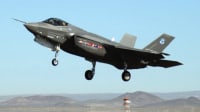
Aerospace & Defense Tech Briefs
Electronic Warfare Weapon
Aerospace & Defense Tech Briefs
Effectiveness of Inter-Vehicle Communications and On-Board Processing for Close Unmanned Autonomous Vehicle Flight Formations
Tech Briefs
Next-Generation Radar for the F-35 Lightning II
Aerospace & Defense Tech Briefs
Rising Star Awards: Women in Engineering Aerospace Winner - Heather Cummings
Aerospace & Defense Tech Briefs
AUSA 2021: High Tech, Big Tech
Aerospace & Defense Tech Briefs
Robotic Helicopter
Aerospace & Defense Tech Briefs
Rugged Network File Servers
Aerospace & Defense Tech Briefs
Surface to Surface Missile
Aerospace & Defense Tech Briefs
Autonomous Multi-Sensor Maritime Awareness System
Motion Design INSIDER
Tailless Jet Flies Free with Novel Control Technique
Top Stories
NewsSensors/Data Acquisition
 Microvision Aquires Luminar, Plans Relationship Restoration, Multi-industry Push
INSIDERRF & Microwave Electronics
 A Next Generation Helmet System for Navy Pilots
INSIDERWeapons Systems
 New Raytheon and Lockheed Martin Agreements Expand Missile Defense Production
NewsAutomotive
 Ford Announces 48-Volt Architecture for Future Electric Truck
INSIDERAerospace
 Active Strake System Cuts Cruise Drag, Boosts Flight Efficiency
ArticlesTransportation

Webcasts
Aerospace
 Cooling a New Generation of Aerospace and Defense Embedded...
Energy
 Battery Abuse Testing: Pushing to Failure
Power
 A FREE Two-Day Event Dedicated to Connected Mobility
Automotive
 Quiet, Please: NVH Improvement Opportunities in the Early Design Cycle
Electronics & Computers
 Advantages of Smart Power Distribution Unit Design for Automotive &...
Unmanned Systems
 Sesame Solar's Nanogrid Tech Promises Major Gains in Drone Endurance