




Army Uses Technology to Increase Aerial Delivery Accuracy

Researchers at the U.S. Army Research Laboratory have developed a new system that will enhance the capabilities of U.S. Army Pathfinders as they conduct aerial operations. In response to a Request for Information from the U.S. Army-Africa to remove what is known as the pilot balloon from the battlefield, ARL undertook a program to reduce the size, weight and power of current commercial-off-the-shelf Doppler Light Detection and Ranging, or LiDAR, systems. The pilot balloon is a small, helium-filled balloon that is released and tracked to measure a wind profile in support of personnel and precision airdrop operations.
Partnering with two companies, Beyond Photonics and Halo Photonics, ARL has developed a Man-Portable Doppler, or MPDL, LiDAR system that meets the requirements. The total system weighs less than 45 pounds, is under two cubic feet and operates on standard 24-volt batteries with required power of less than 100 watts. This reduction in overall SWaP has not impacted the system's operational capabilities as compared to its predecessor, highly accurate Doppler LiDAR systems.
"Pathfinders currently face challenges impacting operations and warfighter safety," said Deryck James, meteorological technician in ARL's Atmospheric Sensing Branch and combat veteran. "Employing Man Portable Doppler LiDAR and other LiDAR systems provide the Pathfinder with capabilities to enhance precision airdrops and enhance environmental awareness for Army operations."
James said that the MPDL also provides the Pathfinder with a capability for forward-area precision airdrop operations, providing for greater delivery of supplies on target, reduction on supplies loss, enhanced drop zone possibilities, improved safety for personnel and increased mission success.
The modern U.S. Army Pathfinders are an elite force making up less than one percent of the total Army. Their primary mission is to infiltrate areas and set up parachute drop zones and helicopter landing zones for airborne and air-assault missions.
James and Dr. David Ligon, also from the laboratory's Atmospheric Sensing Branch, recently trained members of the Georgia National Guard on the new system. In addition to this training, Soldiers from the Georgia National Guard will be trained by ARL on the use of the Doppler LiDAR system prior to their deployment to the Central Accord 2016 joint exercises in Gabon, Africa this summer. James is slated to accompany the Soldiers on the mission.
If the rugged and versatile MPDL performs as expected, it will likely be selected by USARAF to remove the oftentimes unreliable and inaccurate, helium-dependent pilot balloon from the battlefield, providing soldiers with a much needed modern capability that increases the accuracy of aerial delivery operations.
More From SAE Media Group
Defense INSIDER
U.S. Army Orders Next-Generation Missile Warning Systems

Aerospace & Defense Tech Briefs
High-Speed Data Cables for Fighter Aircraft
Defense INSIDER
Army Aviation Team Achieves Software Success in Live Fire Test
Aerospace & Defense Tech Briefs
Lethal Loitering System Meets U.S. Military Requirements
Aerospace INSIDER
Boeing to Develop Two New E-7 Variants for US Air Force
Aerospace & Defense Tech Briefs
101st Combat Aviation Brigade Makes History with First MUOS Connectivity in a Helicopter
Aerospace & Defense Tech Briefs
Autonomous Helicopters
Defense INSIDER
Army to Purchase Additional Soldier Borne Sensor Systems
Aerospace & Defense Tech Briefs
Aircraft Protection Systems
Aerospace INSIDER
Bombardier to Start Building New Army HADES Prototype Spy Plane


Aerospace INSIDER
Navy Completes 73-Hour Nonstop Flight of Solar-Powered UAS
Aerospace & Defense Tech Briefs
Playing Defense — Uncertain Regulations Stall the Implementation of Counter-UAS Technology in The U.S.
Defense INSIDER
In-Flight 3D Printing of Drone Parts on a Black Hawk Helicopter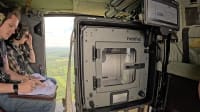
Defense INSIDER
Mounted Troops to Get High-Tech Situational Awareness Tools
Aerospace & Defense Tech Briefs
Light Attack Reconnaissance Helicopter Secures Vertical Lift Dominance
Aerospace INSIDER
Egypt’s Apache Helicopter Fleet to Get Upgraded Sensor Systems

Aerospace & Defense Tech Briefs
Assessing the Effectiveness of a Combat UGV Swarm in Urban Operations
Defense INSIDER
Conference to Focus on Counter-Drone Technology

Aerospace & Defense Tech Briefs
Unmanned Helicopter Drone
Aerospace & Defense Tech Briefs
Autonomous “Wingman” Vehicles
Aerospace & Defense Tech Briefs
Drone-Elimination Fire Control System
Defense INSIDER
DEVCOM Tests Airdrop System for Rapid Deployment in the Field
Aerospace & Defense Tech Briefs
Rugged Network File Servers
Aerospace & Defense Tech Briefs
Ultra-Light Rocket Launchers
Aerospace INSIDER
ATHENA Sensor Brings Generational Leap to Airborne MANPAD Protection
Top Stories
INSIDERManufacturing & Prototyping
 How Airbus is Using w-DED to 3D Print Larger Titanium Airplane Parts
INSIDERManned Systems
 FAA to Replace Aging Network of Ground-Based Radars
NewsTransportation
 CES 2026: Bosch is Ready to Bring AI to Your (Likely ICE-powered) Vehicle
NewsSoftware
 Accelerating Down the Road to Autonomy
EditorialDesign
 DarkSky One Wants to Make the World a Darker Place
INSIDERMaterials
 Can This Self-Healing Composite Make Airplane and Spacecraft Components Last...
Webcasts
Defense
 How Sift's Unified Observability Platform Accelerates Drone Innovation
Automotive
 E/E Architecture Redefined: Building Smarter, Safer, and Scalable...
Power
 Hydrogen Engines Are Heating Up for Heavy Duty
Electronics & Computers
 Advantages of Smart Power Distribution Unit Design for Automotive...
Unmanned Systems
 Quiet, Please: NVH Improvement Opportunities in the Early Design...
