




Aerospace Gimbals Test Service
 A new test service introduced by Bal Seal Engineering, Inc. (Foothill Ranch, CA) offers OEMs verified performance results for Bal Seal spring-energized rotary/face seals used in aerospace and defense gimbal applications. Aerospace gimbals used for targeting, surveillance, and threat detection require precise positioning and must overcome internal drag to function efficiently.
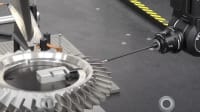
Bal Seal Engineering’s gimbal seal test equipment measures friction and leak rate using customer-defined hardware tolerances and operating conditions, including pressure and speed. Fixtures can accommodate seals up to 22 in. OD, and can be modified for larger seal dimensions. The fixtures can produce a wide range of pressures and exert specific frictional forces to accurately simulate a seal’s performance under real-world conditions. Rotating plates on the fixtures are connected to digital force testers, which measure the friction of rotation. A vacuum tester simulates air flow over the gimbal during flight. The tester pulls a vacuum across the plates, creating suction inside the seal to measure the leak rate across its surface. Both friction and leak rate are measured simultaneously.
For Free Info Click Here
More From SAE Media Group
Aerospace & Defense Tech Briefs
Aerospace Gimbals Test Service
Aerospace & Defense Tech Briefs
Notre Dame’s New Boundary Breaking Mach 10 Quiet Wind Tunnel
Tech Briefs
Thermal Bypass Valves
Aerospace & Defense Tech Briefs
Blast-Induced Acceleration in a Shock Tube

Tech Briefs
Thermostatic Control for Thermal Bypass Systems
Defense INSIDER
Wind Tunnel, Lasers Provide Hypersonic Proving Ground
Aerospace & Defense Tech Briefs
Calculation of Weapon Platform Attitude and Cant Using Available Sensor Feedback

Aerospace INSIDER
Engineers Assess Flow Quality in Wind Tunnel Test Facility
Aerospace & Defense Tech Briefs
Tata Technologies Researchers Use CFD to Predict Cavitation in Liquid Ring Pumps
Aerospace & Defense Tech Briefs
Terrain Model as an Interface for Real-Time Vehicle Dynamics Simulations
Aerospace & Defense Tech Briefs
A New Look at Ignition: Refining Our Understanding of Combustion Dynamics in Gun Chambers
Aerospace & Defense Tech Briefs
Influence of Leading-Edge Oscillatory Blowing on Time-Accurate Dynamic Store Separation
Aerospace & Defense Tech Briefs
Hydraulic Thermal Bypass Valve
Tech Briefs
Impact and Trajectory Detection System
Aerospace Manufacturing and Machining
Aerospace Work Platforms — More than Meets the Eye
Aerospace & Defense Tech Briefs
Shaking Outside the Box to Advance Flight Research

Defense INSIDER
Vibration Table Used to Test Nuclear Weapon Components
Aerospace & Defense Tech Briefs
Ruggedizing Coaxial and Fiber Optic Cable Assemblies from Mechanical Strain
Aerospace INSIDER
Dome-Loaded Pressure Regulator
Aerospace & Defense Tech Briefs
Comparing Blade-Element Momentum Modeling to 3-D CFD
Aerospace & Defense Tech Briefs
Thermal Trends and Improvements for Rugged COTS Cards
Aerospace & Defense Tech Briefs
Predicting Cavitation in Fuel Pumps
Tech Briefs
RFID-Based Rotary Position Sensor
Tech Briefs
Extrans Permeation Measurement System

Top Stories
INSIDERManufacturing & Prototyping
 How Airbus is Using w-DED to 3D Print Larger Titanium Airplane Parts
INSIDERManned Systems
 FAA to Replace Aging Network of Ground-Based Radars
NewsTransportation
 CES 2026: Bosch is Ready to Bring AI to Your (Likely ICE-powered) Vehicle
NewsSoftware
 Accelerating Down the Road to Autonomy
EditorialDesign
 DarkSky One Wants to Make the World a Darker Place
INSIDERMaterials
 Can This Self-Healing Composite Make Airplane and Spacecraft Components Last...
Webcasts
Defense
 How Sift's Unified Observability Platform Accelerates Drone Innovation
Automotive
 E/E Architecture Redefined: Building Smarter, Safer, and Scalable...
Power
 Hydrogen Engines Are Heating Up for Heavy Duty
Electronics & Computers
 Advantages of Smart Power Distribution Unit Design for Automotive...
Unmanned Systems
 Quiet, Please: NVH Improvement Opportunities in the Early Design...
