




Tata Technologies Researchers Use CFD to Predict Cavitation in Liquid Ring Pumps
Liquid ring pumps are used in aircraft fuel systems in conjunction with main impeller pumps. These pumps are used for priming the pump system as well as to remove fuel vapor and air from the fuel. Prediction of cavitation in liquid ring pumps is important as cavitation degrades the performance of these pumps and leads to their failure. As test-based assessment of cavitation risk in liquid ring pumps is expensive and time consuming, recent approaches have been to assess and predict the risk of cavitation using CFD methods with the goal to quicken the design process and optimize the performance of these pumps.
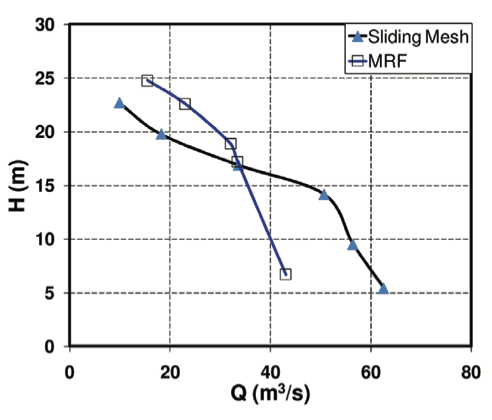
The cavitation phenomena occur in regions where large pressure drops cause the local pressure to fall below the vapor pressure resulting in formation of vapor bubbles. Typically for pumps, cavitation occurs in the suction side of the pump blades that, in turn, results in a reduction of effective area of blade thereby diminishing the efficiency of the pumps. The formation of vapor bubbles and their subsequent bursting creates pressure impulse on the blade surfaces, which leads to vibration and fatigue induced structural damage leading to pump failures.
Researchers from Tata Technologies Ltd. used steady state Multiple Reference Frame (MRF) methodology and the transient sliding mesh methodology to assess cavitation, pump performance, and Net Positive Suction Head (NPSH) in liquid ring pumps using ANSYS-Fluent CFD software.
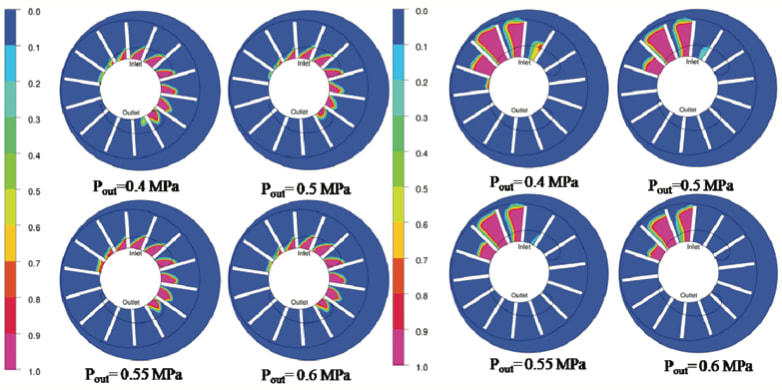
Typically cavitation occurs near the hub surface, and investigation of the pressure distribution in the hub area is important to understand and analyze the cavitation phenomenon. Cavitation occurred in the first, second, and fourth quadrant of the hub. The cavitation region extends from around 0° to 50° and from around 270° to 360°. The results show the appearance of pressure spikes that coincide with the fluid compression and subsequent ejection through the outlet port. The pressure spikes result in an implosion or collapse of the vapor bubble, which is formed during the cavitation process. The large magnitude of the pressure spikes, the value of which can be as much as 2.25 MPa for the pump configuration considered in this study, creates pressure impulse load at the impeller surfaces, which may lead to structural failure. Furthermore, the cyclic nature of the pressure impulses leads to fatigue of the impellers that further expedites their structural failure.
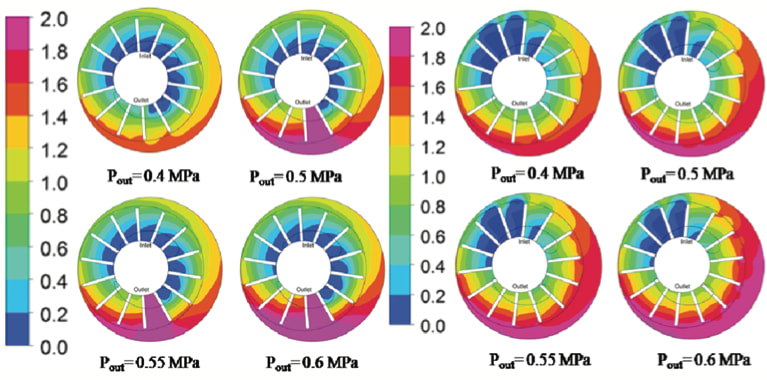

Figure 2 shows the distribution of absolute pressure at the pump mid-section plane as predicted by the transient sliding mesh and the steady state MRF methodology, respectively. As expected, regions of low pressure near the inlet port and regions of higher pressure near the outlet port are observed.
The results indicate that though the computation efforts are cheaper for the steady state MRF model, the results obtained are unphysical. The computationally expensive transient sliding mesh approach results in realistic predictions. Due to unavailability of experimental data, a quantitative validation of the sliding mesh approach for cavitation prediction could not be performed, but the trends observed in the results show promise in this approach as compared to the MRF approach. Further investigation, along with experimental validation, would be required to refine the prediction fidelity of the transient sliding mesh based cavitation model for liquid ring pump applications.
This article is based on SAE International technical paper 2013-01-2238 by Manoj Radle and Biswadip Shome of Tata Technologies Ltd.
More From SAE Media Group
Aerospace & Defense Tech Briefs
Tata Technologies Researchers Use CFD to Predict Cavitation in Liquid Ring Pumps
Aerospace & Defense Tech Briefs
ETS researchers develop new methodology for wind tunnel calibration
Tech Briefs
Thermal Bypass Valves
Aerospace & Defense Tech Briefs
Surviving the Challenge of Thermal Design in Aerospace Electronics
Aerospace & Defense Tech Briefs
Simulating and Analyzing Flow for an Air-to-Air Refueling System
Aerospace & Defense Tech Briefs
Predicting Cavitation in Fuel Pumps
Aerospace INSIDER
Engineers Assess Flow Quality in Wind Tunnel Test Facility
Aerospace & Defense Tech Briefs
Notre Dame’s New Boundary Breaking Mach 10 Quiet Wind Tunnel
Aerospace & Defense Tech Briefs
Vacuum Regulators to Simulate Altitudes
Aerospace & Defense Tech Briefs
Zwick Roell Provides Flexible Materials Testing over a Wide Temperature Range
Tech Briefs
Thermostatic Control for Thermal Bypass Systems


Aerospace & Defense Tech Briefs
Industry Invited to Participate in AeroTech Aerospace and Defense Technical Program
Aerospace & Defense Tech Briefs
Rotorcraft Icing Computational Tool Development
Aerospace & Defense Tech Briefs
SAE International Issues, Revises Technical Reports for Aerospace Engineering
Aerospace & Defense Tech Briefs
UAV Fuel Management System
Aerospace & Defense Tech Briefs
Flight Testing Microvanes and Riblets
Tech Briefs
Fluid Mechanics Comes to Life in 3D
Aerospace & Defense Tech Briefs
Thermostatic Solutions for Temperature Control Applications
Tech Briefs
Supersonic Spike Diffuser

Aerospace & Defense Tech Briefs
Aerodynamic Modeling of a Flapping Wing Unmanned Aerial Vehicle
Aerospace & Defense Tech Briefs
Comparing Blade-Element Momentum Modeling to 3-D CFD
Aerospace & Defense Tech Briefs
A Supercomputer for Aerospace and Defense Systems Modeling and Simulation
Aerospace INSIDER
Supercritical Fluid Extractor
Aerospace & Defense Tech Briefs
Combustion Characteristics of Hydrocarbon Droplets Induced by Photoignition of Aluminum Nanoparticles
Motion Control Technology
Computational Fluid Dynamics Aids Aerospace Apps

Top Stories
INSIDERManufacturing & Prototyping
 How Airbus is Using w-DED to 3D Print Larger Titanium Airplane Parts
INSIDERManned Systems
 FAA to Replace Aging Network of Ground-Based Radars
NewsTransportation
 CES 2026: Bosch is Ready to Bring AI to Your (Likely ICE-powered) Vehicle
NewsSoftware
 Accelerating Down the Road to Autonomy
EditorialDesign
 DarkSky One Wants to Make the World a Darker Place
INSIDERMaterials
 Can This Self-Healing Composite Make Airplane and Spacecraft Components Last...
Webcasts
Defense
 How Sift's Unified Observability Platform Accelerates Drone Innovation
Automotive
 E/E Architecture Redefined: Building Smarter, Safer, and Scalable...
Power
 Hydrogen Engines Are Heating Up for Heavy Duty
Electronics & Computers
 Advantages of Smart Power Distribution Unit Design for Automotive...
Unmanned Systems
 Quiet, Please: NVH Improvement Opportunities in the Early Design...
