




Vacuum Regulators to Simulate Altitudes
Equilibar
Fletcher, NC
828-650-6590
www.equilibar.com
To support air assets, the US Navy’s Altitude Laboratory in Maryland is tasked with testing On-Board Oxygen Generating Systems (OBOGS). The lab has three hypobaric chambers to assess mechanical breathing simulators at altitudes up to 60,000 feet. The altitude in the chambers is simulated by precisely regulating the vacuum pressure.
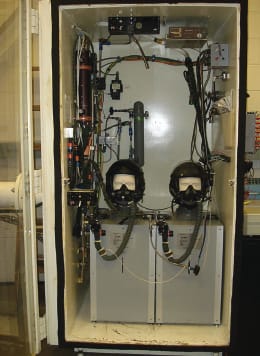 Testing oxygen generating systems presents unique challenges due to the high flow rates created by aircraft systems, the complexity of sinusoidal breathing, and the life-and-death importance of a reliable system. Previously, the lab used traditional vacuum control valves to throttle flow between hypobaric chambers and vacuum pumps. While common throughout industry, such systems are not capable of responding quickly enough to oxygen systems’ frequent perturbations in pressure/flow balance. Barometric swings of 2000 to 4000 feet were observed in some chambers.
In 2011, the Navy contracted with Research, Engineering and Development, Inc., and Spectrum Sciences, Inc., to improve the accuracy of the simulated altitude. Working with Spectrum Sciences aerospace engineer Curtis Stansfield and the Navy’s Dennis Gordge, Equilibar designed three high-flow vacuum regulators. The design used high-resolution Proportion-Air electro-pneumatic regulators to pilot-operate the three vacuum regulators. The light weight, supple diaphragm moves only a few millimeters to modulate the vacuum regulator from fully closed to fully open. The thin Viton diaphragm is sensitive to changes in pressure as small as 0.001 psi. Equilibar regulators provide stable pressure across flow rate changes of up to 1000:1 and adjust to changes in flow rate in less than 10 milliseconds.
The new system provides a significant reduction in altitude pressure variation. Even with non-steady air crew exhalation flows, the chamber altitude is maintained within +/- 50 ft, an 85% reduction in variability. The system uses one bleed orifice and two separate solenoid valves for three different modes. A very small orifice allows a low constant bleed rate for minor adjustments. A .25" sized orifice is used for controlled descent, and a .5" orifice allows for rapid ingress of air in a simulated emergency descent. The actual rate of descent in all cases is set by providing a matching ramping electronic command signal to the electronic pilot regulator.
For Free Info Click Here
More From SAE Media Group
Aerospace & Defense Tech Briefs
ETS researchers develop new methodology for wind tunnel calibration
Tech Briefs
Thermal Bypass Valves
Aerospace & Defense Tech Briefs
Thermostatic Solutions for Temperature Control Applications
Aerospace & Defense Tech Briefs
UAV Fuel Management System
Tech Briefs
Thermostatic Control for Thermal Bypass Systems
Aerospace & Defense Tech Briefs
Industry Invited to Participate in AeroTech Aerospace and Defense Technical Program
Aerospace & Defense Tech Briefs
More Electric, Integrated Fuel Systems
Aerospace & Defense Tech Briefs
Tata Technologies Researchers Use CFD to Predict Cavitation in Liquid Ring Pumps
Aerospace & Defense Tech Briefs
Notre Dame’s New Boundary Breaking Mach 10 Quiet Wind Tunnel
Aerospace & Defense Tech Briefs
Seeing the Light
Aerospace & Defense Tech Briefs
Cold Spray Technology
Aerospace & Defense Tech Briefs
Hydraulic Thermal Bypass Valve
Aerospace & Defense Tech Briefs
F/A-18 Infrared Search and Rescue System
Aerospace & Defense Tech Briefs
Quality Management Experts Provide Guidance on AS9100 Standard, Equipment Calibration
Aerospace & Defense Tech Briefs
Game-Based Training Environment
Aerospace & Defense Tech Briefs
Electronic Warfare Combat Training Pod
Aerospace & Defense Tech Briefs
Hybrid Auxiliary Propulsion System
Aerospace & Defense Tech Briefs
Simulating Lightweight Vehicles Operating on Discrete Terrain
Aerospace & Defense Tech Briefs
SAE International Issues, Revises Technical Reports for Aerospace Engineering
Aerospace INSIDER
Dome-Loaded Pressure Regulator
Aerospace INSIDER
Engineers Assess Flow Quality in Wind Tunnel Test Facility
Aerospace & Defense Tech Briefs
Ceramic Matrix Composites in Aircraft Engines Projected to Double over Five Years, Stratview Research Predicts
Aerospace & Defense Tech Briefs
FAA, SAE International Focus on Engine Fire Protection System Standards for Aerospace
Aerospace & Defense Tech Briefs
CAD-CAM-CNC System
Aerospace & Defense Tech Briefs
Autonomous Collaborative Platform
Aerospace & Defense Tech Briefs
SAE International Extends Call for Abstracts, Seeks Submissions for AeroTech Conference
Aerospace Manufacturing and Machining
Marking Aircraft Components
Aerospace & Defense Tech Briefs
Thermoelectric Cooling
Aerospace & Defense Tech Briefs
Predator Mission Aircrew Training Systems
Top Stories
INSIDERManufacturing & Prototyping
 How Airbus is Using w-DED to 3D Print Larger Titanium Airplane Parts
INSIDERManned Systems
 FAA to Replace Aging Network of Ground-Based Radars
NewsTransportation
 CES 2026: Bosch is Ready to Bring AI to Your (Likely ICE-powered) Vehicle
NewsSoftware
 Accelerating Down the Road to Autonomy
EditorialDesign
 DarkSky One Wants to Make the World a Darker Place
INSIDERMaterials
 Can This Self-Healing Composite Make Airplane and Spacecraft Components Last...
Webcasts
Defense
 How Sift's Unified Observability Platform Accelerates Drone Innovation
Automotive
 E/E Architecture Redefined: Building Smarter, Safer, and Scalable...
Power
 Hydrogen Engines Are Heating Up for Heavy Duty
Electronics & Computers
 Advantages of Smart Power Distribution Unit Design for Automotive...
Unmanned Systems
 Quiet, Please: NVH Improvement Opportunities in the Early Design...
