




NASA Tests New Green Propellants for Satellites
To stay in the proper orbit, many satellites have thrusters – small rocket engines – that fire to change altitude or orientation in space. On Earth, where gravity dominates, five pounds of thrust, equivalent to 22 Newtons of force, may seem small, but in space, it doesn’t take much thrust to move a large spacecraft.
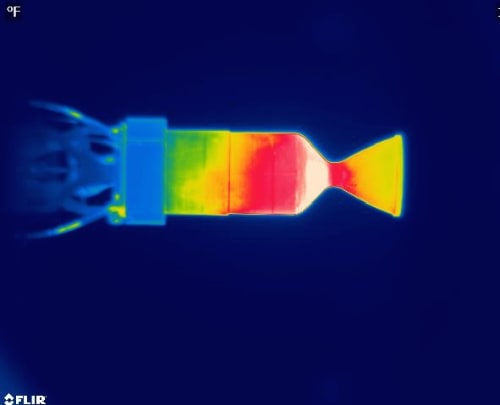
Currently, most satellite thrusters are powered by hydrazine, a toxic and corrosive fuel that is dangerous to handle and store. In a quest to replace hydrazine with a more environmentally friendly fuel, NASA is testing thrusters propelled by green propellants that can provide better performance than hydrazine without the toxicity.
NASA recently completed hot-fire tests with thrusters powered by two different green propellants – AF-M315E and LMP-103S. Both are ionic liquid-based blends that are less toxic and less flammable than hydrazine, which makes them easier and less costly to store, handle, and fuel up spacecraft before launch. Additionally, the new propellants offer higher performance, delivering more thrust for a given quantity of propellant than hydrazine.
More From SAE Media Group
Motion Control and Automation Technology INSIDER
NASA’s Green Propellant Spacecraft Moves Toward Launch

Aerospace INSIDER
Precision NASA Thruster Keeps Spacecraft Still
Aerospace & Defense Tech Briefs
Thrust in Space - The Nuances of Thruster Valve Design
Tech Briefs
De-Orbit Device for SmallSats

Aerospace INSIDER
A Prototype Fuel Gauge for Orbit
Tech Briefs
NASA’s Ruggedized Video Camera Ready for Earth
NASA Spinoff
Redefining the 'Rugged' Video Camera
Aerospace INSIDER
Ursa Major Performs First Successful Hotfire of Hypersonic Draper Engine
Test & Measurement/Sensors INSIDER
NASA Tests 3D-Printed Rocket Fuel Pump
Tech Briefs
Water-Powered Engines Offer Satellite Mobility
NASA Spinoff
Controlled Propulsion for Gentle Landings
Aerospace & Defense Tech Briefs
Electric Propulsion for a Nuclear-Powered Spacecraft

NASA Spinoff
A Huge Development for Tiny Satellites

Aerospace & Defense Tech Briefs
Hybrid Propulsion Systems

Tech Briefs
5Ws of a 3D-Printed Electrospray Engine
NASA Spinoff
Make Way for Satellites
Photonics & Imaging Technology INSIDER
NASA Mission to Test Organic Electro-Optic Materials in Space
Aerospace & Defense Tech Briefs
New Zealand and LeoLabs Establish the First Low-Earth Orbit Regulatory Platform

Tech Briefs
Understanding Space Sustainability

NASA Spinoff
Separation Device Launches New Science Payloads
Aerospace & Defense Tech Briefs
Electric Satellite Thruster
Top Stories
INSIDERManufacturing & Prototyping
 How Airbus is Using w-DED to 3D Print Larger Titanium Airplane Parts
NewsAutomotive
 Microvision Aquires Luminar, Plans Relationship Restoration, Multi-industry Push
INSIDERAerospace
 A Next Generation Helmet System for Navy Pilots
INSIDERDesign
 New Raytheon and Lockheed Martin Agreements Expand Missile Defense Production
ArticlesAR/AI
 CES 2026: Bosch is Ready to Bring AI to Your (Likely ICE-powered) Vehicle
Road ReadyDesign

Webcasts
Semiconductors & ICs
 Advantages of Smart Power Distribution Unit Design for Automotive...
Unmanned Systems
 Quiet, Please: NVH Improvement Opportunities in the Early Design...
Electronics & Computers
 Cooling a New Generation of Aerospace and Defense Embedded...
Power
 Battery Abuse Testing: Pushing to Failure
AR/AI
 A FREE Two-Day Event Dedicated to Connected Mobility
