




Ursa Major Performs First Successful Hotfire of Hypersonic Draper Engine
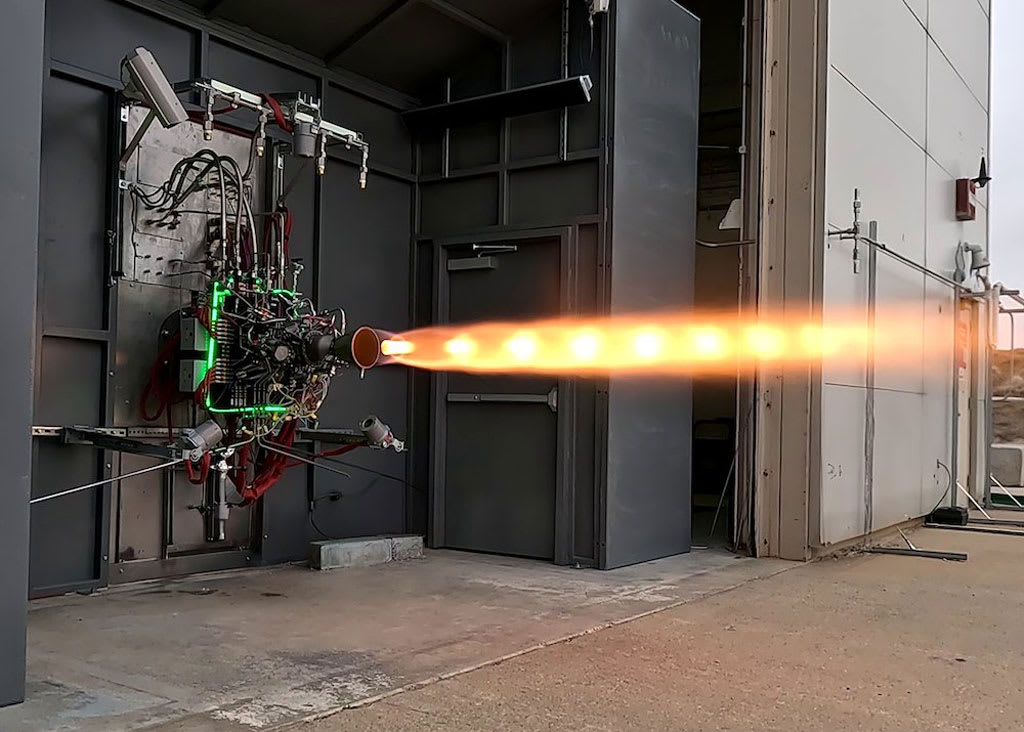
Ursa Major announced the successful hotfire of its 4,000-pound thrust closed catalyst cycle hypersonic Draper engine at the company’s Colorado headquarters. The hotfire test occurred in March, while the startup released details about it last week.
Draper uses a non-cryogenic fuel that optimizes storability, making the engine uniquely suited for in-space propulsion applications. Based on its thrust profile, the engine is not only capable of maneuvering objects in orbit but doing so without fully depleting its store of propellant, potentially allowing for additional mission functions. As nations like Russia and China pursue anti-satellite systems, the need for defensive technology will continue to grow – Ursa Major’s Draper propulsion system is primed to be a part of that response.
Originally designed for hypersonic applications, Draper is additionally working to position the U.S. as a competitor in the field of hypersonics, where the country currently lags behind adversaries.
Drawing on the architectural and manufacturing legacy of Ursa Major’s Hadley engine, Draper combines the storable attributes of a solid rocket motor with active throttle control and throttle range of a liquid engine, providing the maneuverability and flexibility that is needed for hypersonic defense. It is this unique design that allows the engine to effectively simulate hypersonic threats.
“We're excited with how quickly the development program has progressed and look forward to fielding the engine for hypersonics and in-space applications in the coming years,” said Brad Appel, Chief Technology Officer at Ursa Major.
“Perhaps the most-impressive aspect of this program is the delivery of a versatile, storable rocket engine in such an incredibly short timeframe,” said Dr. Shawn Phillips, Chief of AFRL’s Rocket Propulsion Division.
Following this successful engine hotfire, Ursa Major intends to continue an aggressive development campaign and mature the engine towards flight qualification.
More From SAE Media Group
Aerospace & Defense Tech Briefs
Prototype Hypersonic Defense Engine

Aerospace & Defense Tech Briefs
Generation Orbit’s GOLauncher1 Is Officially the Air Force’s X-60A Hypersonic Flight Research Vehicle

Aerospace Manufacturing and Machining INSIDER
Aerojet Rocketdyne Establishes Hydrocarbon R&D Office in Alabama
Aerospace INSIDER
Hermeus Quarterhorse Joins Hypersonic High Cadence Testing Program

Aerospace INSIDER
NASA Tests New Green Propellants for Satellites
Defense INSIDER
Adranos Secures Government Contracts for Hypersonic Research
Test & Measurement/Sensors INSIDER
NASA Tests 3D-Printed Rocket Fuel Pump
Tech Briefs
3D-Printed Rocket Turbopump Successfully Tested
Aerospace & Defense Tech Briefs
NASA Selects Frontier Aerospace to Continue Development of New Deep Space Thruster
Aerospace INSIDER
Safer Electric Solid Propellants for Rocket Engines
Aerospace & Defense Tech Briefs
Electric Propulsion for a Nuclear-Powered Spacecraft
Aerospace Manufacturing and Machining INSIDER
New Defense Department Contract to Expand Domestic Rocket Motor Manufacturing
Aerospace & Defense Tech Briefs
Electric Rockets and the Future of Satellite Propulsion
Aerospace & Defense Tech Briefs
Aerojet Rocketdyne to Develop Propulsion Technology for CubeSats

Aerospace & Defense Tech Briefs
OmegA Rocket Sustains Explosion During First Static Test, Northrop Grumman Maintains Test Was a Success
Motion Control and Automation Technology INSIDER
Rocket Motor Design Could Boost Small Satellite Missions


Aerospace Manufacturing and Machining INSIDER
3D Printed Rocket Engine Parts Survive 23 Hot-Fire Tests
Aerospace Manufacturing and Machining INSIDER
Advanced Manufactured Solid Rocket Motor Completes Latest Flight Test
Aerospace & Defense Tech Briefs
A New Clean Room for Missile and Satellite Propulsion Components
Aerospace INSIDER
3D Printers Create Tomorrow’s Rocket Engines
Tech Briefs
Hybrisol Rocket Engines
Aerospace & Defense Tech Briefs
Raytheon, DARPA Push Forward with Hypersonic Weapon Design
Tech Briefs
Flight Termination System Demonstration
Top Stories
NewsSensors/Data Acquisition
 Microvision Aquires Luminar, Plans Relationship Restoration, Multi-industry Push
INSIDERRF & Microwave Electronics
 A Next Generation Helmet System for Navy Pilots
INSIDERWeapons Systems
 New Raytheon and Lockheed Martin Agreements Expand Missile Defense Production
NewsAutomotive
 Ford Announces 48-Volt Architecture for Future Electric Truck
INSIDERAerospace
 Active Strake System Cuts Cruise Drag, Boosts Flight Efficiency
ArticlesTransportation

Webcasts
Aerospace
 Cooling a New Generation of Aerospace and Defense Embedded...
Energy
 Battery Abuse Testing: Pushing to Failure
Power
 A FREE Two-Day Event Dedicated to Connected Mobility
Automotive
 Quiet, Please: NVH Improvement Opportunities in the Early Design Cycle
Electronics & Computers
 Advantages of Smart Power Distribution Unit Design for Automotive &...
Unmanned Systems
 Sesame Solar's Nanogrid Tech Promises Major Gains in Drone Endurance