




Altair Optimizes 3D-Printed Structures for Complex, Lightweight Designs
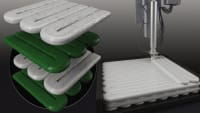
Altair expects to better support the use of additive manufacturing (AM), or 3D printing, by releasing new OptiStruct solver capabilities for topology optimization. The company claims this new technology is the first tool developed specifically for designers of lattice structures.
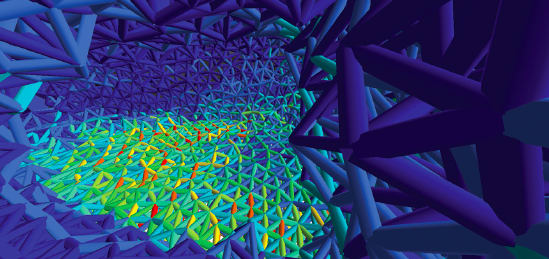
Topology optimization is particularly well-suited for 3D printing, according to Altair, because it tends to create freeform, organic structures that can be difficult or impossible to construct using traditional manufacturing methods.
“3D printing brings new structural freedom to product design, allowing more complexity in shapes and topology and the efficient production of customized products while accelerating the manufacturing process, since no tooling is needed,” said Uwe Schramm, Chief Technical Officer at Altair. “Topology optimization maximizes this design freedom, enabling complex free-form structure development, seamless individual designs, a shorter design process, and optimal 3D-printed structures.”

Instead of simply applying lattice structures to existing geometry, OptiStruct enables the designer to identify the best material placement and lattice structures, according to Altair. Optimization identifies where material is needed in a design—and where it is not required—prior to placing and optimizing lattice.
OptiStruct optimizes lattices in two phases. First, it applies standard topology optimization, allowing more porous materials with intermediate densities to exist. Then, the porous zones are transformed into explicit lattice structures with varying material volume. In the second phase, the dimensions of the lattice cells are optimized. The result is a structure with solid parts plus lattice zones with varying volumes of material.
Lattice zones could enable the successful development of products that require characteristics beyond just stiffness. Some applications, for example, may need to consider buckling behavior, thermal performance, or dynamic characteristics. With OptiStruct, users can manipulate material density based upon the result of an optimization process, comparing stronger vs. weaker, or solid vs. void vs. lattice designs.
“OptiStruct’s lattice capability represents the first step towards integrating smart materials with unique properties in products,” said Ming Zhou, Vice President of Software Development at Altair. “Continuing research and development will explore directional behavior and smooth blending of varying lattice cell layouts to take advantage of exotic material characteristics that could bring innovation to various applications.”
Part of the Altair HyperWorks CAE suite, OptiStruct is used for topology, topography, size, and shape optimization.
More From SAE Media Group
Aerospace & Defense Tech Briefs
Altair Optimizes 3D-Printed Structures for Complex, Lightweight Designs
Automotive Engineering
Lightweight Design Beyond CAD
Aerospace & Defense Tech Briefs
Stratasys Unveils High-Production Additive Manufacturing Spin-Off
Aerospace & Defense Tech Briefs
Software for Additive Design, Manufacturing Evolves Quickly
Tech Briefs
Optimizing a CubeSat with Architected Materials

Aerospace & Defense Tech Briefs
Portable 3D Printing Factory
Tech Briefs
Sustainable 3D-Printed Magnets
Tech Briefs
3D-Printed Device Produces Nanofiber Meshes
Aerospace & Defense Tech Briefs
Streamlining Post-Processing in Additive Manufacturing
Tech Briefs
Painting 3D-Printed Objects
Tech Briefs
Self-Healing, Recyclable, Shape Memory Polymers
Aerospace Manufacturing and Machining
Lightweighting Parts Using 3D Metal Printing

Aerospace & Defense Tech Briefs
Curing the Porosity Problem in Additive Manufacturing

Aerospace & Defense Tech Briefs
Evaluation of Additively Manufactured Ultrahard Steels
Off-Highway Engineering
3DEO Launches New Metal 3D-Printing Platform
Medical Manufacturing and Machining
Process Developed to 3D Print Piezoelectric Materials
Aerospace & Defense Tech Briefs
Using Advanced Computational Engineering Software to Meet Aerospace & Defense Industry Challenges



Aerospace & Defense Tech Briefs
SAE International Issues First Technical Standards for Aerospace Additive Manufacturing

Top Stories
NewsSensors/Data Acquisition
 Microvision Aquires Luminar, Plans Relationship Restoration, Multi-industry Push
INSIDERRF & Microwave Electronics
 A Next Generation Helmet System for Navy Pilots
INSIDERWeapons Systems
 New Raytheon and Lockheed Martin Agreements Expand Missile Defense Production
NewsAutomotive
 Ford Announces 48-Volt Architecture for Future Electric Truck
INSIDERAerospace
 Active Strake System Cuts Cruise Drag, Boosts Flight Efficiency
ArticlesTransportation

Webcasts
Aerospace
 Cooling a New Generation of Aerospace and Defense Embedded...
Energy
 Battery Abuse Testing: Pushing to Failure
Power
 A FREE Two-Day Event Dedicated to Connected Mobility
Automotive
 Quiet, Please: NVH Improvement Opportunities in the Early Design Cycle
Electronics & Computers
 Advantages of Smart Power Distribution Unit Design for Automotive &...
Unmanned Systems
 Sesame Solar's Nanogrid Tech Promises Major Gains in Drone Endurance