




F-35 Gets Cold Treatment in Step Toward IOC Remedy
Since it first became an active cold-weather testing facility in 1947, the 96th Test Wing's McKinley Climatic Laboratory at Eglin Air Force Base, FL, there have been a wide variety of aircraft to undergo testing at the facility, ranging from the B-29 Superfortress and P-51 Mustang through to the Lockheed F-117, Boeing 787, and Airbus A350 XWB.

Most recently, one of Lockheed Martin’s F-35Bs from the F-35 Patuxent River Integrated Test Force in Maryland underwent rigorous climatic testing at the laboratory to verify its all-weather capabilities on its way toward Initial Operating Capability (IOC). The F-35B arrived at McKinley in September 2014, to begin a six-month assessment of the aircraft's performance in wind, solar radiation, fog, humidity, rain intrusion/ingestion, freezing rain, icing cloud, icing build-up, vortex icing, and snow.
With 13 countries currently involved with the program, the F-35 must be tested in all the meteorological conditions representative of those locations from which it will operate, ranging from the heat of northern Australia to the bitter cold of the Arctic Circle above Canada and Norway.
Testing for the F-35 can be done from -40° to +120°F “and every possible weather condition in between," said Billie Flynn, an F-35 test pilot who performed extreme cold testing on the aircraft. "It has flown in more than 100°F heat while also flying in bitter subzero temperatures. In its final days of testing, it will fly through ice and other conditions such as driving rain with hurricane force winds. We are learning more and more about the aircraft every day.”
The chamber allows for the simulation of “virtually any weather condition—all while flying the jet at full power in either conventional or vertical takeoff mode," said Dwayne Bell, the McKinley Climatic Laboratory technical chief.
As the F-35 approaches its IOC debut for the U.S. Marine Corps this year, testing for the STOVL (short takeoff/vertical landing) variant required a few more adaptations to procedures than aircraft before it. Eglin AFB reports that the lift-fan system of the F-35B required the design of a 12-ft high “restraint and support” structure interwoven with a system of ventilation ducts. This apparatus secures the aircraft and allows it to operate at high power in both conventional and STOVL mode while inside the building.
To ventilate the exhaust and thus maintain a stable temperature inside the chamber, conditioned air is constantly pumped in to ensure the pressure in the building is always higher than the pressure inside the ducts surrounding the engine and other openings on the aircraft. This difference in pressure is a safeguard that maintains the jet exhaust is flowing out of the chamber through the ducts, allowing the facility to sustain a constant temperature.
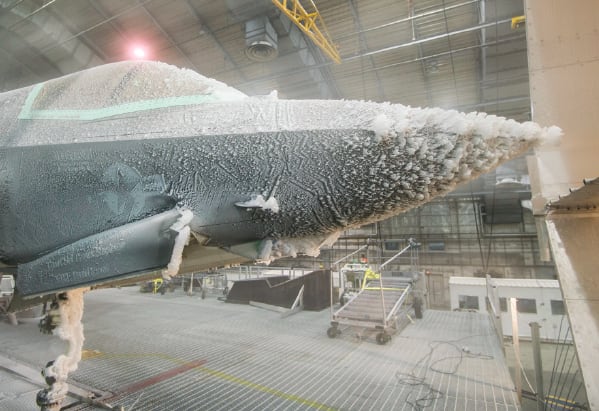
In a matter of days, the chamber transitioned from a seemingly Arizona sauna to the Arctic Circle. Outside air was super-cooled using McKinley Lab’s refrigeration system and pushed into the chamber. In increments, the chamber temperature fell to -40°F while the jet completed test runs along the way. At such frigid temperatures, aircraft fluids start to thicken and mechanisms operate slower—all points test engineers monitor closely.
The F-35 then faced a harsh barrage of snow and ice. When an aircraft flies through clouds at high speeds in freezing climates, large pieces of ice can form quickly on the exterior. Heavy chunks of ice could potentially break off and damage the aircraft, errantly fly into the engine or create a foreign-object-damage concern. For this reason, icing is one of the most dangerous elements in climatic testing.
A large apparatus composed of three massive cylinders stacked in a pyramid, parallel to the ground, was placed in front of the F-35 test aircraft. Inside the cylinders were nine ducted fans that blew a large amount of air through a single funnel in the front. Attached to the front of this funnel was a spray bar capable of producing “clouds” of various water droplet sizes.
Those droplets were blown toward the plane and froze upon contact. While the lab cannot generate the precise wind speeds experienced by airborne aircraft, the unique setup inside the chamber is capable of producing sustained wind speeds up to 120 mph—all while subjecting the F-35 to precipitation.
Snow and ice testing gauges the effectiveness of the aircraft’s Ice Protection System and the ability of the jet to perform in winter weather.
More From SAE Media Group
Aerospace & Defense Tech Briefs
F-35 Gets Cold Treatment in Step Toward IOC Remedy
Aerospace & Defense Tech Briefs
Fanjet Evolution — the Next Steps
RF & Microwave Technology
Microwave Radiometers Help Keep Aircraft Safe From Icing
Aerospace & Defense Tech Briefs
UAV Fuel Management System
Aerospace & Defense Tech Briefs
Influence of Leading-Edge Oscillatory Blowing on Time-Accurate Dynamic Store Separation
Motion Design INSIDER
Exploring Earth Science with a New Navigational System
Aerospace & Defense Tech Briefs
Mobile Counter Unmanned Aircraft System
Aerospace INSIDER
Engineers Assess Flow Quality in Wind Tunnel Test Facility
Aerospace & Defense Tech Briefs
Autonomous Collaborative Platform
Aerospace INSIDER
Navy Completes 73-Hour Nonstop Flight of Solar-Powered UAS
Aerospace & Defense Tech Briefs
Thermal Management Techniques in Avionics Cooling
Tech Briefs
Air Force Research Laboratory
Aerospace & Defense Tech Briefs
H-1 Helicopter
Aerospace & Defense Tech Briefs
High-Speed Data Cables for Fighter Aircraft
Aerospace & Defense Tech Briefs
Light Attack Reconnaissance Helicopter Secures Vertical Lift Dominance
Aerospace & Defense Tech Briefs
3D-Printed NACA Inlet

Aerospace & Defense Tech Briefs
Using Ruggedized Test Equipment to Solve Jet Engine Problems
Aerospace & Defense Tech Briefs
Vertical Takeoff and Landing Drone
Aerospace & Defense Tech Briefs
Rising Star Awards: Women in Engineering Aerospace Winner - Heather Cummings
Aerospace & Defense Tech Briefs
Video Encoders


Aerospace & Defense Tech Briefs
Tiltrotor Aircraft: The CMV-22B Osprey
Aerospace & Defense Tech Briefs
Remotely Piloted Air Systems
Aerospace & Defense Tech Briefs
Remotely Piloted Aircraft
Aerospace & Defense Tech Briefs
Avionics Upgrade for U.S. Forest Service: Sherpa Aircraft
Aerospace & Defense Tech Briefs
Effectiveness of Inter-Vehicle Communications and On-Board Processing for Close Unmanned Autonomous Vehicle Flight Formations
Aerospace & Defense Tech Briefs
Bringing Turbine Power to Small Aircraft
Top Stories
INSIDERDefense
 New Raytheon and Lockheed Martin Agreements Expand Missile Defense Production
NewsAutomotive
 Ford Announces 48-Volt Architecture for Future Electric Truck
INSIDERManufacturing & Prototyping
 Active Strake System Cuts Cruise Drag, Boosts Flight Efficiency
ArticlesTransportation
 Accelerating Down the Road to Autonomy
INSIDERMaterials
 How Airbus is Using w-DED to 3D Print Larger Titanium Airplane Parts
Road ReadyTransportation

Webcasts
Electronics & Computers
 Cooling a New Generation of Aerospace and Defense Embedded...
Power
 Battery Abuse Testing: Pushing to Failure
Connectivity
 A FREE Two-Day Event Dedicated to Connected Mobility
Automotive
 Quiet, Please: NVH Improvement Opportunities in the Early Design Cycle
Transportation
 Advantages of Smart Power Distribution Unit Design for Automotive &...
Aerospace
 Sesame Solar's Nanogrid Tech Promises Major Gains in Drone Endurance