




Production of Satellite with First All-Electric Propulsion System Advances
Boeing is “running on schedule” as it continues to achieve production milestones for the first of its all-electric-propulsion 702SP (small platform) satellites.
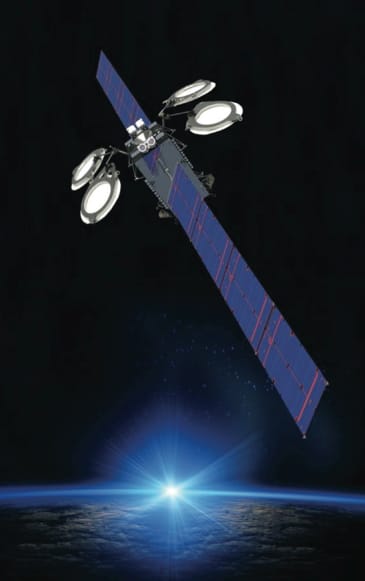
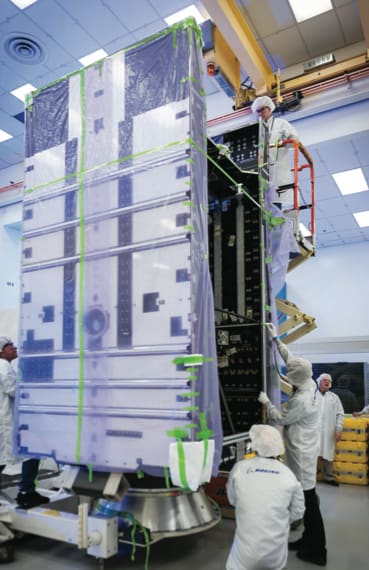
Earlier this year, Boeing announced that it had completed static qualification testing, verification, and assembly of the primary structures for 702SP inaugural customers ABS and Eutelsat, with the spacecraft scheduled to be launched as a pair in a stacked configuration. The initial contract was signed in 2012 between Boeing and Satmex. Eutelsat acquired Satmex in January 2014.
Joanna E. Climer, Communications Specialist, Boeing Space & Intelligence Systems, confirmed to Aerospace & Defense Technology on July 10 that the program is on track.
“We will be first to launch a commercial all-electric satellite, providing customers new flexibility, and next-generation technology for increased performance,” Craig Cooning, Vice President and General Manager of Boeing Space & Intelligence Systems, said in a March 24 press release. “The all-electric propulsion design gives customers more affordable launch options and the ability to nearly double payload capacity.”
Boeing is building two pairs of 702SP satellites under a joint four-satellite agreement with ABS and Eutelsat. Production on the 702SP satellites began in 2013, after the spacecraft passed its critical design review in May of that year.
Most satellites use something similar to combustion for propulsion, but since there is no oxygen in space they need to carry both the fuel and oxygen with them, “which is heavy,” Climer continued. “With the xenon ion propulsion system (XIPS) engine in the 702SP, instead of using fuel and an oxidizer, you have a gas—in this case xenon. The xenon gas is charged, electrically ionized, and travels at a high velocity through the XIPS engine to create thrust, propelling the satellite forward. This makes the 702SP more efficient and lighter in weight. Weight is a main factor in launch costs.”
The 702SP is an evolution of the Boeing 702 satellite. Its lightweight design accommodates launch on most commercial launch systems, including Falcon 9, Ariane 5, Sea Launch, Proton, Soyuz, Atlas V, and Delta IV.
Because of lower mass owing to the lighter-weight components of a xenon-ion propulsion system compared to that of a conventional one requiring liquid fuel, two satellites can be launched on a single launch vehicle, resulting in a cost savings of up to 20% when compared with existing launch options, according to Boeing.
A typical spacecraft will carry between 1800 and 2800 kg of liquid bipropellant to achieve orbit-raising and on-station position / orbit slot change. An all-electric XIPS system only requires around 300 kg of xenon gas to do the same, said Climer.
The disadvantage of all-electric propulsion is that it generates less thrust than conventional propulsion and thus takes longer to move and position the satellite. Climer said a typical XIPS thruster provides 0.165 N thrust. When fired in pairs, this equates to 0.33 N. Typical chemical thrusters are 10 N and 22 N (for control jets), and up to 440 N LATs (liquid apogee thrusters).
More From SAE Media Group
Aerospace & Defense Tech Briefs
Orbex Debuts Innovative Smallsat Launch Vehicle
Aerospace & Defense Tech Briefs
NASA Selects Frontier Aerospace to Continue Development of New Deep Space Thruster
Aerospace & Defense Tech Briefs
Three Stages of Separation: Bidding Farewell to the Delta II Launch Vehicle
Aerospace & Defense Tech Briefs
JAXA Launches HTV7 Unmanned Cargo Spacecraft on Resupply Mission to ISS
Aerospace & Defense Tech Briefs
OmegA Rocket Sustains Explosion During First Static Test, Northrop Grumman Maintains Test Was a Success
Aerospace & Defense Tech Briefs
Production of Satellite with First All-Electric Propulsion System Advances
Aerospace & Defense Tech Briefs
U.K. Space Agency Partners with Industry to Advance Spaceflight Program
Aerospace & Defense Tech Briefs
Electric Rockets and the Future of Satellite Propulsion
Aerospace & Defense Tech Briefs
Delta II’s Final Flight a Success
Aerospace INSIDER
Ursa Major Performs First Successful Hotfire of Hypersonic Draper Engine
Aerospace & Defense Tech Briefs
Firefly Aerospace Is the Latest Addition to Florida’s “Space Coast”
Aerospace & Defense Tech Briefs
Electric Satellite Thruster
Aerospace & Defense Tech Briefs
To the Moon and Beyond with Additive Manufacturing
Aerospace & Defense Tech Briefs
Canada’s RADARSAT Constellation Satellites Receive Thermal Blankets, Ready for Launch
Aerospace & Defense Tech Briefs
Prototype Hypersonic Defense Engine
Aerospace & Defense Tech Briefs
Northrop Grumman Completes First Live Motor Cast for OmegA Rocket
Aerospace & Defense Tech Briefs
NASA Budget Amendment to Help Send Americans to Moon by 2024, Then Mars
Aerospace & Defense Tech Briefs
Can the Air Force Reach a 24-Hour Launch Window?
Aerospace & Defense Tech Briefs
The Future of Space Propulsion
Tech Briefs
Thrusters Support GOES-R Satellite Series
Aerospace & Defense Tech Briefs
Generation Orbit’s GOLauncher1 Is Officially the Air Force’s X-60A Hypersonic Flight Research Vehicle
Aerospace & Defense Tech Briefs
SpaceX Tests Raptor Engine, Prepares for Starship “Hop”
Aerospace & Defense Tech Briefs
NASA Invests $44M to Advance ‘Tipping Point’ Space Exploration Technologies
Aerospace & Defense Tech Briefs
Northrop Grumman Wins $792M to Deliver Intermediate, Heavy Versions of OmegA Space Launch Vehicle
Aerospace & Defense Tech Briefs
Space Launch Providers Submit Proposals for National Security Space Launch Program
Aerospace & Defense Tech Briefs
Soyuz MS-10 Launch Abort Prompts Investigation into Booster Anomaly
Aerospace & Defense Tech Briefs
Blue Origin Mission 9 a Success
Aerospace & Defense Tech Briefs
Thrust in Space - The Nuances of Thruster Valve Design
Aerospace & Defense Tech Briefs
Late Paul Allen’s Stratolaunch Company Cancels Launch Vehicle Projects
Aerospace & Defense Tech Briefs
Japan’s IBUKI-2 (GOSAT-2) Satellite Launches, Powers Up, Completes Critical Phase
Top Stories
NewsRF & Microwave Electronics
 Microvision Aquires Luminar, Plans Relationship Restoration, Multi-industry Push
INSIDERAerospace
 A Next Generation Helmet System for Navy Pilots
INSIDERDesign
 New Raytheon and Lockheed Martin Agreements Expand Missile Defense Production
INSIDERMaterials
 How Airbus is Using w-DED to 3D Print Larger Titanium Airplane Parts
NewsPower
 Ford Announces 48-Volt Architecture for Future Electric Truck
ArticlesAR/AI

Webcasts
Electronics & Computers
 Cooling a New Generation of Aerospace and Defense Embedded...
Automotive
 Battery Abuse Testing: Pushing to Failure
Power
 A FREE Two-Day Event Dedicated to Connected Mobility
Unmanned Systems
 Quiet, Please: NVH Improvement Opportunities in the Early Design Cycle
Automotive
 Advantages of Smart Power Distribution Unit Design for Automotive &...
Energy
 Sesame Solar's Nanogrid Tech Promises Major Gains in Drone Endurance