




Japan’s IBUKI-2 (GOSAT-2) Satellite Launches, Powers Up, Completes Critical Phase

The IBUKI-2 (GOSAT-2) greenhouse gas observation satellite co-developed by the Japanese Ministry of Environment, National Institute of Environmental Studies Japan, and Japan Aerospace Exploration Agency ( JAXA ) has completed the critical operations phase following its launch into orbit. JAXA officials have received telemetry data from the satellite that confirm the attitude control system has transitioned to a steady, stable state.

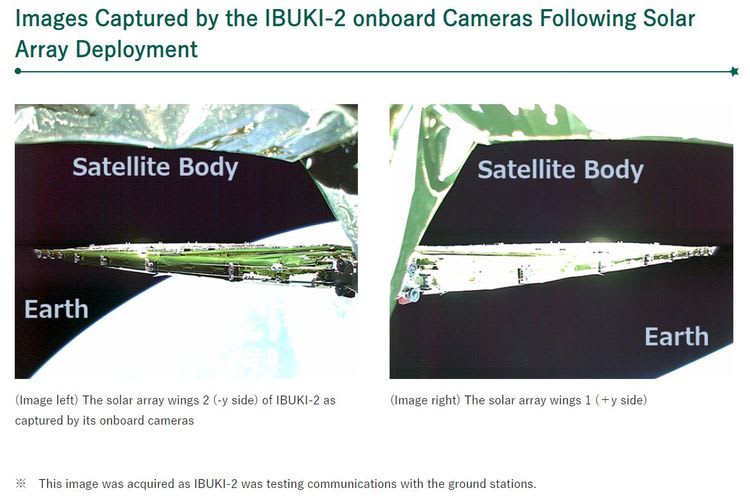
The critical operations phase follows satellite’s separation from the launch vehicle. In this phase, solar arrays are deployed and the onboard instruments are powered on for the satellite’s regular operations. The critical operations phase concludes when the control mode begins for the satellite’s nominal operation.
The satellite has achieved power generation supported by deployed solar array wings, ground communications, and sound attitude control that maintains those operations. The bus and mission equipment has powered up, and IBUKI-2 has been able to sustain itself in orbit, concluding the critical operations phase.
IBUKI-2 will move on to the next operations phase, where the functions of the satellite’s onboard apparatus will be examined over the next two and a half months. During this phase, the entire satellite, its observation/mission sensors, and other onboard equipment are scrutinized.
At 13:08:00 p.m. Japan Standard Time (JST), October 29, 2018, Mitsubishi Heavy Industries Ltd. and JAXA launched H-IIA No. 40 encapsulating IBUKI-2.
JAXA Mingenew Station, Australia, received telemetry data at 13:26 p.m. JST, confirming IBUKI-2’s solar array deployment above Australia. At 13:47p.m. JST, telemetry transmitted to the Troll Satellite Station, Antarctica, demontrated that the satellite’s sun acquisition control proceeded properly.
JAXA officials convey deep appreciation for the support by all for the satellite’s launch and tracking.


Working on aerospace systems and platforms? Wrestling with challenges? Have aerospace wisdom to share for the greater good of the industry? You're invited to get involved with SAE International -- contact
Courtney E. Howard is editorial director and content strategist at SAE International, Aerospace Products Group. Contact her by e-mail at
More From SAE Media Group
Aerospace & Defense Tech Briefs
New Zealand and LeoLabs Establish the First Low-Earth Orbit Regulatory Platform

Aerospace & Defense Tech Briefs
Lockheed Martin’s “Non-Operational” Space Fence Detects Indian Anti-Satellite Operations While Still in Test Mode
Automotive Engineering
OneWeb Ramps up Satellite Production with New Round of Funding
Aerospace & Defense Tech Briefs
U.K. Space Agency Partners with Industry to Advance Spaceflight Program
Aerospace & Defense Tech Briefs
NASA Invests in Aerospace Start-Up, University Projects on CubeSat Platform
Aerospace & Defense Tech Briefs
Iridium, Aireon, SpaceX Celebrate Satellite Launch, System Deployment
Aerospace & Defense Tech Briefs
Navigation Unit
Tech Briefs
GPS-Enhanced Onboard Navigation System (GEONS)
Aerospace & Defense Tech Briefs
JAXA Launches HTV7 Unmanned Cargo Spacecraft on Resupply Mission to ISS
Photonics & Imaging Technology
Getting NASA Data to the Ground With Lasers
Aerospace & Defense Tech Briefs
Lockheed Martin Ships AEHF Satellite in Advance of ULA Rocket Launch
Aerospace & Defense Tech Briefs
NASA Budget Amendment to Help Send Americans to Moon by 2024, Then Mars
Tech Briefs
Affordable Vehicle Avionics (AVA)
Aerospace & Defense Tech Briefs
Can the Air Force Reach a 24-Hour Launch Window?
Aerospace & Defense Tech Briefs
Made in Space Is Set to Make in Space
Aerospace & Defense Tech Briefs
SAE International Extends Call for Abstracts, Seeks Submissions for AeroTech Conference
Aerospace & Defense Tech Briefs
Thrust in Space - The Nuances of Thruster Valve Design
Aerospace & Defense Tech Briefs
FADA-CATEC Uses 3D Printing to Slim down the CHEOPS Satellite
Aerospace & Defense Tech Briefs
Industry Invited to Participate in AeroTech Aerospace and Defense Technical Program
Aerospace & Defense Tech Briefs
Stratolaunch All-Composite Aircraft Achieves First Flight

Tech Briefs
Getting NASA Data to the Ground with Lasers
Aerospace & Defense Tech Briefs
NASA Selects Power and Propulsion Module for Upcoming Lunar Gateway
Aerospace & Defense Tech Briefs
Five-Satellite MUOS Constellation to Deliver Secure, Next-Gen SATCOM on Battlefield
Aerospace & Defense Tech Briefs
JAXA MINERVA-II1 Rovers Achieve Asteroid Landing, Autonomy, Image and Data Capture
Aerospace INSIDER
Boeing to Develop New Space Force Nuclear Communications Satellites
Aerospace & Defense Tech Briefs
NASA Demonstrates a First-of-Its-Kind Space Communications
Aerospace & Defense Tech Briefs
Space Tango Takes Its Next Steps in Orbital Manufacturing
Top Stories
NewsRF & Microwave Electronics
 Microvision Aquires Luminar, Plans Relationship Restoration, Multi-industry Push
INSIDERAerospace
 A Next Generation Helmet System for Navy Pilots
INSIDERDesign
 New Raytheon and Lockheed Martin Agreements Expand Missile Defense Production
INSIDERMaterials
 How Airbus is Using w-DED to 3D Print Larger Titanium Airplane Parts
NewsPower
 Ford Announces 48-Volt Architecture for Future Electric Truck
ArticlesAR/AI

Webcasts
Electronics & Computers
 Cooling a New Generation of Aerospace and Defense Embedded...
Automotive
 Battery Abuse Testing: Pushing to Failure
Power
 A FREE Two-Day Event Dedicated to Connected Mobility
Unmanned Systems
 Quiet, Please: NVH Improvement Opportunities in the Early Design Cycle
Automotive
 Advantages of Smart Power Distribution Unit Design for Automotive &...
Energy
 Sesame Solar's Nanogrid Tech Promises Major Gains in Drone Endurance