




Commercial Programs Are Flying High
With economic regeneration underway this year, the rate of ordering new aircraft has been at an all-time high, with the result that backlogs for undelivered new production stretch well into the next decade for some popular models.
Boeing and Airbus can hardly keep up with demand for 150-seat jets, and both have increased their own monthly production rates to well over 40 aircraft, stretching the capacity of the supply chain to the limit.

Such is the potential cost-of-market entry at the top end of the commercial sector, that Boeing and Airbus are most unlikely to have to face serious global competition for at least a decade or two.
Airbus and Boeing are continuously developing future aircraft concepts that combine advanced aerodynamics, structures, materials, engines, and systems, so as the time approaches for a current production model to face replacement, the next product is already identified with major aspects of the design already de-risked to a large degree.
This procedure typically takes between 10 and 20 years, but as technological advances mature in shorter timescales, the preferred route for major programs in recent years has involved evolutionary steps rather than giant leaps in technology.
Head-to-Head Battles
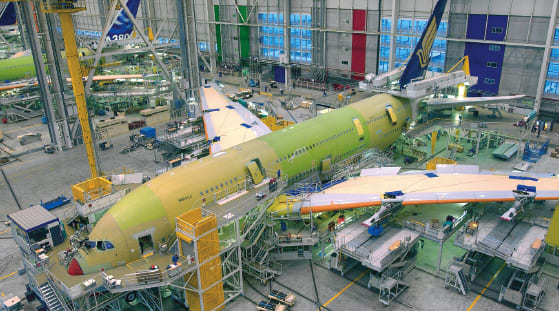
The new assembly facility at Toulouse will be capable of ramping up production rates from two to 10 aircraft a month. The A350 was originally to be a relatively modest upgrade of the A330- 200, but due to increased competition from Boeing’s all-new 787, Airbus started again from scratch calling it the A350 XWB (Extra Wide Body) to exploit improved engine efficiency and an all-new wing and fuselage with a wider cabin cross section.
Customers liked the changes and soon after launch, the sales total had climbed past the 500 mark and now has achieved over 800 firm sales. With five test flight prototype aircraft engaged in the certification procedure, the A350 has undergone hot-and-high as well as cold-soak trials, and the first aircraft fitted with seats and fully representative cabin systems is involved in long-haul flight tests.
Qatar Airways will be the first to take delivery before the end of this year and has ordered 80 A350s in two versions. Airbus currently offers the aircraft in three different sizes: -800, -900, and -1000, the latter designed to compete more directly with the 777.

Boeing’s 767 remains in production after 32 years, currently as a cargo aircraft since passenger sales were completed recently, but production of this model is to be concentrated in the future on the KC-46A military tanker variant for the U.S. Air Force.
The company faces a dilemma over how best to replace its 200-250 seat 757, which also dates from the 1980s but is long out of production. Boeing could shrink its 787-8, and this would offer a good long-range capability, but the economics of taking out seats and cargo capacity is usually an unattractive business proposition compared to stretching a design.
Another option for Boeing might be to further stretch the capacity of the 737-900 Max, but this would not offer the 4,000-5,000 mile range of the 757, and might require an engine thrust increase and further landing-gear modifications.
The 737 family seems to go from strength to strength, especially for a design that first emerged in 1964. Successive makeovers, aerodynamic changes, and re-engine upgrades have led to a continuous customer demand for the 737 lasting over half a century, a world record for a production jet airliner.

Both manufacturers once envisaged that new replacement designs would become available in the early 2020s, but such is the undiminished pace of demand for this pair of highly reliable and efficient people-movers, that there seems no prospect of any all-new replacement anytime soon. The rapid growth of low-cost carriers around the world has fueled demand for 150-seat aircraft and now this is being added to the need for replacements for earlier 737s and A320s, some of which may be over 25 years old.
To have sufficient customer appeal to break the 737/A320 market stranglehold, the next-generation designs will have to offer a really significant advance in performance in terms of fuel efficiency and environmental benefits. This will probably dictate unconventional aerodynamics with integrated powerplants.
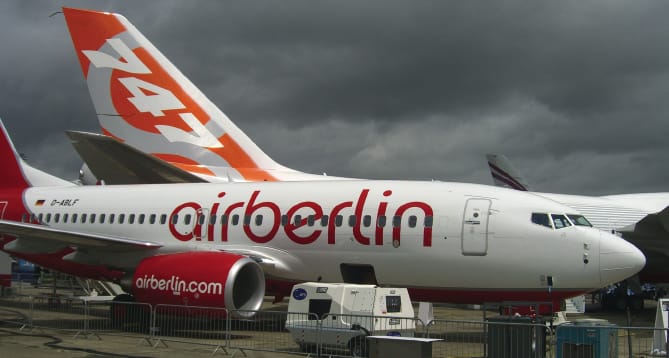
The Boeing 787 has overcome its earlier lithium battery problems and now the new stretched -9 is also rolling off the final assembly lines and about to enter commercial service with the first customer, Air New Zealand. The 787 represents a big step forward for Boeing, with such a large proportion of composite structure and an advanced wing design, which contribute to weight reduction resulting in its impressive long-range performance. The 787 covers the seat capacity range of between 250-320 seats, whereas Airbus’s A350 is slightly larger, offering between 270-350 seats.
Boeing faced a challenge in what to do to retain its market leadership with the high-capacity, long-range 777-300ER, which has sales of over 700 aircraft to date, so when it launched the new 777-X family last year, it had to offer a new product that would go beyond a mere upgrade. The resulting 777-8X and 777-9X feature an all new composite wing; new engine, the GE9X; and many cabin features taken from the 787.

With a maximum mixed class capacity of over 400 seats — approaching that of the much larger, thirstier, and heavier 747-400 — the popularity of the 777 as a jumbo replacement had already been proven. The Airbus A340, with its four engines, was promoted as the ultimate verylong- range airliner, with an added safety factor on lengthy over-water sectors, but such has been the reliability of the 777 and A330 big twins, that operating fourengine aircraft is no longer competitive.
Is Big Beautiful?
When Airbus made the case for its double-deck A380, there was a widespread belief in the airline community that while it looked like a natural 747 replacement, offering the potential in a stretched version for up to 1,000 seats, the most prudent course of action might be to “wait and see” before committing to such a leap in capacity.
With the subsequent market domination of long-haul routes by twin-engine widebody aircraft, the A380 has had to struggle at times to maintain a sales momentum since entering service in 2008, but today nearly 330 have been ordered and the backlog of around 200 aircraft yet to be delivered will keep the production lines busy for many years ahead.
The present A380 is well short of its ultimate design stretch limits and is flying with plenty of development potential ahead of it, but nevertheless is currently selling relatively slowly, as is Boeing’s relaunched super-jumbo, the 747-8. Once passenger capacity rises much above 600 seats, handling issues can arise at many airports, in terminals, and in parking slots, and this has discouraged airlines to press either company for even bigger versions of these aircraft.
In February this year, the Londonbased leasing company Amedeo ordered 20 A380s and is in discussion with Airbus with a view to fitting 11-abreast economy seating in a four-class configuration that would take a total of 600 passengers. Emirates is planning to fit 617 seats in a 10-abreast, two-class layout, while Russia’s Transaero is intending to fit out its A380s with 652 seats. In an all-economy layout, the standard A380 has certified sufficient exit doors so that it could accommodate over 800 seats.
The latest Boeing 777-X, which will be able to accommodate over 400 passengers, features increased wingspan with folding wing tips to try and avoid access and parking problems when docking at terminals, but whether this becomes a standard operating procedure remains to be seen. Ground handling a stretched A380 would challenge many airports.
Eastern Promise?

Plans for a new family of widebody Sino-Russian commercial jets are still under discussion and if built, will probably be assembled in China. Russian design input would include experience gained from its previous widebody Il-96 airliner, which was an A340 look-alike but was only produced in very small numbers with negligible export sales.
China would like to make the new widebody, known as the C929, a twin-engine aircraft. Its new narrow-body twin, the C919, falls into the same size category as the A320 family, which highlights the degree of ambition in China to establish a global aerospace capability, bearing in mind that the nation already assembles complete A320s at the Airbus plant in Tianjin in partnership with AVIC.
The first C919 is now in production and is due to make its first flight before the end of this year. Comac has been really struggling for years to bring its ARJ21 regional jet out of development through certification and into service in China, even though it is a very dated design, based on a long abandoned joint program with the U.S., which took the MD-95 as the baseline for the project.
Agreements have been signed between Comac and Bombardier that will see Canadian assistance on marketing and supporting the ARJ21, as well as deeper technical help and general promotional support on the C919 alongside Bombardier’s work on its new C Series 130-seat regional jet.
Big Regionals
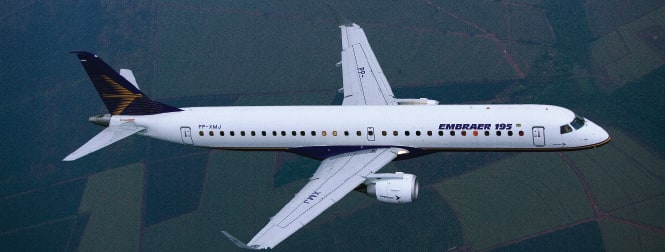
The aircraft has a high-tech specification with a very spacious interior and cockpit, with the latest displays and avionics. But in the face of massive competition from Embraer and Bombardier in global markets, the SSJ100 has had a hard time winning substantial orders, even though some 40,000 flight hours have now been achieved with all operators.
Bombardier has also been suffering from extended development delays on its all-new C Series. The C Series looks almost identical to the SSJ100 but is also being offered in a stretched version that could carry 149 passengers. This program has been a very expensive gamble for Bombardier, as it lifts its regional family of jets into a category that also competes with the lower end of the 737 and A320 families as well as the Embraer E-Series and SSJ100.
Delays have postponed the C Series’ scheduled entry into service until the second half of 2015, and it is now using four test aircraft to work toward clearance for the fly-by-wire system and certification next year. So far, just over 200 firm sales have been announced.
Even further delayed in development, Japan’s MRJ from Mitsubishi was originally offered as a “next-generation” regional jet featuring a structure with very high composite content and the “then-revolutionary” PW1200G geared turbofan engines. Years later, the program is still at the structural test stage, with first flight now scheduled for 2015.
While these delays have been significantly lengthening the development timescale of the MRJ, Embraer in Brazil has launched its new re-engined and rewinged E2 Series offering capacity from 175-120 seats. The high-aspect-ratio wing design promises to provide ultra-high performance, and with new cockpit and cabin features and P&W GTF engines, the E2 looks destined to take a lion’s share of this market over the next decade. It follows on from sales of more than 1,000 E175, E190, and E195 regional jets that makes it a leading contender in this sector.
More From SAE Media Group
Aerospace & Defense Tech Briefs
Fanjet Evolution — the Next Steps
Aerospace & Defense Tech Briefs
Europe's Aerospace Industry Looking Confident
Aerospace & Defense Tech Briefs
Let the Good Times Continue to Roll
Aerospace & Defense Tech Briefs
Industry Invited to Participate in AeroTech Aerospace and Defense Technical Program
Aerospace & Defense Tech Briefs
Boeing Completes Assembly of the First 777X
Aerospace & Defense Tech Briefs
Regional and Bizjets Refined and Redefined
Aerospace & Defense Tech Briefs
Powering On
Aerospace & Defense Tech Briefs
FAA, SAE International Focus on Engine Fire Protection System Standards for Aerospace
Aerospace & Defense Tech Briefs
Boeing’s Next EcoDemonstrator Test Bed Will Be a 777
Aerospace & Defense Tech Briefs
China to Require 7,400 New Aircraft Valued at $1T Through 2037
Aerospace & Defense Tech Briefs
Boeing Names New Environment, Health and Safety Leader
Aerospace INSIDER
How Aerospace Manufacturers are Adjusting to Ongoing Tariff Changes
Aerospace & Defense Tech Briefs
Early Growing Pains Have Not Stopped Pratt & Whitney’s GTF Engine Orders
Aerospace & Defense Tech Briefs
Flight Testing Microvanes and Riblets
Aerospace & Defense Tech Briefs
SAE International Extends Call for Abstracts, Seeks Submissions for AeroTech Conference
Aerospace & Defense Tech Briefs
Ceramic Matrix Composites in Aircraft Engines Projected to Double over Five Years, Stratview Research Predicts
Aerospace & Defense Tech Briefs
Maintaining the Data-Rich Pratt & Whitney GTF Engine
Aerospace & Defense Tech Briefs
Maintainers Design a $400 Maintenance Fixture to save the U.S. Air Force $500k per Year
Aerospace & Defense Tech Briefs
First Airbus A330-800 Airliner Goes Airborne in Maiden Flight, Enters Flight Test Phase
Aerospace & Defense Tech Briefs
Quality Management Experts Provide Guidance on AS9100 Standard, Equipment Calibration
Aerospace & Defense Tech Briefs
VISTARA Signs Contract with Airbus to Support A320 Fleet
Aerospace & Defense Tech Briefs
Mitsubishi Heavy Industries Will Acquire Bombardier’s Regional Jet Program
Aerospace & Defense Tech Briefs
New Boeing, Safran Joint Venture Dedicated to Developing Aircraft Auxiliary Power Units
Aerospace & Defense Tech Briefs
Air Mobility Innovations Take Center Stage at Aerospace Systems and Technology Conference
Aerospace & Defense Tech Briefs
Connected Aircraft Technologies Benefit Manufacturers, Airlines, and Travelers
Aerospace & Defense Tech Briefs
Boeing’s 777X Finally Gets Its Engines
Tech Briefs
How Jet Engine Flow Can Be Controlled Optically
Aerospace & Defense Tech Briefs
Parker Aerospace and GKN Aerospace to Develop Passive Cooling Solutions for Next-Generation Aircraft Engines

Top Stories
INSIDERManufacturing & Prototyping
 How Airbus is Using w-DED to 3D Print Larger Titanium Airplane Parts
INSIDERManned Systems
 FAA to Replace Aging Network of Ground-Based Radars
NewsTransportation
 CES 2026: Bosch is Ready to Bring AI to Your (Likely ICE-powered) Vehicle
NewsSoftware
 Accelerating Down the Road to Autonomy
EditorialDesign
 DarkSky One Wants to Make the World a Darker Place
INSIDERMaterials
 Can This Self-Healing Composite Make Airplane and Spacecraft Components Last...
Webcasts
Defense
 How Sift's Unified Observability Platform Accelerates Drone Innovation
Automotive
 E/E Architecture Redefined: Building Smarter, Safer, and Scalable...
Power
 Hydrogen Engines Are Heating Up for Heavy Duty
Electronics & Computers
 Advantages of Smart Power Distribution Unit Design for Automotive...
Unmanned Systems
 Quiet, Please: NVH Improvement Opportunities in the Early Design...
