




Aerospace & Defense Technology - August 2014
Inside this issue
Overview
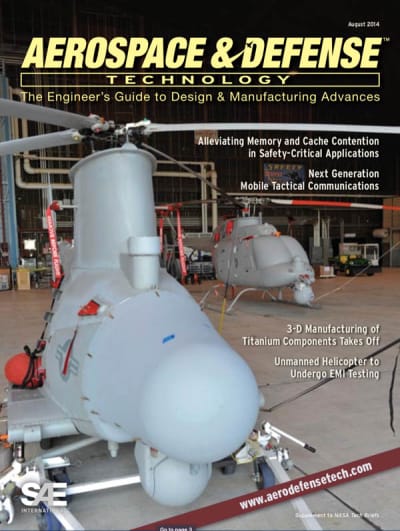
The August 2014 issue of Aerospace & Defense Technology presents a comprehensive overview of the latest advancements and innovations in the aerospace and defense sectors. This issue features a variety of articles that delve into critical topics, including mobile tactical communications, manufacturing technologies, and safety-critical applications.
One of the standout articles discusses the evolution of mobile tactical communications, particularly the integration of smartphones into military operations. The article highlights how military leadership is exploring ways to leverage the powerful capabilities of smartphones for enhanced situational awareness. Despite their potential, smartphones face challenges such as weak security and limited compatibility with military networks, which restrict their use in tactical communications. The current solution involves tethering smartphones to tactical radios, allowing for data transfer while relying on the radio for secure voice communication. The article advocates for the development of a next-generation mobile tactical communications solution that combines the strengths of smartphones with military-grade communication capabilities, aiming for a cost-effective solution that can be deployed to all soldiers.
Another significant topic covered in this issue is the advancements in 3-D manufacturing, particularly in the production of titanium components. The article outlines how 3-D printing technology is revolutionizing the manufacturing process, enabling the creation of complex geometries that were previously difficult or impossible to achieve with traditional methods. This technology not only reduces waste but also shortens production times, making it a valuable asset in the aerospace industry where precision and efficiency are paramount. The article discusses various applications of 3-D printing in aerospace, including the production of lightweight components that can enhance the performance of aircraft and spacecraft.
The issue also addresses the challenges of memory and cache contention in safety-critical applications. As systems become more complex and interconnected, ensuring reliable performance in safety-critical environments is essential. The article explores strategies for alleviating memory contention issues, which can lead to system failures or degraded performance. It emphasizes the importance of robust design practices and the implementation of advanced algorithms to manage memory resources effectively, ensuring that safety-critical applications can operate reliably under demanding conditions.
In addition to these key articles, the magazine features insights from industry experts and thought leaders, providing readers with a well-rounded perspective on current trends and future directions in aerospace and defense technology. The editorial team has curated a selection of case studies and technical briefs that showcase innovative solutions and best practices from leading organizations in the field.
The issue also includes a section dedicated to the latest products and technologies available in the market, highlighting advancements in materials, components, and systems that are shaping the future of aerospace and defense. This section serves as a valuable resource for professionals seeking to stay informed about the latest tools and technologies that can enhance their operations.
Overall, the August 2014 issue of Aerospace & Defense Technology serves as a vital resource for industry professionals, researchers, and enthusiasts alike. It provides a thorough examination of the challenges and opportunities facing the aerospace and defense sectors, emphasizing the importance of innovation and collaboration in driving progress. With its focus on cutting-edge technologies and practical applications, this issue is a must-read for anyone interested in the future of aerospace and defense.
Features
-
Application Briefs
-
Articles
Alleviating Memory and Cache Contention in Safety-Critical Applications
Next-Generation Mobile Tactical Communications
Commercial Programs Are Flying High
3-D Manufacturing of Titanium Components Takes Off
New Technique Could Make Sub-Wavelength Images at Radio Frequencies
Tech Briefs
-
Physical Sciences
Automatic-Alignment Fiber Optic Coupling System for Optimal Signal Transmission
Detecting Maritime Radiological/Nuclear Threats with Hybrid Imaging
Testing Particle Counters for Detection of Fuel Contamination
Products
Top Stories
INSIDERManufacturing & Prototyping
 How Airbus is Using w-DED to 3D Print Larger Titanium Airplane Parts
INSIDERManned Systems
 FAA to Replace Aging Network of Ground-Based Radars
NewsTransportation
 CES 2026: Bosch is Ready to Bring AI to Your (Likely ICE-powered) Vehicle
NewsSoftware
 Accelerating Down the Road to Autonomy
EditorialDesign
 DarkSky One Wants to Make the World a Darker Place
INSIDERMaterials
 Can This Self-Healing Composite Make Airplane and Spacecraft Components Last...
Webcasts
Defense
 How Sift's Unified Observability Platform Accelerates Drone Innovation
Automotive
 E/E Architecture Redefined: Building Smarter, Safer, and Scalable...
Power
 Hydrogen Engines Are Heating Up for Heavy Duty
Electronics & Computers
 Advantages of Smart Power Distribution Unit Design for Automotive...
Unmanned Systems
 Quiet, Please: NVH Improvement Opportunities in the Early Design...
Power

Similar Stories
ProductsDefense

ArticlesDefense
 Next-Generation Mobile Tactical Communications
BriefsPhysical Sciences
 Testing Particle Counters for Detection of Fuel Contamination
ProductsDefense

ArticlesAerospace
 3-D Manufacturing of Titanium Components Takes Off
Technology UpdateDefense
 Production of Satellite with First All-Electric Propulsion System Advances