




Next-Generation Mobile Tactical Communications
After many years of development and well-publicized budget overruns, the DoD’s Joint Tactical Radio System program (since reorganized and renamed) has recently given birth to a set of handheld voice and data radios — so-called Rifleman radios — built by a number of traditional military radio firms, including Exelis, GD, Harris, and Thales.
 Here are some key differences between a Rifleman radio and a modern smartphone:
Because of their scale, smartphones outpace tactical radios in processing power by a significant margin and at significantly lower production cost. Yet tactical radios require custom radio hardware and software for military environments that would never be of interest to smartphone manufacturers. Rifleman and its associated waveforms were designed strictly for a military combat environment, where robust push-to-talk voice operation is by far the highest priority.
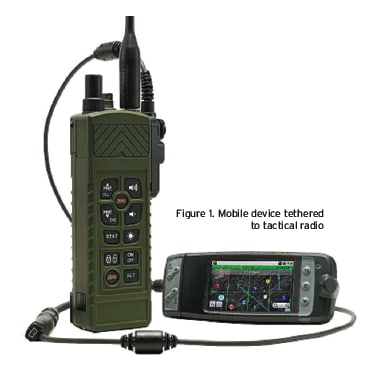
At an order of magnitude higher in price than a smartphone, governments do not have the budget to enable all field personnel with tactical radios. Today, tactical radio possession ends at the platoon, or at best, squad leader, leaving other team members devoid of the valuable capability.
A next-generation mobile tactical communications solution would ideally meld the tactical radio and modern smartphone worlds, creating a solution that enables:
- Powerful apps associated with modern mobile computing;
- Ability to communicate on military tactical networks; and
- Low cost, so every soldier can have one.

Two important recent technology revolutions are making this vision possible: NSA CSfC cryptographic solutions and mobile security powered by separation kernel-based hypervisors.
CSfC
Launched in 2012, the NSA’s Commercial Solutions for Classified (CSfC) program aims to leverage commercial off-the-shelf solutions to secure classified government networks and information. CSfC is a sharp change from the traditional approach of designing and building expensive government-purpose cryptographic communications equipment.
One of the key principles of CSfC is to implement multiple independent layers of commercial cryptographic products to replace a traditional, single-layer government cryptographic solution. For example, to send classified information over an open network (e.g. the Internet), the traditional government approach is to use a government-certified in-line encryptor, such as TACLANE or Talon. The encryptor contains specialized encryption hardware and software and undergoes a rigorous development and approval process (Type-1 NSA certification). Some Type-1 encryptors are orders of magnitude more expensive than commercial encryption products.
The individual products used in CSfC-composed solutions are developed for the larger commercial enterprise and therefore are much lower-cost and not dependent upon or subject to the same government funding and certification overhead used for traditional Type-1 systems. For example, a dual CSfC VPN solution might be composed of standard enterprise Cisco and open source StrongSwan products.
Separation Kernel-Based Hypervisors
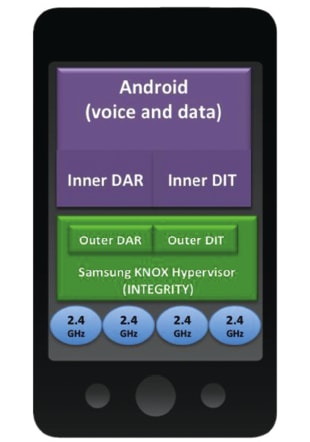
Commercial, off-the-shelf bare metal mobile hypervisors have been deployed in standard consumer smartphones and tablets for several years, and the USMC (via its Trusted Handheld, or TH2, program) recently took a leadership role in applying them to improve mission capability while reducing total cost of mobile computing for the government. Mobile hypervisors provide strong isolation between the mobile OS (e.g. Android) and other execution environments (e.g. security components or even a second Android instance) that must be protected even if the Android OS itself is vulnerable and exploited by malware or remote attacks.
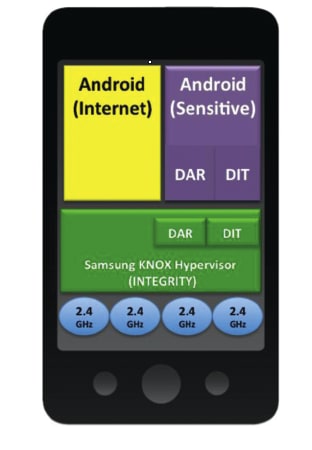
Samsung KNOX Hypervisor can host two mobile OS instances. Under the auspices of the TH2 program, this solution became the first commercial solution to be approved for simultaneous access to the open Internet as well as sensitive government networks (Figure 4), in late 2013.
Applying TH2 to Tactical Radio Communications
USMC recognized that Samsung KNOX Hypervisor provides an extensible execution environment for other critical processing. Developers from Green Hills are now working on an application of this environment to offload some of the tactical radio processing onto the powerful mobile device. The mobile device can then be conjoined with a reduced footprint tactical radio to create a single unit that has the power and flexibility of the modern smartphone or tablet, yet communicates seamlessly on traditional military tactical networks.
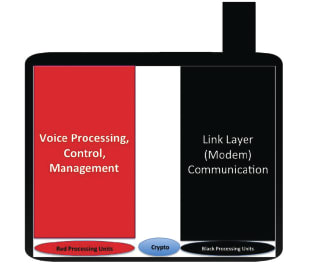
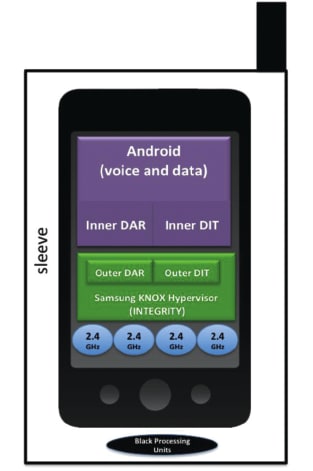
Figure 6 shows the notional concept of a scope and cost-reduced tactical radio, wherein only the black-side processing remains, and the red-side and cryptographic subsystems have been offloaded as additional software applications on the hypervisor-powered smartphone. Furthermore, because the radio hardware is so much simpler, it can be manufactured into a smaller, more flexible form factor, such as a sleeve or attachment on the smartphone itself, enabling the warfighter to carry them easily as a single unit. When the smartphone is connected to the sleeve, the smartphone’s built-in communications peripherals are disabled, and all communication is routed to the radio. Even push-to-talk voice can be handled by the smartphone, reducing the complexity of the radio and providing the warfighter with the most modern graphical interface and application environment possible.
This article was written by David Kleidermacher, Chief Technology Officer, Green Hills Software (Santa Barbara, CA). For more information, Click Here .
More From SAE Media Group
Aerospace & Defense Tech Briefs
Mil-Aero Design Embraces Intelligent Application-Ready ATCA Platforms
Aerospace & Defense Tech Briefs
Industry Invited to Participate in AeroTech Aerospace and Defense Technical Program
Aerospace & Defense Tech Briefs
In-Network Processing on Low-Cost IoT Nodes for Maritime Surveillance
Aerospace & Defense Tech Briefs
Secure Wireless Command Post
Aerospace & Defense Tech Briefs
Evaluating Key Certification Aspects of Multicore Platforms for Safety Critical Avionics Applications
Aerospace & Defense Tech Briefs
Tracking WiFi Signals to Passively See Through Walls
Aerospace & Defense Tech Briefs
Defeating Commercial Drone Threats with Open-Source SDR
Tech Briefs
Crew Activity Analyzer
Aerospace & Defense Tech Briefs
Open Standard Middleware Enables New HPEC Solutions
Aerospace & Defense Tech Briefs
Bio-inspired Airborne Infrastructure Reconfiguration (BioAIR)
Aerospace & Defense Tech Briefs
Pushing the Boundaries of RF Passive Hardware with Additive Manufacturing
Tech Briefs
Test Strategies to Track Hypersonic Threats
Aerospace & Defense Tech Briefs
The Future of Managing Mission-Critical Systems

Aerospace & Defense Tech Briefs
High-Performance Enclosure Systems for Aerospace and Defense Applications: Preparing for What’s Next
Aerospace & Defense Tech Briefs
CompactPCI Serial Space
Aerospace & Defense Tech Briefs
Quality Management Experts Provide Guidance on AS9100 Standard, Equipment Calibration
Aerospace & Defense Tech Briefs
Content Addressable Memory (CAM) Technologies for Big Data and Intelligent Electronics Enabled By Magneto-Electric Ternary CAM
Aerospace & Defense Tech Briefs
Electronic Warfare Development Targets Fully Adaptive Threat Response Technology
Aerospace Manufacturing and Machining INSIDER
Army Launches CMOSS Prototyping Competition for Computer Chassis and Cards
Aerospace & Defense Tech Briefs
How Thunderbolt 4 Helps Bring Fault-Tolerant, Distributed Systems to Market
Aerospace & Defense Tech Briefs
Clamoring for More Entertainment
Aerospace & Defense Tech Briefs
Critical Communications Break Out of the Analog Mold
Aerospace & Defense Tech Briefs
Achieving Performance Advantages in Unmanned Systems

Aerospace INSIDER
Aitech’s New Palm-Sized Satellite Enables Space-Based AI Processing

Aerospace & Defense Tech Briefs
How Miniaturized Distributed Modular Architecture Advances Avionics Design
Aerospace & Defense Tech Briefs
Software-Designed System Improves Wireless Test Speed and Coverage
Aerospace & Defense Tech Briefs
Protecting Critical Data on Unmanned Underwater Platforms
Top Stories
INSIDERManufacturing & Prototyping
 How Airbus is Using w-DED to 3D Print Larger Titanium Airplane Parts
INSIDERManned Systems
 FAA to Replace Aging Network of Ground-Based Radars
NewsTransportation
 CES 2026: Bosch is Ready to Bring AI to Your (Likely ICE-powered) Vehicle
NewsSoftware
 Accelerating Down the Road to Autonomy
EditorialDesign
 DarkSky One Wants to Make the World a Darker Place
INSIDERMaterials
 Can This Self-Healing Composite Make Airplane and Spacecraft Components Last...
Webcasts
Defense
 How Sift's Unified Observability Platform Accelerates Drone Innovation
Automotive
 E/E Architecture Redefined: Building Smarter, Safer, and Scalable...
Power
 Hydrogen Engines Are Heating Up for Heavy Duty
Electronics & Computers
 Advantages of Smart Power Distribution Unit Design for Automotive...
Unmanned Systems
 Quiet, Please: NVH Improvement Opportunities in the Early Design...
