




Autonomous Vehicle Engineering - March 2019
Inside this issue
Overview
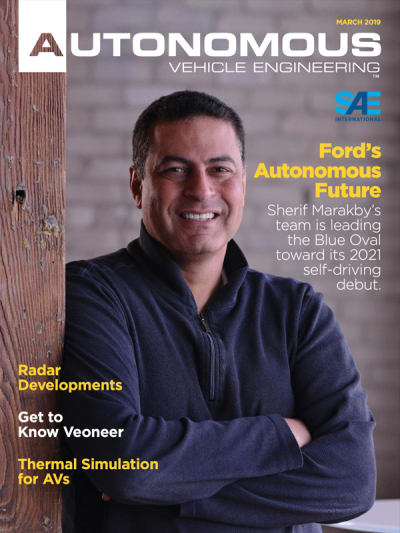
The March 2019 issue of Autonomous Vehicle Engineering marks a significant milestone as it transitions into a standalone publication, having previously been a supplement to SAE International’s Automotive Engineering. This issue reflects the growing demand for in-depth coverage of the engineering behind automated driving, showcasing a variety of topics that highlight the advancements and challenges in the field of autonomous vehicles (AVs).
Editorial Insights and Industry Perspectives
The editorial section, led by Bill Visnic, emphasizes the magazine's mission to serve as a platform for constructive dialogue among engineers and other stakeholders affected by the rise of automated driving technologies. The issue features an exclusive interview with Sherif Marakby, the CEO of Ford Autonomous Vehicles, who discusses Ford's ambitious plans to launch its self-driving vehicle by 2021. Marakby outlines the company's vision for integrating AVs into urban environments and the importance of collaboration with city planners and regulators to ensure successful deployment.
Technological Advancements
One of the key articles in this issue delves into the critical role of thermal analysis in the development of autonomous electric vehicles. As these vehicles rely heavily on advanced electronic systems, managing heat generation is essential for maintaining performance and safety. The article discusses various thermal management strategies and technologies that are being implemented to optimize the efficiency of AVs.
Another significant topic covered is the necessity of ultrahigh-definition (UHD) mapping for autonomous driving. The article explains how UHD maps provide detailed information about road conditions, traffic patterns, and potential obstacles, which are crucial for the safe navigation of AVs. The integration of these maps with real-time data from sensors allows for more accurate decision-making by the vehicle's control systems.
Radar Technology and Sensor Fusion
The issue also explores the evolving landscape of automotive radar technology. As AVs rely on a combination of sensors to perceive their environment, radar plays a vital role in detecting objects and measuring distances, especially in adverse weather conditions. The article highlights recent advancements in radar systems, including improved resolution and range, which enhance the vehicle's ability to operate safely in various scenarios.
Additionally, the importance of sensor fusion—combining data from multiple sensors such as cameras, lidar, and radar—is discussed. This approach allows for a more comprehensive understanding of the vehicle's surroundings, improving the reliability of the AV's perception system.
Legal and Ethical Considerations
The magazine does not shy away from addressing the legal and ethical challenges that accompany the adoption of autonomous vehicles. Regular contributor Jennifer Dukarski provides insights into the complex legal landscape surrounding AVs, including liability issues and regulatory hurdles. As AVs become more prevalent, understanding the legal implications of their operation will be crucial for manufacturers and consumers alike.
Empathy in Engineering
A thought-provoking piece emphasizes the need for engineers to cultivate empathy for the humans that AVs will serve. It argues that while technical proficiency is essential, understanding the human experience and addressing concerns related to safety, privacy, and trust are equally important in the development of autonomous driving systems. This perspective encourages engineers to consider the broader societal impacts of their work.
Future of Aerial Autonomy
The issue also touches on the future of aerial autonomy, discussing the potential for autonomous drones and air taxis. As these concepts gain traction, the article highlights the legal and regulatory challenges that must be addressed before widespread adoption can occur. The integration of aerial autonomy into existing transportation systems presents unique opportunities and obstacles that will require careful planning and collaboration among various stakeholders.
Conclusion
Overall, the March 2019 issue of Autonomous Vehicle Engineering provides a comprehensive overview of the current state of the autonomous vehicle industry. It covers a wide range of topics, from technological advancements and legal considerations to the importance of empathy in engineering. As the industry continues to evolve, this publication aims to be a trusted source of information and analysis, fostering dialogue among engineers, policymakers, and the public about the future of mobility.
With its focus on credible and balanced coverage, Autonomous Vehicle Engineering positions itself as an essential resource for anyone interested in the engineering and societal implications of autonomous driving technologies. The magazine's commitment to exploring the multifaceted challenges and opportunities presented by AVs reflects the dynamic nature of this rapidly advancing field.
Articles
-
The Navigator
-
Features
Computer-Generated Scenes Provide Virtual Testing for Autonomous Vehicles
Deere Touts Software, AI Tech at CES
Industry Remains Unsettled on Vehicle Connectivity Standard
New Automotive Radars Take Tech from a Blip to a Boom
Is the Future of Aerial Autonomy up in the Air?
Safety Testing for AVs Is Just Beginning
Top Stories
INSIDERAerospace
 How Airbus is Using w-DED to 3D Print Larger Titanium Airplane Parts
NewsAutomotive
 Microvision Aquires Luminar, Plans Relationship Restoration, Multi-industry Push
INSIDERManufacturing & Prototyping
 A Next Generation Helmet System for Navy Pilots
INSIDERDefense
 New Raytheon and Lockheed Martin Agreements Expand Missile Defense Production
ArticlesAR/AI
 Accelerating Down the Road to Autonomy
Road ReadyDesign

Webcasts
Automotive
 Advantages of Smart Power Distribution Unit Design for Automotive...
Unmanned Systems
 Quiet, Please: NVH Improvement Opportunities in the Early Design...
Defense
 Cooling a New Generation of Aerospace and Defense Embedded...
Power
 Battery Abuse Testing: Pushing to Failure
Power
 A FREE Two-Day Event Dedicated to Connected Mobility
