




Adas & Autonomous Vehicle Engineering - April 2023
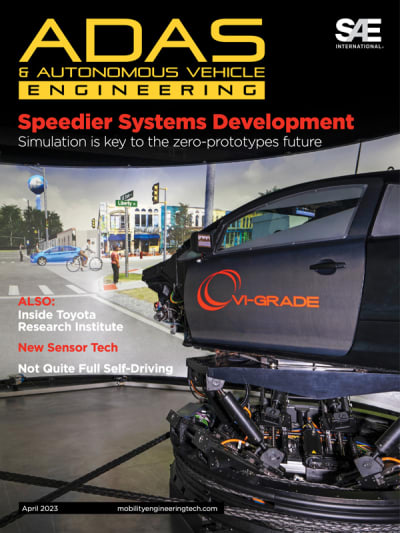
Inside this issue
Overview
The latest issue of ADAS & Autonomous Vehicle Engineering delves into the evolving landscape of advanced driver-assistance systems (ADAS) and autonomous vehicles (AVs), highlighting key technological advancements, industry challenges, and the ongoing discourse surrounding automated driving.
Editorial Insights: The editorial by Bill Visnic addresses the critical need for accountability in the automated driving sector. Prominent figures, including Kyle Vogt, CEO of Cruise, and GM CEO Mary Barra, emphasize the misleading nature of terms like "Full Self-Driving," which can confuse consumers about their responsibilities while using such technologies. U.S. Secretary of Transportation Pete Buttigieg also critiques the terminology used by companies like Tesla, pointing out the importance of clear communication regarding the limitations of automated systems.
Technological Advancements: The issue features a spotlight on driving simulators, such as VI-grade’s DiM250, which are revolutionizing ADAS and AV development. These simulators allow engineers to test environmental factors and real-world driving conditions without the risks associated with actual road testing. This innovation is crucial for refining automated systems and ensuring safety before deployment.
Industry Trends: The magazine discusses the increasing efficiency of electric vehicles (EVs) through enhanced computational capabilities. As the industry pushes towards greater automation, the integration of advanced computing technologies is essential for improving vehicle performance and extending range. The issue also covers the competitive landscape of onboard sensors, where a combination of technologies will be necessary to ensure safe operation in future vehicles.
Research and Development: A significant portion of the issue is dedicated to the Toyota Research Institute (TRI) and its mission to leverage artificial intelligence (AI) to address societal challenges. Gill Pratt, TRI's CEO, articulates the importance of simplifying complex topics related to AI and automation, fostering a better understanding among the public and stakeholders.
Call for Papers: The magazine announces a call for papers for an upcoming conference, inviting submissions on various topics, including composites in electric vehicles, additive manufacturing, and sustainable technologies. This initiative aims to encourage collaboration and knowledge sharing within the industry, with awards for the best papers presented during the event.
Challenges in the AV Sector: The issue does not shy away from discussing the challenges facing the AV industry, particularly in light of Tesla's recent recall of its Full Self-Driving Beta. This incident has raised concerns about the credibility of automated driving technologies and the potential impact on public perception. The editorial team stresses the importance of transparency and responsible marketing in maintaining consumer trust.
Future Directions: Looking ahead, the magazine emphasizes the need for a balanced approach to automation, where safety and consumer education are prioritized. As the industry continues to innovate, the integration of new technologies must be accompanied by clear communication about their capabilities and limitations.
In summary, this issue of ADAS & Autonomous Vehicle Engineering provides a comprehensive overview of the current state of the AV industry, highlighting both the technological advancements and the critical discussions surrounding safety, accountability, and consumer understanding. As the sector evolves, the insights shared in this publication will be invaluable for industry professionals, researchers, and policymakers alike.
Articles
-
The Navigator
Top Stories
INSIDERAerospace
 How Airbus is Using w-DED to 3D Print Larger Titanium Airplane Parts
NewsAutomotive
 Microvision Aquires Luminar, Plans Relationship Restoration, Multi-industry Push
INSIDERManufacturing & Prototyping
 A Next Generation Helmet System for Navy Pilots
INSIDERDefense
 New Raytheon and Lockheed Martin Agreements Expand Missile Defense Production
ArticlesAR/AI
 Accelerating Down the Road to Autonomy
Road ReadyDesign

Webcasts
Automotive
 Advantages of Smart Power Distribution Unit Design for Automotive...
Unmanned Systems
 Quiet, Please: NVH Improvement Opportunities in the Early Design...
Defense
 Cooling a New Generation of Aerospace and Defense Embedded...
Power
 Battery Abuse Testing: Pushing to Failure
Power
 A FREE Two-Day Event Dedicated to Connected Mobility
