




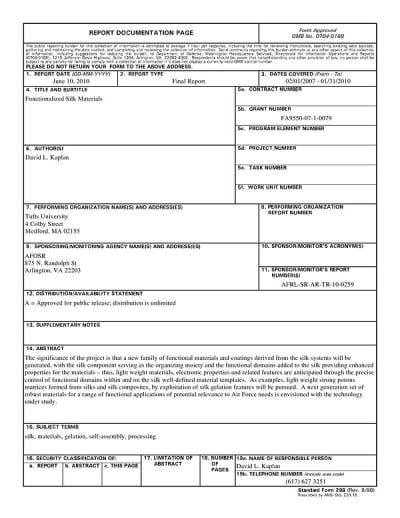
Functionalized Silk Materials
Silk protein-based material systems offer a unique combination of features potentially useful for a range of biosensors.
T he goal of this work was to exploit the novel structural, physical, and biological features of silk proteins towards functionalization of materials systems generated from this family of protein. A new generation of functional silk systems is sought to provide novel materials with precise control of material features. Three main directions were planned: (a) protein chimeras to form organic (silk) – inorganic nanocomposites; (b) formation of electronic materials using a similar design strategy, but based on enzymatic coupling reactions to form conducting polymers; and (c) continuing to understand and exploit novel processing approaches with these proteins towards new functional materials systems.
A new family of functional materials and coatings derived from the silk systems was generated, with the silk component serving as the organizing moiety and the functional domains added to the silk providing enhanced properties for the materials. Thus, lightweight materials, electronic properties, and related features are anticipated through the precise control of functional domains within and on the silk’s well-defined material templates. As examples, lightweight, strong, porous matrices formed from silks and silk composites, by exploitation of silk gelation features, were pursued.
New variations in the functional silk designs were prepared by bioengineering, with variants void of purification tags to allow better interpretation of structure-assembly relationships related to materials function, and new insight into self-assembly. By incorporating peptide sequences, identified by phage display, into silk, new materials that incorporate mineral binding, while retaining the useful functional properties of the silk, were attained.
A family of fusion proteins with silk and metal binding peptides was prepared via genetic engineering. The various structures were studied in solution and on surfaces with respect to metallization. In addition, ambient conditions were used for the control of silica morphology and distribution on the surface of silk films utilizing genetically engineered chimeric proteins. The silk component serves as an organic scaffold that controls material stability and allows multiple modes of processing. Si-derived nanostructures with strong morphological and spatial control are attractive in electronics, biosensors, microfluidic devices, and DNA microarray technology.
The design, construction, and characterization of a novel family of spider silk-like block copolymers were described. The design was based on the assembly of individual spider silk modules — in particular, polyalanine (A) and glycine-rich (B) blocks — that display different phase behavior in an aqueous solution. Spider silk was chosen as a model for these block copolymer studies based on its extraordinary material properties, such as toughness, biocompatibility, and biodegradability. In terms of morphology, spheres, rod-like structures, bowl-shaped micelles, and giant compound micelles were observed, and the morphologies were linked with the size of
the hydrophobic block, as well as the presence of the purification tag and solvent environment.
Unconventional material-processing and device-fabrication procedures were developed by combining silk with silicon nanomaterials to generate new flexible electronic devices. A technology of this type could result in applications for insertion of high-performance flexible electronics into implantable devices. For the fabrication process, single crystalline nanomembranes of silicon were used to construct transistors on ultrathin sheets of polyimide. Briefly, the doped silicon nanomembranes were transfer-printed onto a film of polyimide and then cast onto a thin sacrificial layer of polymethylmethacrylate (PMMA) on a silicon wafer for processing. After printing, a spin coating a layer of polyimide was used to encapsulate the active devices. Dry etching the polymer layers completed the fabrication of an array of isolated devices on PMMA, which was then dissolved with acetone to release the devices from the carrier wafer. These devices were lifted onto the surface of a transfer stamp of polydimethylsiloxane and then transfer-printed to a spun cast film of silk on a silicon substrate or a freestanding silk membrane.
All-aqueous processing of silk fibroin was accomplished into novel surface-nanopatterned protein materials. Control of this nanomorphology was exploited to optimize the optical features of these silk protein systems. Control of surface morphology was achieved down to 125 nanometers with fidelity over large length scales. This surface nanopatterning allows the silk protein to be formed into diffractive optics such as diffraction gratings, pattern generators, and lenses, due to novel aqueous processing into optically clear materials via control of beta sheet crystallinity. Further, biological components, such as hemoglobin and the enzyme peroxidase, were incorporated during the process of forming the silk diffraction gratings. The ambient processing of the silk protein in water, in combination with these bioactive components, allows these entrained molecules to retain activity and provide added functions and selectivity to the optically active silk films. Thus, combinations of biochemical and optical readout are feasible and are provided in a single, disposable/all degradable element with both spectral discrimination and biological function.
These new surface-nanopatterned, bioactive, silk protein-based material systems offer a unique combination of features potentially useful for a range of biosensor needs, particularly when considered in concert with the remarkable mechanical properties of these proteins, their biocompatibility, and controllable biodegradation.
This work was done by David L. Kaplan of Tufts University for the Air Force Office of Scientific Research. For more information, download the Technical Support Package (free white paper) at www.defensetechbriefs.com/tsp under the Materials category. AFRL-0178
This Brief includes a Technical Support Package (TSP).
Functionalized Silk Materials
(reference AFRL-0178) is currently available for download from the TSP library.
Don't have an account?
More From SAE Media Group
Medical Design Briefs
Transforming Plastic Parts into High-Value Products

Tech Briefs
A Lightweight Material Stronger than Steel
Photonics & Imaging Technology
Manufacturing Wafer-Level Optics Using UV Adhesives and Polymers
Medical Design Briefs
3D Printable Polymer Nanocomposite Ink
Aerospace & Defense Tech Briefs
Designing Sensory and Adaptive Composite Materials
Tech Briefs
Scaling Up Nano for Sustainable Manufacturing


Aerospace & Defense Tech Briefs
Cold Sprayed Coatings with Dual Nanoparticle Reinforcements for Wear and Corrosion Protection
Medical Design Briefs
Cohesive Circuit Protection for Wearable Electronics

Aerospace & Defense Tech Briefs
Novel Whisker Mitigating Composite Conformal Coat Assessment

Tech Briefs
Fabrication of Multilayer Ferritin Arrays
Tech Briefs
Janus Particles Improve Paints and Coatings
Tech Briefs
Precision CNT Cutting Mechanism
Medical Design Briefs
From Research to Diagnostics: Plasma Treatments Improve Quality, Function
Aerospace & Defense Tech Briefs
Outsourcing Plasma Treatments for Surface Modification
Tech Briefs
University of Pennsylvania School of Engineering
Air Force Research Laboratory Technology Horizons
Conductive Polymeric Nanocomposite Materials

Tech Briefs
3D-Printed Device Produces Nanofiber Meshes
Medical Design Briefs
Nontoxic, Flexible Energy Converters Could Power Wearable Devices
Tech Briefs
Miniscule Robots of Metal and Plastic
Overview
The document appears to be a report detailing research and development related to functionalized silk materials, specifically focusing on the synthesis and application of silk fibroin films and genetically engineered silk proteins. The research spans from February 1, 2007, to January 31, 2010, and is associated with the Air Force Labs.
Key highlights include:
-
Silk Protein Engineering: The report discusses the genetic engineering of spider silk proteins, particularly a combination of spider dragline silk and a peptide derived from diatoms. This genetic modification aims to create novel silk variants that can be utilized in various applications.
-
Silica Morphology Control: The research emphasizes the control of silica morphology and distribution on silk films. By manipulating ambient conditions, the team was able to synthesize 3D porous silica networks and silica nanoparticles, which are expected to have significant applications in electronics, biosensors, microfluidic devices, and DNA microarray technology.
-
Biomaterial Applications: The document outlines the potential applications of these silk-based biomaterials, including their use in biodopants and protein-silica nanocomposites. The ability to tailor mineral phase loading and morphologies synthetically allows for the alteration of biomaterial properties, enhancing their functionality.
-
Silk Degradation Studies: The report also covers the degradation mechanisms of the newly synthesized silk proteins, providing insights into the lifecycle of these materials. Understanding degradation is crucial for assessing the long-term stability and environmental impact of silk-based products.
-
Processing Methods: The document references various processing methods to control the features of silk fibroin films, which are essential for optimizing their performance in different applications.
-
Research Collaboration: The report indicates collaboration with various researchers and institutions, highlighting the interdisciplinary nature of the work, which combines materials science, biology, and engineering.
Overall, the document presents a comprehensive overview of innovative approaches to silk material development, focusing on genetic engineering, material processing, and potential applications in advanced technologies. The findings suggest that these silk-based materials could lead to significant advancements in various fields, including electronics and biotechnology, due to their unique properties and versatility.
Top Stories
INSIDERManufacturing & Prototyping
 How Airbus is Using w-DED to 3D Print Larger Titanium Airplane Parts
NewsAutomotive
 Microvision Aquires Luminar, Plans Relationship Restoration, Multi-industry Push
INSIDERAerospace
 A Next Generation Helmet System for Navy Pilots
INSIDERDesign
 New Raytheon and Lockheed Martin Agreements Expand Missile Defense Production
ArticlesAR/AI
 CES 2026: Bosch is Ready to Bring AI to Your (Likely ICE-powered) Vehicle
Road ReadyDesign

Webcasts
Semiconductors & ICs
 Advantages of Smart Power Distribution Unit Design for Automotive...
Unmanned Systems
 Quiet, Please: NVH Improvement Opportunities in the Early Design...
Electronics & Computers
 Cooling a New Generation of Aerospace and Defense Embedded...
Power
 Battery Abuse Testing: Pushing to Failure
AR/AI
 A FREE Two-Day Event Dedicated to Connected Mobility
