




Nonlinear, High-Fidelity, Aeroelastic Analysis for Novel Configurations
With multiple individually articulated sections, various wing geometries can be achieved in-flight, allowing for multirole missions with the same aircraft.
Efforts to develop morphing air vehicles with multiple mission capabilities have recently been undertaken by several research teams, including NASA’s Aircraft Morphing program and the Defense Advanced Research Projects Agency’s (DARPA) Morphing Aircraft Structures program. One such morphing wing structure is the folding wing concept. With multiple individually articulated sections, various wing geometries can be achieved in-flight, allowing for multirole missions with the same aircraft.
The folding wing system consists of three separate components: component A (fuselage), component B (inboard wing), and component C (outboard wing). Components A and B are attached through a hinge, which is modeled as a set of torsional springs at several points. Components B and C are also attached through a hinge, which is modeled as a set of torsional springs at several points. The hinge model is assumed to have negligible mass compared to the wing structure model. The initial folding angles between components A and B, and B and C are static equilibrium angles. These depend upon the initial unsprung wing folding angle and sprung deformation due to wing gravity.
Several parametric studies have been performed to assess the linear aeroelastic characteristics of generic folding wing configurations. The effect on aeroelastic stability of such parameters as inboard wing folding angle and hinge stiffness were investigated. Conclusions from these studies include: 1) a trend of increasing flutter dynamic pressure with increasing inboard wing folding angle; 2) higher sensitivity of flutter dynamic pressure with respect to outboard hinge stiffness as compared to the inboard hinge stiffness; and 3) morphing wing actuation energy depending on center of gravity position, Mach number, and wing sweep.
This work includes nonlinear effects in both the structural and aerodynamic models. Geometric nonlinearity in the structure is modeled using von Karman strains with Kirchhoff thin-plate theory, and the resulting nonlinear variational statement is discretized with a discrete Ritz basis computed using a combined finite-element/component synthesis analysis. The flow is modeled using a vortex lattice potential model, which accounts for the nonlinear tangent flow boundary conditions. Post-flutter limit-cycle results from the computational model are compared to those measured in experiment for three different outboard wing folding angle configurations.
A significant result from this study is the determination that both the experiment and computation show that differences in the limit cycle behavior do exist between the various folding wing angles. Also, based upon the calculations using a linear aerodynamic model, it appears that the nonlinear aerodynamic effects are smaller than the nonlinear structural effects for the cases studied.
This work was done by Earl H. Dowell, Deman Tang, and Peter Attar of Duke University for the Air Force Office of Scientific Research. For more information, download the Technical Support Package (free white paper) at www.defensetechbriefs.com/tsp under the Information Sciences category. AFRL-0170
This Brief includes a Technical Support Package (TSP).
Nonlinear, High-Fidelity, Aeroelastic Analysis for Novel Configurations
(reference AFRL-0170) is currently available for download from the TSP library.
Don't have an account?
More From SAE Media Group
Tech Briefs
Aerostructures Test Wing
Aerospace & Defense Tech Briefs
Some Advances in Reducing Drag and Suppressing Convection
Aerospace & Defense Tech Briefs
Generic Miniature Airplane for Research and Development
Aerospace & Defense Tech Briefs
SparkJet Actuators for Controlling Flows
Aerospace & Defense Tech Briefs
Approximating the Material Stresses and System Requirements for Hypersonic Flight
Tech Briefs
Flap Device for Airframe Noise Reduction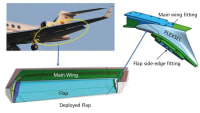
Motion Design
Variable-Camber Compliant Wing
Tech Briefs
UCF’s Hypersonic Technology Advances
Aerospace & Defense Tech Briefs
SAE International Extends Call for Abstracts, Seeks Submissions for AeroTech Conference


Aerospace & Defense Tech Briefs
Industry Invited to Participate in AeroTech Aerospace and Defense Technical Program
Tech Briefs
Control Derivatives of the F-18 Airplane

Aerospace INSIDER
New DARPA X-Plane Will Have No Moving Control Surfaces
Tech Briefs
Improved Fixed-Wing Gust Load Alleviation Device
Tech Briefs
Bio-Inspired Wing Design for Small Drones

Aerospace & Defense Tech Briefs
3D Optical Scanner
Tech Briefs
FoilSim: Software for Teaching About Airfoils
Tech Briefs
Tension Element Vibration Damping
Aerospace Manufacturing and Machining
Why Heat Exchanger Manufacturers Need to Rethink Design and Fabrication


Overview
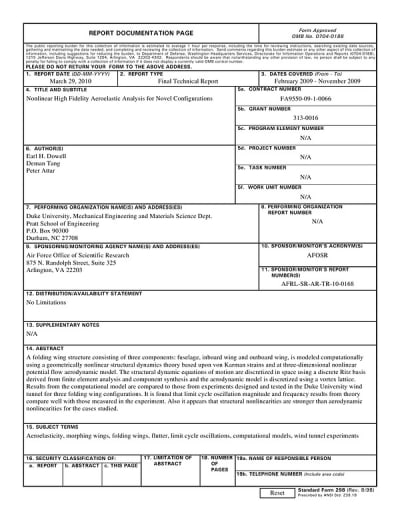
The document is a technical report titled "Nonlinear High Fidelity Aeroelastic Analysis for Novel Configurations," authored by Peter J. Attar, Deman Tang, and Earl H. Dowell from Duke University. It details a study conducted between February and November 2009, focusing on the aeroelastic behavior of a folding wing structure, which consists of three main components: the fuselage, inboard wing, and outboard wing.
The research employs a geometrically nonlinear structural dynamics theory based on von Kármán strains, coupled with a three-dimensional nonlinear potential flow aerodynamic model. This approach allows for a comprehensive analysis of the complex interactions between structural dynamics and aerodynamic forces in the context of morphing wing technologies.
The structural dynamic equations of motion are discretized using a discrete Ritz basis derived from finite element analysis and component synthesis. The aerodynamic model is discretized through a vortex lattice method. This combination of techniques enables the researchers to create a high-fidelity computational model that accurately represents the behavior of the folding wing structure under various conditions.
The report highlights the experimental validation of the computational model, comparing its results with data obtained from wind tunnel tests conducted at Duke University. The findings indicate that the theoretical predictions of limit cycle oscillation (LCO) magnitude and frequency align well with the experimental measurements. This suggests that the model is effective in capturing the essential dynamics of the folding wing configurations.
Additionally, the study reveals that structural nonlinearities have a more significant impact than aerodynamic nonlinearities for the cases examined. This insight is crucial for the design and optimization of morphing wing structures, as it emphasizes the importance of considering structural behavior in the analysis of aeroelastic phenomena.
Overall, the report contributes valuable knowledge to the field of aeroelasticity, particularly in the context of innovative wing designs that can adapt to varying flight conditions. The research findings have implications for future developments in aerospace engineering, particularly in enhancing the performance and efficiency of aircraft through advanced wing configurations.
Top Stories
INSIDERManufacturing & Prototyping
 How Airbus is Using w-DED to 3D Print Larger Titanium Airplane Parts
INSIDERManned Systems
 FAA to Replace Aging Network of Ground-Based Radars
NewsTransportation
 CES 2026: Bosch is Ready to Bring AI to Your (Likely ICE-powered) Vehicle
NewsSoftware
 Accelerating Down the Road to Autonomy
EditorialDesign
 DarkSky One Wants to Make the World a Darker Place
INSIDERMaterials
 Can This Self-Healing Composite Make Airplane and Spacecraft Components Last...
Webcasts
Defense
 How Sift's Unified Observability Platform Accelerates Drone Innovation
Automotive
 E/E Architecture Redefined: Building Smarter, Safer, and Scalable...
Power
 Hydrogen Engines Are Heating Up for Heavy Duty
Electronics & Computers
 Advantages of Smart Power Distribution Unit Design for Automotive...
Unmanned Systems
 Quiet, Please: NVH Improvement Opportunities in the Early Design...
