




Generic Miniature Airplane for Research and Development
Designs of micro aerial vehicles can now be compared more systematically.
The Air Force Research Laboratory has promulgated the geometrical design of a miniature airplane denoted the Generic Micro Aerial Vehicle (GENMAV). This design is intended to serve as a baseline for analyses of geometrical designs of other micro aerial vehicles (MAVs). As such, the GENMAV design is meant to be distributed openly among organizations engaged in research and development pertaining to MAVs. The need for the GENMAV or a similar standard of comparison has become more acute in recent years because of the increasing interest in the use of MAVs [a subset of uninhabited aerial vehicles (UAVs)] for diverse purposes, especially in military, law-enforcement, and rescue activities.

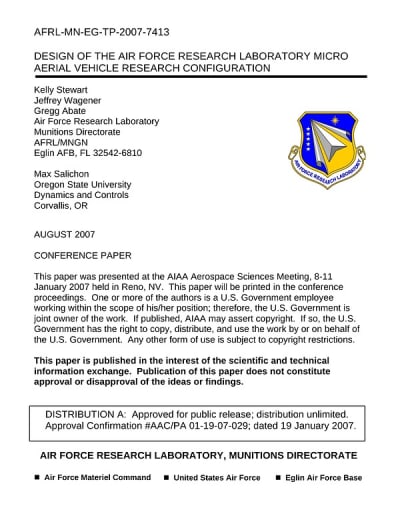
The GENMAV (see figure) features a high wing configuration, a fuselage having a circular cross section, and a conventional tail. The overall length of the fuselage is 17.00" (43.18 cm); the wingspan is 23.77" (60.38 cm). The circular cross section of the fuselage was chosen over other cross sections to facilitate analysis of its aerodynamic characteristics. Although the design at the present stage of development does not include a specification for an engine and a propeller, it is assumed that a tractor propeller is located at the front end of the fuselage and that the center line of the engine and propeller coincides with the center line of the fuselage.
The GENMAV wings are characterized by a thin airfoil configuration and a planform that are modified versions of those of a prior MAV design. The wings have a positive dihedral angle of 7° and are oriented at an angle of incidence of 5°. A saddle structure makes a smooth transition between the wings and the fuselage. The tail assembly features conventional horizontal and vertical stabilizers. The conventional tail configuration facilitates analysis in that many established methods for predicting aerodynamic effects of actuation of tail control surfaces are based on this configuration. The chord lengths of the rudder and elevator are approximately 25 percent of tip chord lengths of their respective stabilizers. The rudder and elevators lie parallel to their respective trailing edges.
An initial estimate of the aerodynamic characteristics of the GENMAV was made by use of an aeroprediction computer code that implements a vortex lattice method. At the time of reporting the information for this article, wind-tunnel testing of a prototype GENMAV was in progress. It is planned to do a more thorough analysis of the aerodynamics of the GENMAV, utilizing results of both wind-tunnel tests and computational simulations. It is also planned to perform flight tests of the prototype GENMAV. Data from initial flight tests are to be recorded and analyzed to define maximum and minimum airspeeds and to characterize the handling qualities of the GENMAV in roll, pitch, and yaw. Further flight tests are to be performed to document the flying qualities of the GENMAV. Data from the flight tests are to be used to establish a control point, to which modified versions of the MAV can be compared. Data from the flight tests can also be used to validate a six degree of freedom simulation currently under development.
This work was done by Kelly Stewart, Jeffrey Wagener, and Gregg Abate of the Air Force Research Laboratory and Max Salichon of Oregon State University.
AFRL-0051
This Brief includes a Technical Support Package (TSP).
Generic Miniature Airplane for Research and Development
(reference AFRL-0051) is currently available for download from the TSP library.
Don't have an account?
More From SAE Media Group
Aerospace INSIDER
New DARPA X-Plane Will Have No Moving Control Surfaces
Tech Briefs
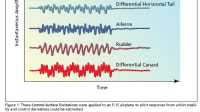
Control Derivatives of the F-18 Airplane
Tech Briefs
Flap Device for Airframe Noise Reduction
Motion Design
Variable-Camber Compliant Wing
Motion Control Tech Briefs
Conformably Stowable Canard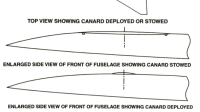
Tech Briefs
UCF’s Hypersonic Technology Advances
Tech Briefs
Improved Fixed-Wing Gust Load Alleviation Device
Tech Briefs
Probe Without Moving Parts Measures Flow Angle
Test & Measurement INSIDER
NASA Tests Shape-Changing Wing for Next-Generation Aviation
Aerospace & Defense Tech Briefs
Designing a High-Speed Decoy Unmanned Aerial Vehicle (UAV)
Aerospace & Defense Tech Briefs
Advanced Assembly Solutions for the Airbus RACER Joined-Wing Configuration
Tech Briefs
Bio-Inspired Wing Design for Small Drones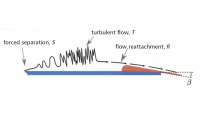
Air Force Research Laboratory Technology Horizons
Blended Wing Body Aircraft
Aerospace INSIDER
NASA Tests Aircraft Wing Coatings that Slough Bug Guts
Tech Briefs
Flying Robot Mimics Rapid Insect Flight
Aerospace & Defense Tech Briefs
SAE International Extends Call for Abstracts, Seeks Submissions for AeroTech Conference
Aerospace & Defense Tech Briefs
3D Optical Scanner
Tech Briefs
Aerostructures Test Wing
Tech Briefs
Winglet with Injected Flow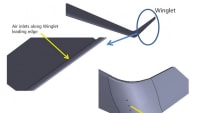

Aerospace & Defense Tech Briefs
Industry Invited to Participate in AeroTech Aerospace and Defense Technical Program
Tech Briefs
Outer Aileron Yaw Damper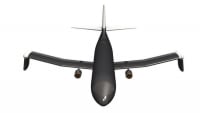
Motion Control Tech Briefs
Tip Fences for Reduction of Lift- Generated Airframe Noise
Tech Briefs
Flipperons for Improved Aerodynamic Performance

Aerospace & Defense Tech Briefs
Approximating the Material Stresses and System Requirements for Hypersonic Flight
Tech Briefs
Spanwise Adaptive Wing
Tech Briefs
Hinge Design Helps Quadrotors Climb
Overview
The document titled "Design of the Air Force Research Laboratory Micro Aerial Vehicle Research Configuration" is a conference paper authored by Kelly Stewart, Jeffrey Wagener, Gregg Abate from the Air Force Research Laboratory, and Max Salichon from Oregon State University. It was presented at the AIAA Aerospace Sciences Meeting held from January 8-11, 2007, in Reno, Nevada.
The paper focuses on the design and development of micro aerial vehicles (MAVs), which are small, unmanned aircraft that can perform various missions, including surveillance, reconnaissance, and environmental monitoring. The research aims to enhance the capabilities of MAVs, making them more effective for military and civilian applications.
The authors discuss the technical challenges associated with MAV design, including issues related to aerodynamics, control systems, and payload capacity. They emphasize the importance of optimizing these factors to improve flight performance and mission effectiveness. The paper outlines the methodologies used in the design process, including simulations and experimental testing, to validate the performance of the MAV configurations.
Additionally, the document highlights the collaborative nature of the research, showcasing the partnership between the Air Force Research Laboratory and Oregon State University. This collaboration aims to leverage academic expertise in dynamics and controls to advance the development of MAV technologies.
The paper also addresses the implications of MAV research for future military operations, particularly in terms of enhancing situational awareness and reducing risks to personnel. By providing a platform for real-time data collection and analysis, MAVs can significantly improve decision-making processes in various operational scenarios.
The authors conclude by underscoring the potential of MAVs to revolutionize aerial operations and the ongoing need for research and development in this field. They express hope that the findings will contribute to the broader scientific and technical community, facilitating further advancements in unmanned aerial systems.
Overall, the document serves as a significant contribution to the understanding of micro aerial vehicle design and its applications, reflecting the commitment of the U.S. Government and academic institutions to foster innovation in aerospace technology. The paper is approved for public release, ensuring that the information is accessible for further research and development in the field.
Top Stories
INSIDERManufacturing & Prototyping
 How Airbus is Using w-DED to 3D Print Larger Titanium Airplane Parts
INSIDERManned Systems
 FAA to Replace Aging Network of Ground-Based Radars
NewsTransportation
 CES 2026: Bosch is Ready to Bring AI to Your (Likely ICE-powered) Vehicle
NewsSoftware
 Accelerating Down the Road to Autonomy
EditorialDesign
 DarkSky One Wants to Make the World a Darker Place
INSIDERMaterials
 Can This Self-Healing Composite Make Airplane and Spacecraft Components Last...
Webcasts
Defense
 How Sift's Unified Observability Platform Accelerates Drone Innovation
Automotive
 E/E Architecture Redefined: Building Smarter, Safer, and Scalable...
Power
 Hydrogen Engines Are Heating Up for Heavy Duty
Electronics & Computers
 Advantages of Smart Power Distribution Unit Design for Automotive...
Unmanned Systems
 Quiet, Please: NVH Improvement Opportunities in the Early Design...
