




Shortwave Infrared Sensors: A New Way to See
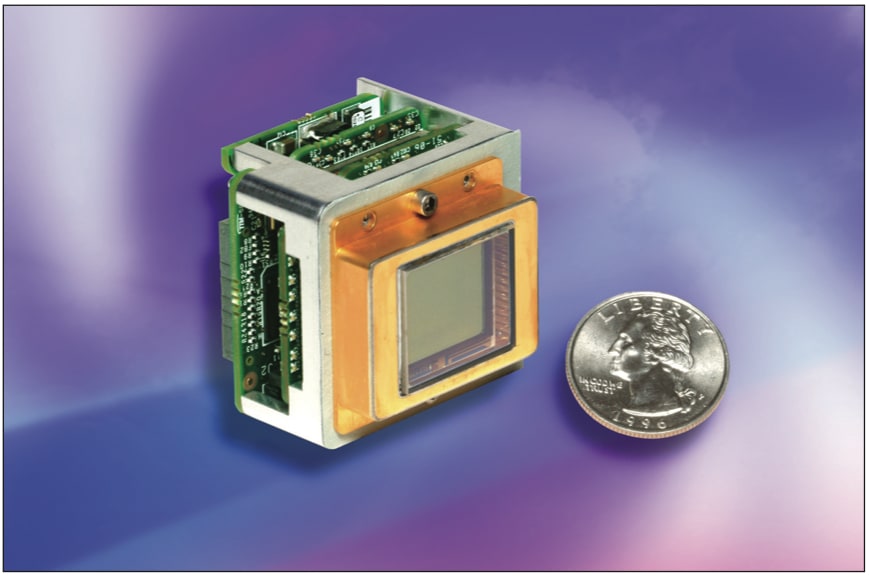
Compact, lightweight, and uncooled imaging sensors are fueling a revolution in intelligence, surveillance, and reconnaissance (ISR). They are the key enablers for a powerful new breed of sophisticated, small, unmanned aerial systems (UAS) and man-portable sensor systems. Very capable small UAS can work from lower-altitude vantage points and still remain undetectable. With their smaller sensor payloads, they are a fraction of the cost, and still produce uncompromised results. Uncooled indium gallium arsenide (InGaAs) shortwave infrared (SWIR) and longwave infrared (LWIR) thermal microbolometers have been primary enablers in this imaging revolution.
SWIR light bridges the spectral gap between the visible and thermal bands. SWIR imagers detect reflected light, offering more intuitive, visible-like images. SWIR light propagates longer distances undistorted and scatter-free than does shorter-wavelength visible light, so it is better suited for imaging in adverse environments and weather conditions including fog, dust, and smoke. SWIR imagers can also see in low light conditions, and use eyesafe 1550-nm illumination, totally undetectable by regular night vision equipment. Most importantly, InGaAs SWIR imagers can see all the lasers on the battlefield, a capability lacking in other night vision technologies. SWIR imagers generate digital video outputs and offer more dynamic range than traditional image intensifier night vision equipment.
LWIR imagers, on the other hand, see thermal emissions, making them excellent for detecting hot targets such as people or vehicles. LWIR imagers can see in very dark conditions when there is not sufficient light available for other night vision technologies to see anything. Thermal imagers operate at even longer wavelengths than SWIR, sometimes providing better obscuration penetration, but not during dawn and dusk transitions. Capturing shadows and contrast in reflected light is characteristic of SWIR images, and makes interpretation intuitively easier than with thermal images. SWIR imagery offers an essential complement to thermal imagery for positive target identification.
Hinted SWIR Imagery
No single sensor modality works best in all scene variations, but combining complementary features of multiple sensing modalities through image fusion comes closest. Image fusion is a process of combining video streams from multiple sensors into a single composite video stream in real time without losing contrast or resolution. The complementary combination of LWIR for detection and SWIR for positive identification enables potential threats to be triaged at greater ranges and in more weather conditions and environments than each sensor is capable of doing alone.
SWIR imagers work primarily with reflected light, in contrast to thermal imagers. In very-low-light-level conditions at night under no moon or even on heavily overcast days, there can be times when contrast with the background is insufficient for good detection of people. Hinted SWIR™ from Goodrich is a variant of image fusion in which a primary grayscale SWIR scene is complemented with colorized thermal hints provided by an uncooled LWIR microbolometer. Figures 2 and 3 show examples of Hinted SWIR imagery, where, for example, important low-light-level illuminated scene detail from the SWIR sensor forms a contextual background for thermally active target highlights detected with the LWIR sensor.

Hinted SWIR works particularly well in cold, wet, overcast urban night scenes like the one depicted in Figure 2. It is the highly complementary nature of the SWIR and thermal image components that makes the Hinted SWIR image so powerful. The representative individual SWIR and LWIR component images are shown in Figures 2a and 2b, respectively, illustrate how each one contributes synergistically to the complete Hinted SWIR image in Figure 2c.
In the NIR/SWIR component image in Figure 2a, there is rich scene contextual detail, but it is not easy to pick out the presence of a person in the distance since there is little contrast between the person and the wooded backdrop. In the corresponding thermal component image in Figure 2b, the person stands out in sharp contrast to the background; however, many very important scene contextual clues such as the presence of several cars (most of which have been sitting there for many hours), are lost.

In the urban night theater of operation, adverse weather and lighting challenge traditional single-sensor systems. Hinted SWIR combines the best of SWIR and LWIR imaging modes to bridge the capability gaps of each sensor mode alone. Detecting, identifying, tracking, and targeting become easier with Hinted SWIR. The warfighter benefits from the richer information content of a Hinted SWIR video stream by not having to switch focus between separate sensor displays. Relationships between scene features rendered differently by the individual sensor modalities stand out clearly in a single co-registered display. The thermal component enables hot objects such as people and vehicles to stand out and be detected, while the SWIR imager adds visible-like details, sees lasers, and sees through glass. The blended imagery enhances the ability to see further through obscurants. One of the tactical advantages of SWIR cameras is the ability to image laser sources used in military equipment for the purpose of marking, tagging, pointing, and designating targets.
InGaAs SWIR imager technology that is more sensitive, more compact, lighter in weight, and with lower power consumption will make up the next generation. Most recently, the Defense Advanced Research Projects Agency (DARPA) Dual Mode Detector Ensemble (DUDE) program currently under development by DRS Technologies, Goodrich, and Duke University, builds on the DARPA PCAR and MISI forerunners, and targets the development of a composite sensing focal plane consisting of a vertical stack of an LWIR microbolometer-sensing layer precisely co-registered with an underlying SWIR focal-planearray sensing layer. This intimate integration of SWIR and LWIR imagers will exploit common electronics and a single broadband optic that will result in unprecedented size, weight, and power
consumption savings. This technology will pave the way for more powerful capabilities on even smaller UAS, and enable true parallax error-free image fusion. Goodrich is rapidly evolving more capable small UAS sensors, micro-gimbals and payloads, and UAV flight management aids to serve the DoD customer.
This article was written by Dr. David G. Dawes, manager of business development for DoD applications at Sensors Unlimited-Goodrich Corp., Princeton, NJ. For more information, Click Here .
More From SAE Media Group
Aerospace & Defense Tech Briefs
Designing COTS Optics Into Defense Projects
Aerospace & Defense Tech Briefs
Calibrated Long-Wave Infrared (LWIR) Thermal and Polarimetric Imagery of Small Unmanned Aerial Vehicles (UAVs) and Birds

Aerospace & Defense Tech Briefs
New Technique Could Make Sub-Wavelength Images at Radio Frequencies
Aerospace & Defense Tech Briefs
Analysis of Broadband Metamaterial Shielding for Counter-Directed Energy Weapons
Aerospace & Defense Tech Briefs
High-Energy Laser Weapon Systems
Tech Briefs
Drones Use Machine Learning to Detect Landmines
Aerospace & Defense Tech Briefs
Integration of Adaptive Optics Into High-Energy Laser Modeling And Simulation
Aerospace & Defense Tech Briefs
Beam Propagation Model Selection for Millimeter-Wave Directed Energy Weapons
Aerospace & Defense Tech Briefs
Nonlinear Effects in Transformation Optics-Based Metamaterial Shields for Counter Directed Energy Weapon Defense
Aerospace & Defense Tech Briefs
Panoramic Thermal Imaging Technology
Photonics & Imaging Technology
Space-Based Hyperspectral Imaging
Aerospace & Defense Tech Briefs
Counter-Directed Energy Weapons: Defense of Air Assets
Medical Design Briefs
Improving Mid-Infrared Imaging and Sensing

Aerospace & Defense Tech Briefs
MUSHER Demonstrates Manned-Unmanned Aircraft Teaming Applications

Aerospace & Defense Tech Briefs
Unmanned Aerial Systems Electromagnetic Induction Sensor Development
Aerospace & Defense Tech Briefs
Nominal High-Altitude Electromagnetic Pulse (HEMP) Waveforms
Aerospace & Defense Tech Briefs
Coating Technology Enables Effective Missile Countermeasures
Aerospace & Defense Tech Briefs
Physics-Guided Neural Network for Regularization and Learning Unbalanced Data Sets
Aerospace & Defense Tech Briefs
Air Force Technology Tracks “Sporadic E”
Aerospace & Defense Tech Briefs
Designing for the Connected Battlespace
Aerospace & Defense Tech Briefs
Defeating Commercial Drone Threats with Software Defined Radio
Photonics & Imaging Technology
Micro-Cameras Bring New Video Applications into Focus
Tech Briefs
Air Force Research Laboratory
Photonics & Imaging Technology
Military Optics Technology
Aerospace & Defense Tech Briefs
Directed-Energy System to Defeat Small Unmanned Aircraft System Swarms
Aerospace & Defense Tech Briefs
Optimal UAS Assignments and Trajectories for Persistent Surveillance and Data Collection from a Wireless Sensor Network
Top Stories
INSIDERDesign
 How Airbus is Using w-DED to 3D Print Larger Titanium Airplane Parts
NewsSensors/Data Acquisition
 Microvision Aquires Luminar, Plans Relationship Restoration, Multi-industry Push
INSIDERManned Systems
 A Next Generation Helmet System for Navy Pilots
NewsAR/AI
 Accelerating Down the Road to Autonomy
INSIDERDefense
 New Raytheon and Lockheed Martin Agreements Expand Missile Defense Production
ArticlesAR/AI
 CES 2026: Bosch is Ready to Bring AI to Your (Likely ICE-powered) Vehicle
Webcasts
Semiconductors & ICs
 Advantages of Smart Power Distribution Unit Design for Automotive...
Unmanned Systems
 Quiet, Please: NVH Improvement Opportunities in the Early Design...
Electronics & Computers
 Cooling a New Generation of Aerospace and Defense Embedded...
Automotive
 Battery Abuse Testing: Pushing to Failure
Transportation
 A FREE Two-Day Event Dedicated to Connected Mobility
