




Eccentric Mounting and Adjustment System for Belt-Driven Devices
This system properly tensions drive belts for automotive applications.
This design relates to an eccentric mounting and adjustment (EMA) system for belt driving, or for belt-driven devices, that is installed and operated within the restricted confines of an engine compartment, typically a motor vehicle. It satisfies two essential requirements for automotive devices driven by an endless flexible belt, including a reliable mounting to the engine block assembly, and a continuous provision of a proper amount of tension to the belt for either driving or driven devices. As a result, there is minimal wear and tear on device bearings and the belt, which reduces operational failures and assures maximum efficiency for these devices.
The system includes a housing fixed to the engine, a socket rotatable in pawl-and-ratchet fashion within the housing, and a socket aperture eccentrically disposed relative to the socket’s axis. The aperture receives the belt-engaging component, whereby rotation of the socket moves the component to adjust belt tension.
This innovation allows any flexible belt of the armed forces’ inventory to be readily removable, installable, and adjustable by a single person using the simplest of tools, such as a large screwdriver, a pair of pliers, or an elongated rod of about 0.5" in diameter. Thereby, former frustrations and expenses involving special tools or fasteners, which can be lost or misplaced, are avoided. Moreover, minimal force and exertion are expended.
This invention does not significantly modify or depart from standard procedures currently being used by motor pools for maintaining belts, drives, and driven devices. For example, electrical connections are easily made by using a simple bayonet or coaxial connector, that in form resembles the ends of modern “jumper cables” employed by the U.S. military, such that positive and negative poles are axially symmetrical. Similarly, connections for mechanical or hydraulic systems are just as easily made by conventional methods at the rear of this invention.
For military vehicles, belt performance is critical with regard to the tension that is maintained on them. With use, the belts can become loose and full torque is not easily transmitted to the driven devices. Thereafter, the belts can slip and become more damaged. If the belts are too tight, excessive wear can result in the bearing assemblies of the driving or driven devices as well as causing belt shredding or separation, which impacts operating efficiency. An eccentric adjustment and mounting system is useful for belt-engaging engine components such as alternators or water pumps.
This work was done by David N. Hansen for the Army Research Laboratory. For more information, download the Technical Support Package (free white paper) at www.defensetechbriefs.com/tsp under the Mechanics/Machinery category. ARL-0091
This Brief includes a Technical Support Package (TSP).
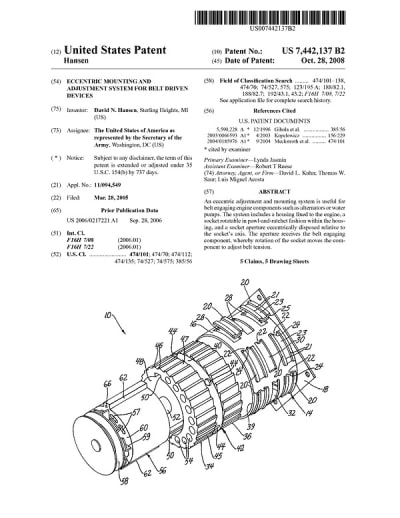
Eccentric Mounting and Adjustment System for Belt-Driven Devices
(reference ARL-0091) is currently available for download from the TSP library.
Don't have an account?
More From SAE Media Group
Off-Highway Engineering
Schaeffler Optimizes Rolling Bearings for Hydraulic and Axle Drives
Motion Design
Gear Bearings
Aerospace & Defense Tech Briefs
SAE International Extends Call for Abstracts, Seeks Submissions for AeroTech Conference
Aerospace & Defense Tech Briefs
Using Electromagnetic Brakes to Keep Thrust Reversers IN PLACE
Automotive Engineering
New Ampere EV Motor Aims for Power, Torque Benchmarks
Motion Design
Making Automotive Assembly Lines Safer
Aerospace & Defense Tech Briefs
Industry Invited to Participate in AeroTech Aerospace and Defense Technical Program
Off-Highway Engineering
Liebherr Reveals ‘Hybrid’ CFRP Cylinders and Parallel-Pump Concept
Tech Briefs
Quick Disconnect for High-Pressure Mate/De-Mate
Tech Briefs
Chemically Driven Wheels “Morph” Into Gears
Motion Design
Valves for Pneumatic Cylinders and Actuators
Medical Design Briefs
Mechatronic Integration for Precision Medical Device Linear Motion

Motion Design
Torque Limiters 101: Benefits, Types, and Comparisons

Aerospace & Defense Tech Briefs
Hydraulic Thermal Bypass Valve

Automotive Engineering
Schaeffler Heads Back to CES with New Acquisition, Capabilities
Aerospace & Defense Tech Briefs
Biaxial and Shear Testing Apparatus With Force Controls
Motion Design
The Fundamentals of Applying Electrohydraulic Valves
Motion Design
Conical, Floating-Piston Isolation Valve

Tech Briefs
Products of Tomorrow
Aerospace Manufacturing and Machining
Changing How the Aerospace Industry Makes Parts
Overview
The document titled "Eccentric Mounting and Adjustment System for Belt Driven Devices," authored by David N. Hansen, presents an innovative approach to the mounting and adjustment of belt-driven devices. The report, dated October 28, 2008, is associated with the U.S. Army RDECOM-TARDEC and is approved for public release, indicating its relevance to military and industrial applications.
The primary focus of the document is on the design and functionality of an eccentric mounting system that allows for precise adjustments in the alignment and tension of belt-driven devices. This system addresses common challenges faced in the maintenance and operation of such devices, which are widely used in various mechanical applications, including automotive and industrial machinery.
The eccentric mounting system is designed to facilitate easier adjustments without the need for extensive disassembly of the equipment. This innovation can significantly reduce downtime during maintenance, enhance operational efficiency, and improve the overall performance of belt-driven systems. The report likely includes detailed descriptions of the system's components, operational principles, and potential applications, although specific technical details are not provided in the excerpt.
Additionally, the document includes information about the public reporting burden associated with the collection of information, emphasizing the importance of efficient data management in research and development processes. It also mentions the approval of the report by the Office of Management and Budget (OMB), ensuring compliance with federal regulations regarding information collection.
Overall, this report contributes to the field of mechanical engineering by presenting a practical solution to enhance the functionality and reliability of belt-driven devices. The eccentric mounting and adjustment system represents a significant advancement that could lead to improved maintenance practices and operational efficiencies in various industries. The document serves as a valuable resource for engineers, researchers, and industry professionals interested in innovative mechanical solutions.
Top Stories
INSIDERManufacturing & Prototyping
 How Airbus is Using w-DED to 3D Print Larger Titanium Airplane Parts
INSIDERManned Systems
 FAA to Replace Aging Network of Ground-Based Radars
NewsTransportation
 CES 2026: Bosch is Ready to Bring AI to Your (Likely ICE-powered) Vehicle
NewsSoftware
 Accelerating Down the Road to Autonomy
EditorialDesign
 DarkSky One Wants to Make the World a Darker Place
INSIDERMaterials
 Can This Self-Healing Composite Make Airplane and Spacecraft Components Last...
Webcasts
Defense
 How Sift's Unified Observability Platform Accelerates Drone Innovation
Automotive
 E/E Architecture Redefined: Building Smarter, Safer, and Scalable...
Power
 Hydrogen Engines Are Heating Up for Heavy Duty
Electronics & Computers
 Advantages of Smart Power Distribution Unit Design for Automotive...
Unmanned Systems
 Quiet, Please: NVH Improvement Opportunities in the Early Design...
