




MEMS-Based Optical Limiter
This device can aid in the protection of optical sensors and detectors, and in protection against flares or laser beams directed as countermeasures against the sensor system.
Protecting optical sensors and detectors against excessive input signals is not only important for dealing with unintentional overloads, but also central for protecting sensors against intentional high-intensity sources such as flares or laser beams directed as countermeasures against the sensor system. In prior work, a microelectromechanical system (MEMS)-based, all optically driven deformable mirror was designed and fabricated. In this work, an optical limiter using this optically addressed, deformable mirror is proposed and designed.
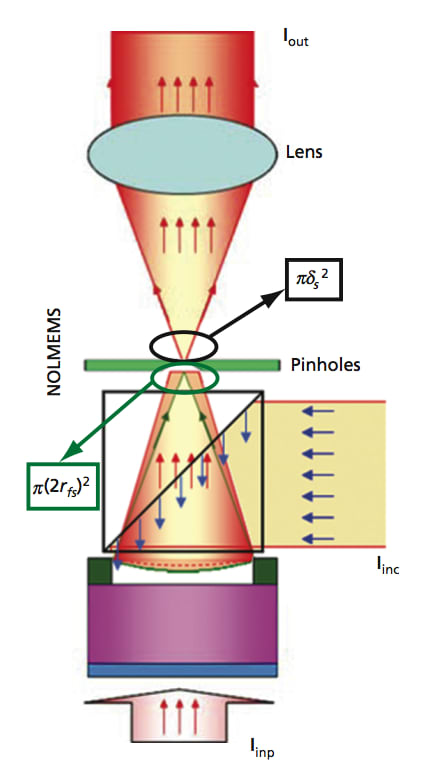
Several operating mechanisms of this device have been described before and include: DC bias, DC bias accompanied by AC light modulation, and a combination of AC and DC biases. In the DC bias operating mechanism, the device de flects in a binary fashion. In the AC light modulation with the DC bias mode, it is possible to control the impedance only in a non-steady-state situation. This suggests that this operating mechanism is suitable for moving targets or similar situations where only response to transient events is desired. In very-high-frequency AC light modulation, it is possible to control the impedance between the membrane and substrate under both transient and steady-state conditions, while a combination of AC and DC provides further control of the heterojunction capacitance between the transparent ZnO electrode and substrate. For the last three operating mechanisms it was found, both experimentally and theoretically, that the membrane deflection saturates as a function of the back illumination intensity. Both the saturable deflection of the membrane and the parabolic form of this deformation are used to create a MEMS optical limiter, focused in particular on using the very-high-frequency AC bias operating mode.
This work was done by Jed Khoury and Charles L. Woods of the Air Force Research Laboratory; Bahareh Haji-saeed and John Kierstead of Solid State Scientific Corp; and William D. Goodhue of the University of Massachusetts. AFRL-0128
This Brief includes a Technical Support Package (TSP).
MEMS-Based Optical Limiter
(reference AFRL-0128) is currently available for download from the TSP library.
Don't have an account?
More From SAE Media Group
Sensor Technology
Better LIDAR in Autonomous Systems Starts with MEMS
Photonics & Imaging Technology
This MEMS Scanning Mirror Could Solve LiDAR’s Expensive Autonomous Vehicle Challenges
Aerospace & Defense Tech Briefs
Miniature Snapshot Multispectral Imager
Sensor Technology
2021 Supplier Guide: Sensors
Sensor Technology
Seeables and Hearables for Fitness Feedback
Electronics & Sensors INSIDER
Careful Heating Unlocks Unprecedented Sensitivity to Pressure in Semiconductor Materials
Autonomous Vehicle Engineering
A Solution for Ice-Free Sensors
Sensor Technology
MEMS — Smart Sensors for the IoT
Tech Briefs
New on the Market

Tech Briefs
Optical Pointing Sensor
Photonics Tech Briefs
Optically Driven Deformable Mirrors
Tech Briefs
5 Ws of 3D-Printed MEMS
Aerospace & Defense Tech Briefs
Curled RF MEMS Switches For On-Chip Design
Photonics Tech Briefs
Curved Piezoelectric Actuators for Stretching Optical Fibers
Aerospace & Defense Tech Briefs
Uncooled Tunable LWIR Microbolometers

Power Electronics INSIDER
The Battery Powering a Truly Green Revolution in Personal Electronics
Tech Briefs
Inductive Non-Contact Position Sensor
Sensor Technology
MEMS-Based Inertial Switch for Event Detection
Autonomous Vehicle Engineering
Velodyne Preps for Volume Lidar
Aerospace & Defense Tech Briefs
Damping Measurement for Wafer-Level Packaged MEMS Acceleration Sensors
Medical Design Briefs
EIT-Based Tactile Sensor
Photonics & Imaging Technology
Compact MEMS-Based NIR Spectroscopy for Mobile Applications

Tech Briefs
Synapse-Like Phototransistor


Overview
The document presents a research paper focused on the design and theoretical analysis of a MEMS (Micro-Electro-Mechanical Systems) based optical limiter, which utilizes a deformable mirror to control light intensity. The primary objective of the study is to develop a device that can effectively limit the intensity of light, thereby protecting sensitive optical components from damage due to excessive illumination.
The paper begins by introducing the concept of the optical limiter, which is based on a parabolic-shaped deformable mirror. This mirror reflects focused light, and the design incorporates a pinhole aperture to control the transmitted light. The authors derive a nonlinear transfer function that relates the intensity of the reflected light to the intensity of the back illumination. This relationship is crucial for understanding how the device operates under varying light conditions.
Key parameters influencing the performance of the optical limiter are discussed, including the substrate carrier concentration and the photo-generated carrier concentration. The paper provides a mathematical expression that describes the photo-generated carrier concentration as a function of the incident light intensity. The absorption coefficient, carrier lifetime, and light frequency are also considered in the analysis.
The results indicate that as the intensity of the incident light increases, the device reaches a saturation point where the total reflected light intensity stabilizes. This saturation behavior is illustrated through a plot of the device's response to varying light intensities, demonstrating the effectiveness of the optical limiter in preventing damage from high-intensity light.
The conclusion emphasizes the significance of the proposed MEMS-deformable-mirror optical limiter design, highlighting its potential applications in adaptive optics and nonlinear optical signal processing. The architecture and theoretical framework developed in this study are tailored for integrated photoconductive-based systems operating with high-frequency AC bias, showcasing the innovative approach taken by the researchers.
Overall, the document provides a comprehensive overview of the design, theoretical underpinnings, and expected performance of a MEMS-based optical limiter, contributing valuable insights to the field of optoelectronics and adaptive optics. The research is a collaborative effort involving multiple institutions and is approved for public release, ensuring that the findings can benefit a wider audience in the scientific community.
Top Stories
INSIDERLighting Technology
 Using Ultrabright X-Rays to Test Materials for Ultrafast Aircraft
INSIDERDesign
 New 3D-Printable Nanocomposite Prevents Overheating in Military Electronics
INSIDERUnmanned Systems
 F-22 Pilot Controls Drone With Tablet
INSIDERDesign
 F-35 Proves Nuke Drop Performance in Stockpile Flight Testing
INSIDERAR/AI
 Algorithms for Autonomous Marine Vehicles
INSIDERTest & Measurement
 NASA’s Quiet Supersonic Demonstrator Jet Completes First Flight
Webcasts
Energy
 SAE Automotive Engineering Podcast: Additive Manufacturing
Aerospace
 A New Approach to Manufacturing Machine Connectivity for the Air Force
Software
 Optimizing Production Processes with the Virtual Twin
Power
 EV and Battery Thermal Management Strategies
Energy
 How Packet Digital Is Scaling Domestic Drone Battery Manufacturing
Automotive
 Advancements in Zinc Die Casting Technology & Alloys for Next-Generation...