




Microfabrication and Testing of a Thermoelectric Device for Generating Mobile Electrical Power
This technology can be used to power robotics, enable portable/wearable power, and provide power from vehicle waste heat energy.
Several attractive features of thermo-electric (TE) technology include no moving parts, light weight, modularity, covertness, silence, high power density, low amortized cost, and long service life with no required maintenance. Many of the potential uses for mounted/ dismounted power, such as recharging batteries, are therefore ideal for TE technologies. However, these applications will require more interconnected, smaller-scale modular devices than are currently available. Most commercial off-the-shelf (COTS) TE devices are optimized for cooling, not for generating power, so new device structures with materials and geometries better optimized for power generation are needed for broader use of TE technologies.

The PbTe and Sb2Te3 TE legs were polished to a specular finish to reduce uncertainty in geometry and thus, reduce measurement error. Each sample had similar geometries: 0.40 cm in length, 0.25 cm in width, and 0.10 cm in depth. All geometrical dimensions were measured using a micrometer thickness gauge, which yields measurements that are accurate to about 2%.
The metal junctions of the device were fabricated from oxygen-free copper stock so that the contribution to the total electrical resistivity from the hot and cold junctions is negligible. Further, the thermal conductivity is significantly better in copper than either of the semiconductors, so the junctions remain isothermal. To maintain permanent electrical isolation between the different sections of the TE module, the metal junctions were mounted on a thin square aluminum nitride (AlN) platen having an area of 6.25 cm2.
The components are shown in the figure at the various stages of assembly. In (A), the large copper heat sink, the AlN top isolation with serpentine trace, one of the metal junctions (positioned next to the copper heat-sink), and one of the Sb2Te3 components (positioned next to the length scale) are shown. In (B), the PbTe and Sb2Te3 components are shown fully integrated with copper hot-junctions permanently mounted to the top AlN isolator. Between that and the length scale are the three copper cold-junctions permanently mounted onto the bottom AlN isolator.
To proceed with the “flip-chip” assembly, a special mechanical x-y translation stage was designed to accurately manipulate and strategically position the hot-junction onto the cold junctions permanently mounted onto the copper heat sink. Once in position, the metallurgical junctions were formed by application of pressure and heat. Fabricated in this way, the obtained device shown in (C) is mechanically rugged and fully operational.
The initial characteristics of the device were determined immediately after assembly. The device’s total electrical resistance was experimentally found to be 0.432 Ω and remained stable throughout thermal testing. The resistivity of the oxygen-free copper is 1.7 × 10⁻⁶ Ω-cm, so the contribution to the total device resistance from the sum of the resistance from all six copper junctions is more than almost five orders of magnitude less than that from the semiconductor materials, so the dominant contributions would be only from the semiconductors, and potentially from the average contact resistance, Rc.
For higher-temperature tests, the device was mounted in a vacuum system to prevent oxidation of the materials and reduce error from convective heat flow. Two type-K thermocouples were used to independently determine the temperature hot-junction at the top of the device, and a third thermocouple was used to measure the temperature of the cold-junction on the large heat sink on the bottom.
To test the device for power generation, the hot-junction was heated radiatively by a 30 W “HotWatt” electrical power resistor. The resistor was not in contact with the TE device so as to minimize thermal mass. The output power was measured from the two braided copper terminals (shown in C in the figure). To assure that the device had reached a steady-state temperature difference, the range of temperature difference was slowly scanned from ΔT = 0 to 100 K. To normalize this electrical power to the area from which it was generated, the cross-sectional area of all the elements of the device was calculated and the power density was determined.
The high power density also points to the utility of this technology for producing even more highly miniaturized and integrated state-of-the-art power sources. Because this fabrication assembly yields low contact resistance, it can be scaled to microscopic dimensional scales consistent with integrated circuits (ICs) and micro electromechanical systems (MEMS). Such a demonstration would show excellent potential for providing power for auton omous microsystems, robotics, and portable/wearable power for mounted/dismounted units. Although this device is not perfectly impedance-matched, its performance under thermal testing is excellent and can be used to qualify its potential for power generation in more realistic applications. One application could be to provide electrical power from the waste heat energy from vehicles that would otherwise be dissipated and lost to the environment.
This work was done by Patrick J. Taylor, Brian Morgan, and Bruce Geil of the Army Research Laboratory; and Nibir K. Dhar of the Defense Advanced Research Projects Agency (DARPA). ARL-0055
This Brief includes a Technical Support Package (TSP).
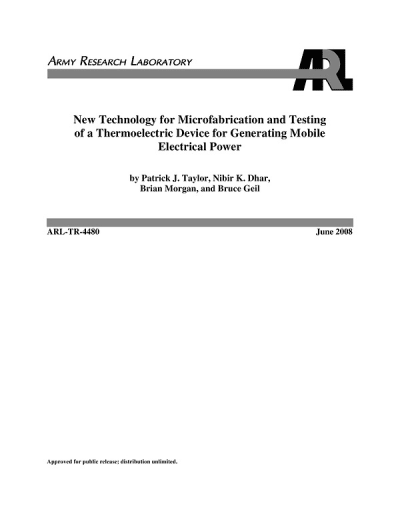
Microfabrication and Testing of a Thermoelectric Device for Generating Mobile Electrical Power
(reference ARL-0055) is currently available for download from the TSP library.
Don't have an account?
More From SAE Media Group
Automotive Engineering
Getting a Grip on EV Fasteners

Aerospace & Defense Tech Briefs
Physics-Guided Neural Network for Regularization and Learning Unbalanced Data Sets
Electronics & Sensors INSIDER
Fast Low-Cost Sensor Prototyping for Wearable Technology
Power Electronics INSIDER
An Electrifying Improvement in Copper Conductivity
Aerospace & Defense Tech Briefs
Shielding Aerospace Systems from Electromagnetic Interference
Aerospace & Defense Tech Briefs
Molded RF Materials for Hypersonic Sensors and Seekers
Electronics & Sensors INSIDER
Making Cheaper Biocompatible E-Skin Electrodes
Aerospace & Defense Tech Briefs
Designing for Space and Other Extreme Environments
Electronics & Sensors INSIDER
An Electronic Fiber for Stretchable Sensing
Power Electronics INSIDER
Highly Conductive Aluminum Can Equal Copper

Medical Design Briefs INSIDER
Product Demonstration: Live Demonstrations Showcase Heat Sealing Processes
Medical Design Briefs
Summer 2022 Resource Guide
Aerospace & Defense Tech Briefs
3D Printing Metal Parts on a Ship
Electronics & Sensors INSIDER
Researchers Devise Efficient, Scalable Process for Fabricating MXene Films That Block Electromagnetic Interference
Defense INSIDER
Air Force Scientists Discover Unique Stretchable Conductor


Medical Design Briefs
Winter 2021 Resource Guide
Aerospace & Defense Tech Briefs
Portable 3D Printing Factory

Aerospace & Defense Tech Briefs
Exploring High-Performance Applications for Distributed Transport Property Thermoelectrics
Tech Briefs
A Novel Way to Convert Heat to Electricity
Medical Design Briefs INSIDER
Liquid Metal Circuits Enable Flexible, Self-Healing Wearables
Medical Design Briefs INSIDER
Product Launch: Micro Component Group Unveils 2026 Application-Led PCE Agenda
Electronics & Sensors INSIDER
3D Printing of Organic Electronics

Medical Design Briefs
Winter 2022 Resource Guide
Medical Design Briefs
Nontoxic, Flexible Energy Converters Could Power Wearable Devices
Overview
The document titled "New Technology for Microfabrication and Testing of a Thermoelectric Device for Generating Mobile Electrical Power" presents research conducted by Patrick J. Taylor, Nibir K. Dhar, Brian Morgan, and Bruce Geil, under the auspices of the U.S. Army Research Laboratory. The report, dated June 2008, focuses on advancements in the microfabrication and testing of thermoelectric devices, which are crucial for generating electrical power in mobile applications.
The introduction outlines the significance of thermoelectric devices, which convert temperature differences into electrical energy, making them ideal for portable power generation. The report emphasizes the need for improved efficiency and reliability in these devices to meet the demands of modern military and civilian applications.
The experimental section details the materials characterization and assembly processes used in developing the thermoelectric devices. It highlights innovative techniques that enhance the performance and scalability of these devices, addressing challenges associated with traditional fabrication methods.
Results are presented in terms of device characteristics, showcasing the performance metrics achieved during testing. Elevated temperature testing is discussed, providing insights into how the devices perform under various thermal conditions, which is critical for their application in real-world scenarios.
The discussion section delves into the implications of the findings, exploring the path toward realistic applications of thermoelectric devices. It outlines the potential for chip-level assembly, which could lead to more compact and efficient power generation solutions. The authors also address the significance of their work in the context of energy sustainability and the growing need for portable power sources.
The report concludes with a summary of the key findings and their relevance to future research and development in thermoelectric technology. It emphasizes the importance of continued innovation in microfabrication techniques to enhance the performance and applicability of thermoelectric devices.
Overall, the document serves as a comprehensive resource for understanding the advancements in thermoelectric device technology, providing valuable insights for researchers, engineers, and stakeholders interested in mobile power generation solutions. The findings are approved for public release, ensuring that the information can contribute to broader discussions and developments in the field.
Top Stories
INSIDERDefense
 New Raytheon and Lockheed Martin Agreements Expand Missile Defense Production
NewsAutomotive
 Ford Announces 48-Volt Architecture for Future Electric Truck
INSIDERManufacturing & Prototyping
 Active Strake System Cuts Cruise Drag, Boosts Flight Efficiency
ArticlesTransportation
 Accelerating Down the Road to Autonomy
INSIDERMaterials
 How Airbus is Using w-DED to 3D Print Larger Titanium Airplane Parts
Road ReadyTransportation

Webcasts
Electronics & Computers
 Cooling a New Generation of Aerospace and Defense Embedded...
Power
 Battery Abuse Testing: Pushing to Failure
Connectivity
 A FREE Two-Day Event Dedicated to Connected Mobility
Automotive
 Quiet, Please: NVH Improvement Opportunities in the Early Design Cycle
Transportation
 Advantages of Smart Power Distribution Unit Design for Automotive &...
Aerospace
 Sesame Solar's Nanogrid Tech Promises Major Gains in Drone Endurance