




Accelerating Down the Road to Autonomy
Commercial success of the autonomous truck may be closer than we think.

The last half decade has brought the best of times and worst of times for the commercial autonomous truck sector. While some perceived pillars of this technology have fallen, others have continued to carry the weight of bringing driverless trucks closer to commercialization.
Consolidation was inevitable given the volume of speculative investment that brought a tidal wave of capital to various startups. Even so, some industry experts and Wall Street investors wondered if the autonomous truck sector might collapse entirely.
Starsky Robotics was the first notable name to fail in 2020, followed by Embark in 2023. The latest to crumble was Luminar Technologies, a supplier of lidar sensors. The company lost its supply contract with Volvo and announced in late 2025 that it had entered Chapter 11 liquidation.
However, for every financial failure, there have been successes. In May 2025, Aurora announced the successful launch of its commercial self-driving trucking service in Texas. Aurora’s trucks began completing regular driverless customer deliveries between Dallas and Houston, making Aurora the first company to operate a fully autonomous commercial service with heavy-duty trucks on public roads. Last fall, International and PlusAI announced they were advancing the commercialization of Level 4 autonomous trucks built on the NVIDIA DRIVE AGX Hyperion platform. International states that its trucks would begin to utilize PlusAI’s SuperDrive virtual driver technology to enable production-ready autonomous trucks for large-scale freight operations.
Daimler Truck and Torc Robotics announced in December they had selected Innoviz Technologies as lidar supplier for series production of SAE Level 4 autonomous trucks. Innoviz’s lidar technology will be integrated into autonomous Freightliner Cascadia models in combination with Torc’s virtual driver as one of several key components enabling L4 autonomous trucking.
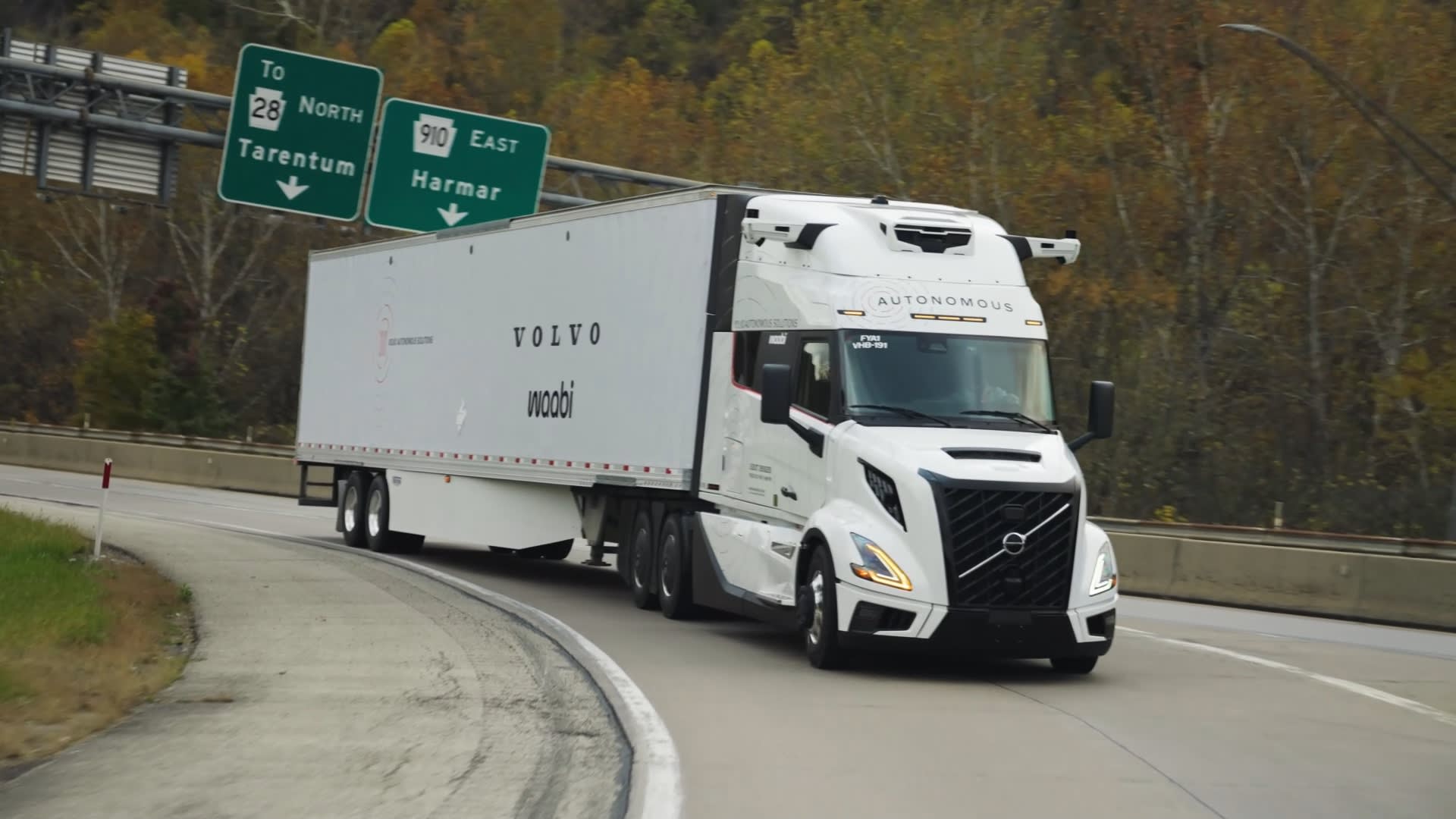
Canadian-based physical AI firm Waabi also announced in the fall of 2025 that its partnership with Volvo Autonomous Solutions reached a major milestone by successfully integrating the Waabi Driver with a Volvo VNL Autonomous truck.

Waabi states that its driver is “the only interpretable and verifiable end-to-end AI model that is capable of true generalization, enabling it to safely and quickly scale autonomous driving across different geographies, including highways and general surface streets.”
The dawn of driverless
Aurora has been one of the most consistent players in autonomous trucking. The Pittsburgh, Pennsylvania-based firm secured a partnership with Volvo in 2021 to develop fully autonomous trucks for the North American market. 2025 saw their first successful commercial deployment of this tech with their Texas delivery route.
Aurora also announced last summer that it had opened a new terminal in Phoenix, Arizona, that will serve as the blueprint for future plans to integrate with more customer endpoints. “Just three months after launch, we’re running driverless operations day and night and we’ve expanded our terminal network to Phoenix. Our rapid progress is beginning to unlock the full value of self-driving trucks for our customers,” said Chris Urmson, co-founder and CEO of Aurora.

Aurora also launched a second driverless route from Fort Worth to El Paso last year. This came after the company had surpassed 100,000 driverless miles on public roads. Aurora reportedly plans to deploy hundreds of driverless trucks with its next-generation Aurora Driver hardware in 2026.
“Six months out from launch, we’re achieving more industry-firsts, expanding quickly and paving the way to deploy hundreds of trucks next year,” said Urmson. “Expanding to El Paso, notching over 100,000 driverless miles and integrating our new hardware with multiple truck platforms extends our strong lead.”
Aurora’s next-generation hardware is reportedly designed to reduce overall cost by half while boosting performance and durability. Key features include increased reliability with a claimed one million-mile service life, extended sensing range FirstLight Lidar that detects objects 1,000 meters (3,280 ft) away – twice the distance of the current generation – and enhanced sensor cleaning that allows the Aurora Driver to operate reliably in harsh weather conditions.
The new hardware is manufactured by Fabrinet and precedes hardware being jointly developed with AUMOVIO (formerly Continental), which is slated for production in 2027. It is being integrated with the Volvo VNL Autonomous truck with lineside integration taking place at Volvo’s New River Valley manufacturing facility in Dublin, Virginia.

“The integration of Aurora’s next-generation hardware with the Volvo VNL Autonomous on the pilot line at our New River Valley facility marks an industry-first partnership and highlights the meaningful progress we are making together,” said Nils Jaeger, president of Volvo Autonomous Solutions. “By manufacturing trucks purpose-built for autonomy, we’re moving beyond prototypes and creating scalable solutions that are ready to meet the demands of a modern supply chain.”
Aurora also entered into a commercial agreement with Detmar Logistics, a provider in dry bulk and frac sand logistics solutions, to autonomously transport proppants. Detmar has initially committed to using 30 Aurora Driver-powered trucks in 2026, with each unit hauling sand for over 20 hours a day.
The deployment marks the first time frac sand will be hauled autonomously on public roads and highways in the Permian Basin. It also establishes one of Aurora’s initial routes between customer sites – a key milestone as the company expands its network beyond terminal-to-terminal operations next year.

“As simul-fracs demand higher sand volumes and operators move to 24/7 schedules, maintaining a safe, reliable flow of proppant is critical,” said Matt Detmar, CEO of Detmar Logistics. “Aurora's autonomous technology is a gamechanger for our industry. It will enable us to safely improve efficiency and support our customers’ continuous operations. We expect autonomous trucks to become a competitive advantage to strengthen and grow our business in the years to come.”
International collaboration
International is making its own effort to advance commercialization of SAE Level 4 autonomous trucks in partnership with PlusAI. The firms announced they are collaborating on the commercialization of the technology by utilizing PlusAI’s SuperDrive virtual driver.
“We are excited about the advancements we’re making in our autonomy program with our global autonomy partner PlusAI. Building on our fleet trials in Texas, the collaboration with NVIDIA and PlusAI is an important step on our path to production,” said Tobias Glitterstam, SVP and chief strategy and transformation officer at International.

“By combining automotive-grade computing and AI-native autonomous driving software with our deep customer relationships and insights, we’re supporting the future deployment of autonomous solutions that will deliver real value and reliability to the freight industry.”
PlusAI states that its SuperDrive AI-based autonomous driving software has logged over six million miles of real-world driving. It is built on end-to-end AI models to enable dynamic adaptation to diverse routes, geographies and driving conditions.
NVIDIA is providing a range of AI infrastructure including the DRIVE AGX Thor centralized compute platform powered by the NVIDIA Blackwell architecture, purpose-built for the complex AI workloads required for safe autonomous driving.
“By collaborating with International and NVIDIA, we’re enabling scalable, factory-built autonomy designed to meet the real-world performance and safety expectations of fleets,” said David Liu, CEO and co-founder at PlusAI. “We have to build for a future with thousands of self-driving trucks on the road and that requires not just cutting-edge AI-native autonomous driving technology, but relentless rigor in safety, reliability and excellence in large-scale manufacturing.”

International’s autonomous trucks will be integrated with lidar and 360-degree view cameras from the factory. The company also states that the combination of its vehicle architecture, PlusAI’s scalable autonomy software and NVIDIA’s platform provides the redundancy, sensor fusion and high-speed AI inference needed for safe driverless operation in complex long-haul trucking environments.
Daimler doubles down
Innoviz will supply its InnovizTwo Short-Range lidar sensors to support Daimler Truck’s autonomous commercial vehicle program. As part of the joint development effort, the companies will collaborate to advance the sensors for commercial trucking applications. They plan to deploy trucks across highway and regional routes in North America.
“This partnership with Daimler Truck and Torc represents a significant validation of our technology and our position in the autonomous trucking market,” said Omer Keilaf, CEO and founder of Innoviz. “The trucking industry demands lidar sensors that can perform reliably in the most challenging conditions while delivering the precision and range needed for safe autonomous operation.”
“Selecting the right lidar partner is fundamental to our autonomous trucking strategy,” said Rakesh Aneja, head of corporate development at Daimler Truck North America. “Innoviz’s proven track record in automotive-grade lidar sensors makes them an ideal partner as we advance toward series production. This collaboration brings us closer to delivering autonomous trucks that will reshape the logistics industry.”
An AI approach
In October 2025, Canadian-based AI firm Waabi announced that it had reached “a major milestone in autonomous trucking” by integrating the Waabi Driver with the Volvo VNL Autonomous. This solution integrates NVIDIA’s DRIVE AGX Thor and DRIVE AGX Hyperion 10 architecture.
“The future of autonomous trucking hinges on three critical areas: autonomous technology that is safe, scalable and can deliver on customer needs,” said Raquel Urtasun, founder and CEO of Waabi. “Hardware that is purpose-built for autonomous operations from the ground up and a commercial deployment model that solves problems in the supply chain without added friction.”
Waabi believes that vertically integrating its driver directly into an OEM’s autonomy-ready, fully redundant platform is the best path to bring safe, robust autonomous vehicles to public roads. The system features redundancies in power distribution, computing, steering and braking. These fail-safes allow Waabi to safely control the vehicle even during edge cases such as hardware failure.
Waabi also built a comprehensive fault monitoring and management system on board the trucks, which continuously monitors the health of the vehicle and autonomy system and takes the appropriate fallback action to ensure that the vehicle is operating safely in all circumstances.
Waabi has built a proprietary cloud platform and an app to define autonomy missions, launch vehicles and continuously monitor their health and progress as they operate driverlessly.
Remote systems cannot be relied upon for real-time control of the vehicle or any safety-critical operations due to potential network latency or outages, according to Waabi. The remote assistance system enables the company to provide high-level instructions to the onboard autonomy system to execute upon, such as defining a new route.
Waabi is not the only supplier currently testing deployments utilizing AI drivers. In December 2025, Kodiak announced that its driver will feature Verizon connectivity that allows Kodiak’s driverless vehicles to communicate with assisted autonomy drivers and send mission-critical communication between vehicles and command centers with low latency over long distances in remote environments.
This collaboration leverages Verizon’s 5G and LTE networks and IoT telematics to help fill Kodiak’s need for advanced data capabilities. Use cases include over-the-air software updates, seamless remote fleet management, and skilled remote assistance for Kodiak’s long-haul trucking and industrial operations.
“Our autonomous driver-as-a-service business model requires highly reliable, low-latency communications for a number of different data transport and management needs,” said Don Burnette, founder and CEO, Kodiak AI. “This is physical AI at work to enable up to 24/7 driverless operations, and Verizon’s cellular and IoT capabilities provide the backbone that helps Kodiak safely scale its business and deliver for our customers.”
Kodiak also announced in January that it has entered into an agreement with Bosch to collaborate on and scale the manufacturing of a production-grade, redundant autonomous platform.
“By supplying production-grade hardware, we are enabling the next generation of autonomous trucking alongside Kodiak,” said Paul Thomas, president, Bosch in North America and president, Bosch Mobility Americas. “Kodiak has already deployed trucks with no humans on board in commercial operation, and this cooperation gives us a valuable opportunity to deepen our understanding of real-world autonomous vehicle requirements and to further enhance our offerings for the broader autonomous mobility ecosystem.”
Brave new world
Autonomy has been one of the great “what ifs” of the commercial transportation industry for years. While the technology has consumed substantial financial and engineering resources with little to show for it in terms of commercial success, those years of work and burning cash appear closer to paying off than ever.
The sudden rise and commercial reliance of AI will only accelerate the development of these systems. Though widespread commercial adoption still seems like a moonshot, it’s not out of the question that hundreds of unmanned trucking routes across North America will be a reality by the end of the decade. The next roadblock to commercial success may not be the technology itself, but the legislation around it. The final resolution to that tug of war remains to be determined both at the federal and state level. In the meantime, testing and validation of these systems will continue to refine the reliability of the technology.
More From SAE Media Group
Autonomous Vehicle Engineering
Platform-Agnostic Interface Aims to Accelerate Truck Autonomy
Off-Highway Engineering
Shifting Design of Autonomous Architectures
Off-Highway Engineering
Daimler Truck and Torc Intensify Pursuit of Autonomous Trucks
Automotive Engineering
Manufacturers Must Take the Wheel to Scale SDV Success

Autonomous Vehicle Engineering
The Road to Automobility
Aerospace & Defense Tech Briefs
The CAN Bus: Driving the Future of Autonomous Military Vehicles
Autonomous Vehicle Engineering
Nvidia’s ‘Kitchen Sink’ for AV Testing
Off-Highway Engineering
Over-The-Air Affair

Automotive Engineering
The Future of “Core” Vehicle Systems
Autonomous Vehicle Engineering
Delivering on Autonomous Transport
Off-Highway Engineering
Autonomous Trucking Hits Rocky Road
ADAS & Autonomous Vehicle Engineering
Mercedes-Benz Architecting Its Own Operating System
Autonomous Vehicle Engineering
Hopeful but Closer Scrutiny for SAE Level 4 Automation
Sensor Technology
Driverless Forklifts
Off-Highway Engineering
Off-highway Innovators to Demo Digital Prowess at CES 2026


Tech Briefs
Executive Forum: Sensors & the IoT
Autonomous Vehicle Engineering
Building Geofences to Speed AV Adoption
Off-Highway Engineering
Meeting Truck Autonomy Hurdles Head-on
Autonomous Vehicle Engineering
Integration, Communication Hurdles to Truck Automation

Motion Design
Algorithm Helps Swarming Robots Avoid Collisions
Automotive Engineering
MAGNA Say Some Hurdles of Seat-reconfiguration System to Be Addressed by OEMs
Off-Highway Engineering
Making Sense of Autonomy
Motion Design INSIDER
Eyes on Self-Driving Cars Reduce Accidents

Top Stories
INSIDERRF & Microwave Electronics
 FAA to Replace Aging Network of Ground-Based Radars
PodcastsDefense
 A New Additive Manufacturing Accelerator for the U.S. Navy in Guam
NewsSoftware
 Rewriting the Engineer’s Playbook: What OEMs Must Do to Spin the AI Flywheel
Road ReadyPower
 2026 Toyota RAV4 Review: All Hybrid, All the Time
INSIDERDefense
 F-22 Pilot Controls Drone With Tablet
INSIDERRF & Microwave Electronics
 L3Harris Starts Low Rate Production Of New F-16 Viper Shield
Webcasts
Energy
 Hydrogen Engines Are Heating Up for Heavy Duty
Energy
 SAE Automotive Podcast: Solid-State Batteries
Power
 SAE Automotive Engineering Podcast: Additive Manufacturing
Aerospace
 A New Approach to Manufacturing Machine Connectivity for the Air Force
Software
 Optimizing Production Processes with the Virtual Twin
