




New 3D-Printable Nanocomposite Prevents Overheating in Military Electronics

U.S. Army and university researchers collaborated to develop a 3D-printable material using tiny particles that conduct heat and can be used to more efficiently cool military advanced electronics. The technology is ready for industry engagement and commercialization.
The advanced material, a research effort between Northeastern University and U.S. Army Combat Capabilities Development Command, or DEVCOM, Army Research Laboratory, has the potential to advance warfighter capabilities. Thermal management and packaging of high-power electronics in communication systems, radar, drones and electric vehicles are some of the technologies it could improve. These systems currently can suffer from degraded performance, or even shut down when they overheat, which is a growing challenge for the Army.
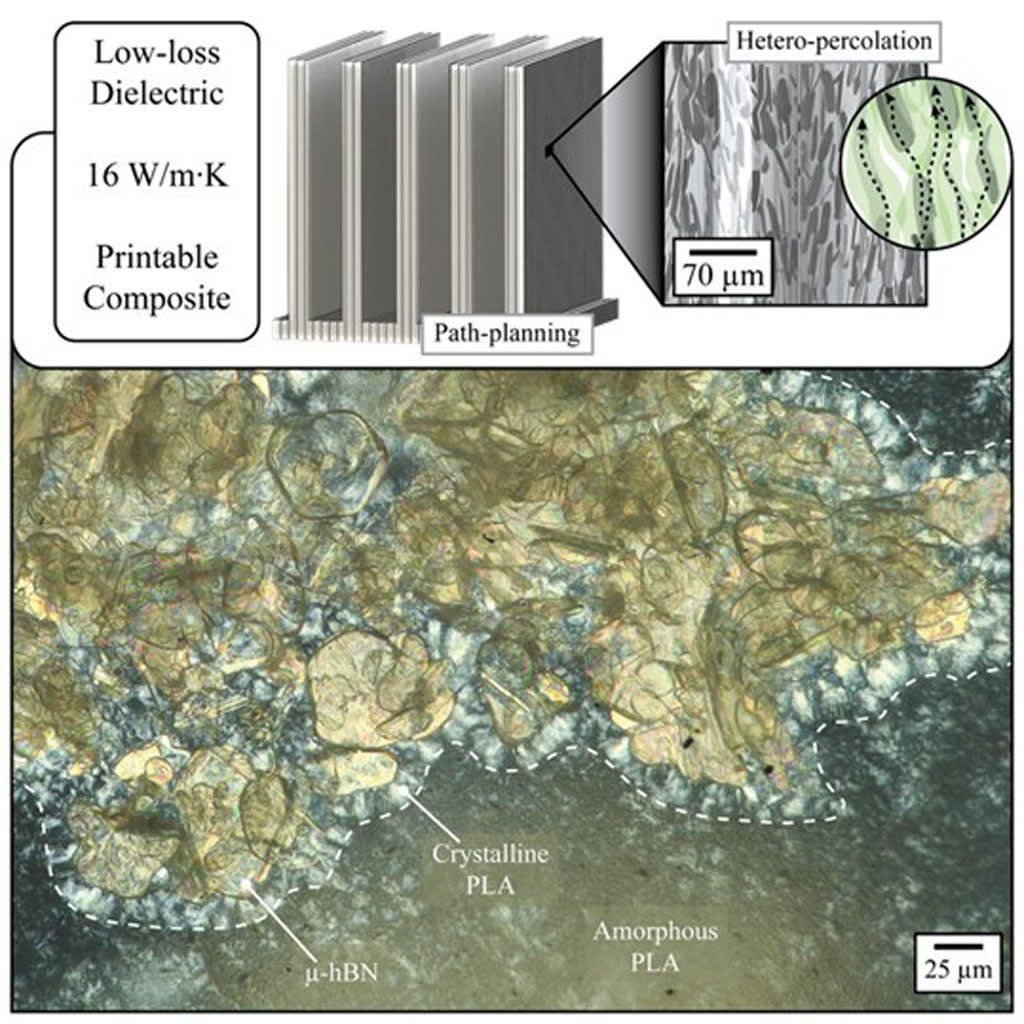
“This advanced material is a significant step forward for packaging of advanced electronics,” said Dr. Eric Wetzel, Mechanical Engineer at DEVCOM ARL and the paper’s co-author. “Its ability to efficiently manage heat while maintaining RF transparency, while also being 3D printable, enables new possibilities for military and industry applications.”
Published in Advanced Materials , the research uses a nanocomposite material comprising inorganic, hexagonal boron nitride (hBN) fillers embedded in a thermoplastic polymer. By carefully combining additives, surface treatments and thermal post-processing, the team created a crystalline polymer structure that bridges the highly conductive fillers, significantly enhancing thermal conductivity.
The nanocomposite is first formed into continuous filament, which can then be fed into a desktop 3D printer to create complex structures such as heat sinks, thermal spreaders, mounting plates or panel covers. The 3D printing process further aligns the fillers, boosting the material’s performance. Unlike metal packaging, this hBN nanocomposite is both RF transparent and electrically insulating, so it can be placed in close proximity to high-current and high-voltage electronics without blocking RF signals — critical to communications or radar systems — or risking an electrical short.

The material is also lightweight, about 40 percent less dense than aluminum and 80 percent less dense than copper, two of the most widely used materials for advanced thermal management of electronics.
This material could enable the development of lighter, more compact and more efficient electronic assemblies for use in harsh environments, which could lead to improved Soldier survivability and mobility.
“We are looking for industry partners to transition this technology,” Wetzel said. “In additional to military applications, we see a wide range of commercial applications for this material, including personal electronics such as mobile phones, telecommunications equipment, data centers and electric vehicles.”
More From SAE Media Group

Tech Briefs
3D Printing Stronger Carbon Nanotubes

Tech Briefs
Strong, Stretchy, 3D-Printed Metamaterials
Medical Design Briefs
New Products and Services
Tech Briefs
Testing the Thermal Limits of BNNTs

Medical Design Briefs
New Products & Services
Aerospace & Defense Tech Briefs
Unlocking the Potential of 3D-Printed Polymers in Aerospace and Defense
Electronics & Sensors INSIDER
MIT Team Takes a Major Step Toward Fully 3D-Printed Active Electronics

Electronics & Sensors INSIDER
3D Printing of Organic Electronics
Sensor Technology
3D Printable Sensors Disposed of Without Contaminating the Environment
Tech Briefs
Products of Tomorrow

Tech Briefs
New on the Market
Medical Design Briefs
Winter 2022 Resource Guide


Aerospace & Defense Tech Briefs
Carbon Nanotube Thermal Interfaces Enhanced with Sprayed-On Nanoscale Polymer Coatings

Tech Briefs
Conductive Carbon Fiber Polymer Composite


Aerospace Manufacturing and Machining INSIDER
Supernova to 3D Print Military Grade Energetic Materials
Medical Design Briefs
New Products and Services
Aerospace & Defense Tech Briefs
Next Generation Carbon Fiber Composites 3D Printer for Hypersonic Research

Aerospace & Defense Tech Briefs
Aitiip Integrates Freeform Injection Molding to Lower Weight and Reduce Production Costs
Top Stories
INSIDERDefense
 New Raytheon and Lockheed Martin Agreements Expand Missile Defense Production
NewsAutomotive
 Ford Announces 48-Volt Architecture for Future Electric Truck
INSIDERManufacturing & Prototyping
 Active Strake System Cuts Cruise Drag, Boosts Flight Efficiency
ArticlesTransportation
 Accelerating Down the Road to Autonomy
INSIDERMaterials
 How Airbus is Using w-DED to 3D Print Larger Titanium Airplane Parts
Road ReadyTransportation

Webcasts
Electronics & Computers
 Cooling a New Generation of Aerospace and Defense Embedded...
Power
 Battery Abuse Testing: Pushing to Failure
Connectivity
 A FREE Two-Day Event Dedicated to Connected Mobility
Automotive
 Quiet, Please: NVH Improvement Opportunities in the Early Design Cycle
Transportation
 Advantages of Smart Power Distribution Unit Design for Automotive &...
Aerospace
 Sesame Solar's Nanogrid Tech Promises Major Gains in Drone Endurance