2025 Altair Enlighten Awards Winners
Syensqo, Horse Powertrain, CompositeEdge, ATA Mute and other industry leaders recognized for developing and optimizing lighter, more sustainable automotive designs.
Winners of the 13th edition of the Altair Enlighten Awards, presented in association with the Center for Automotive Research, were recognized during a ceremony at the CAR Management Briefing Seminars in Detroit. The awards not only acknowledged the automotive industry’s best initiatives to reduce vehicle weight and meet emissions targets, but also considered other parameters such as cost reduction, part count reduction and applicability to other vehicle programs.
“Starting in the 2000s, the automotive industry wasn’t really that interested in optimization. Weight was an outcome of achieving performance. Seeing the rise of these digital technologies over two decades has been such a thrill,” Royston Jones, CTO of Altair Product Design and senior VP for automotive, said to kick off the event. “I’d say now we’re really through the gate, particularly over the last five years where globally there’s such pressure to develop products quickly. AI has really helped with technology such as optimization, so I think it’s only going to accelerate, it’s going to get smarter. This is such an exciting time to be in this digital space.”
Automotive Engineering helped judge this year’s lightweighting entries and also served as a media partner for the awards. Below are details of all the winners, runners-up and honorable mentions for the three lightweighting categories. Companies recognized for their work in sustainability and responsible AI are also listed.
Module Lightweighting
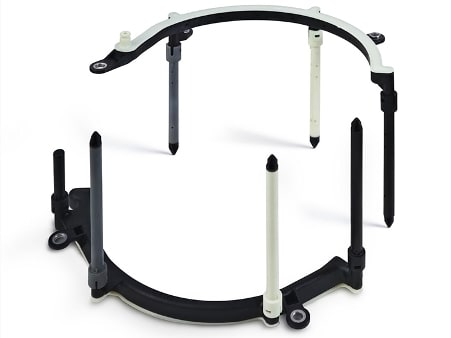
Winner: Geely and its Horse Powertrain joint venture with Renault improved e-motor efficiency with a stator cooling guide and oil delivery tube employing Syensqo’s Amodel PPA, achieving a 47% weight reduction and 36% cost savings versus metal. The metal-to-plastic conversion also enables part integration and streamlines high-volume assembly through injection molding, laser welding and snap fits. Syensqo says this approach has enabled the successful mass production of the Horse 3DHT160 Dedicated Hybrid Transmission and other powertrain products. Highly resistant to automotive fluids, Amodel PPA retains nearly 70% burst pressure resistance after 2,000 hours of aging at 150°C (302°F) ATF. The design achieves precise lubrication with lower oil pump power consumption, reducing the risk of overheating.
Runner-up: American Axle & Manufacturing (AAM) engineers replaced two axle configurations with a single, modular design, cutting complexity and cost. Delivering up to 10% mass reduction, around 1.3 million lb (589,670 kg) annually across 145,000 units, the axle housing design was optimized using Altair’s Multi-Model Optimization to balance weight and strength. Fully compatible with existing assembly lines and preserving back-serviceability, the solution reduces fuel consumption and emissions through material efficiency and streamlined logistics.
Enabling Technology
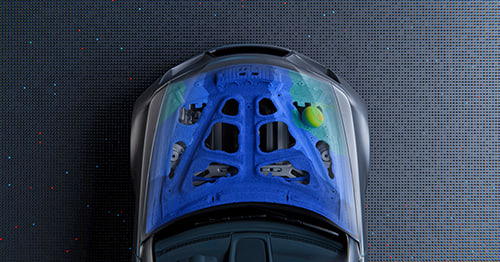
Winner: CompositeEdge and ATA Mute engineers partnered to develop an acoustic element under 1 mm (0.04 in) thick that offers up to 97% sound absorption, particularly at low frequencies where conventional materials are less effective. Waterproof, fire-resistant and fully recyclable, the noise-control solution is produced without adhesives from natural, carbon or glass fibers combined with thermoplastics. The material maintains its performance in humid and high-temperature environments and is suitable for a wide range of applications such as vehicles, heat pumps and interior facades.
Runner-up: Lucid Motors, in collaboration with the Altair OptiStruct development team, developed and implemented a seamless durability CAE workflow that progressed from MBD-based vehicle dynamics simulation to FEM-based strength, stiffness and fatigue analysis, and ultimately to structural optimization. The workflow could be applied to a wide range of components, including the body-in-white, subframes, battery pack, suspension components, powertrain and closures, using a Global-Local Analysis approach for detailed local assessments with refined meshing.
Honorable mention: Mercedes-Benz Research and Development India was recognized for a fully automated process for generating superelements that streamlines setup to just 15 minutes for complex parts and eliminates user errors. The process enables iterative optimizations and cuts computational demands, achieving over 90% runtime reduction, lower hardware utilization and more efficient resource use.
Future of Lightweighting

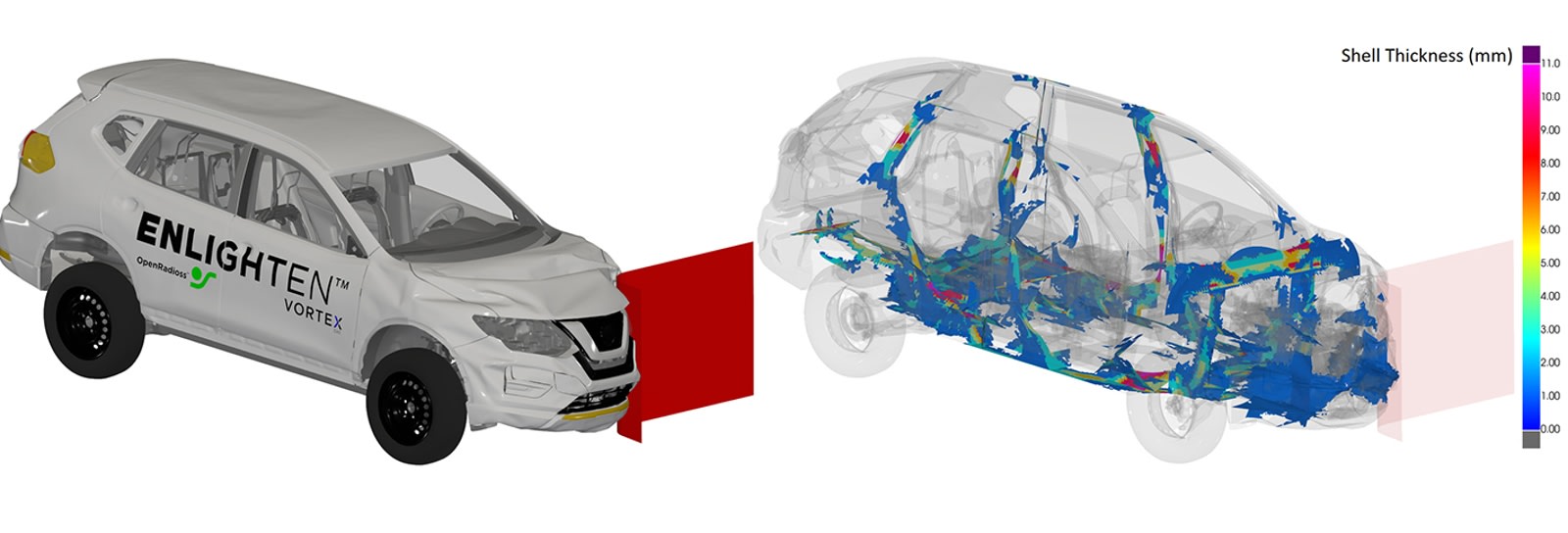
Winner: Vortex CAE won for its Enlighten topometry-based optimizer for the design of lightweight crash structures. “What we have achieved is to close the design loop between optimization and design validation in terms of CAE,” a company representative said. The new solver offers direct crash and impact optimizations using full-fidelity models, with outputs producing pre-validated CAE solutions. The team also developed a 3D generative-design methodology to identify and size fundamental structural features early on. A generative-design case study reduced body-in-white mass by 77% while meeting or exceeding structural performance in 13 primary crash load cases. Assuming a 50% mass-retention loss, they estimate that $500 million in raw material costs for this vehicle could have been saved, along with 1.35 million tons of CO2 from manufacturing alone.
Runner-up: Magna and its Polycon division successfully demonstrated the use of hemp nylon (PA6) in exterior components, specifically for a composite roof rack inner. Developed in collaboration with BASF and Heartland, the new renewable material replaces talc in traditional nylon resin and delivers performance and processing equivalent to the original resin. “Anyone who’s molded or worked with natural fiber-based materials, there are a lot of issues – thermal stability, smoke and odor during processing, susceptibility to moisture, just to name a few,” a Magna rep said. “Together we tackled these technical challenges. The fact that we’re standing here proves that you can bring this innovation to [production reality] if the value chain works as one.”
Sustainability and AI innovations
Sustainable Computing: Lucid Motors won for its design-driven structural assessment to enable accelerated product development using Altair SimSolid’s meshless solver. Mercedes-Benz Research and Development India was runner-up for its automated process for generating superelements (see above).
Sustainable Process: Marelli took the top spot for its adhesive wastewater recovery solution that uses a three-part chemical agent to enable the recovery and reuse of approximately 85% of adhesive wastewater. The runner-up technology from CITIC Dicastal enables integrated forming of large aluminum alloy structural components, reportedly marking the first application of a non-heat-treated Al-Mg alloy in commercial vehicle structures. The innovation consolidated 98 parts into a single component, reducing weight by 30% and lowering both cycle time and cost.
Sustainable Product: The winning innovation from NIO and AkzoNobel extended the lifespan of the bottom plate coating for battery packs from five to 15 years while reducing coating thickness by 90%, cutting vehicle weight by 2.2 kg (4.8 lb), and pioneering powder coating technology for EVs. The runner-up was Chery Automobile’s low-carbon aluminum initiative, which uses 100% recycled aluminum in a closed-loop system with over 99% impurity removal and employs heat-treatment-free integrated die-casting, cutting manufacturing energy by up to 95%.
Responsible AI: Lucid Motors won for integrating Altair PhysicsAI with Ansys LS-DYNA to transform crash CAE by applying AI-driven insights to predict complex, non-linear deformation behaviors under realistic off-axis and oblique impact scenarios. The team trained surrogate models to classify crash modes, such as axial crush and bending, well before physical testing, reducing design iterations and minimizing prototype reliance. Lucid also took the runner-up spot with its effort to automate CAD data retrieval, custom script execution, analysis and reporting by implementing AI-driven natural language support, which eliminated the need to learn each individual tool.
More From SAE Media Group
Automotive Engineering
Constellium Develops New Alloys for EV Battery Enclosures
Off-Highway Engineering
Volvo Charts Its Path Towards Zero Emissions
Automotive Engineering
Novelis Creates First Aluminum Sheet Battery Enclosure for Mass Electric Vehicle Production
Aerospace & Defense Tech Briefs
SAE International Extends Call for Abstracts, Seeks Submissions for AeroTech Conference
Automotive Engineering
Bosch’s EV Efficiency Upgrade: Continuously Variable Transmissions
Off-Highway Engineering
FPT’s New EPowertrain Plant Commences EAxle Production for Nikola Tre BEV
Off-Highway Engineering
Quantron Launches 12-M Battery-Electric Bus; Fuel-Cell Variant to Follow
Off-Highway Engineering
Bosch Invested in Large-Scale Metal 3D Printing
Off-Highway Engineering
ABS Ramps up Commercial-Vehicle Battery-Pack Assembly
Automotive Engineering
Hydrogen Storage Tank Options: Not Everything Need Look like a Sausage
Automotive Engineering
Battle for the Box
Off-Highway Engineering
Freudenberg to Deliver Batteries, Fuel-Cell Stacks
Battery Technology
Ultrasonic Metal Welding Enables Advances in Battery Technology
Automotive Engineering
Altair Honors Weight-Saving Innovations
Off-Highway Engineering
Eaton and BAE Gear up a New Electrified Truck
Automotive Engineering
Hydrogen Storage in a Box!
Automotive Engineering
Stellantis Goes All-In on EVs
Automotive Engineering
Casting Around for Lightweighting Solutions
Off-Highway Engineering
Catering to Off-Highway EVs’ Unique Thermal Need
Off-Highway Engineering
ACT Expo 2025: Heavy-Duty EVs, H2 Trucks and Tariff Talk Dominate Day One
Off-Highway Engineering
Hybrid Powertrains in the Product Mix

Off-Highway Engineering
Hydrogen ‘Inevitable’ for Commercial Vehicles
Automotive Engineering
Cadillac's Future-Tech Flagship
Automotive Engineering
Toyota Tacoma’s Resin Seat Named SPE’s 2024 Best Automotive Plastic Innovation
Automotive Engineering
Honda Pioneering New Manufacturing Tech for Zero Electrified Platform
Off-Highway Engineering
Battery Innovation Key for Commercial and Off-Highway EVs
Off-Highway Engineering
Electrification’s Impact on Commercial-Vehicle Chassis Design
Off-Highway Engineering
EV Startup Prepares to Enter Commercial Market with Novel EAxle
Automotive Engineering
Toward an Electric Two-Wheeled Triumph
Top Stories
INSIDERManufacturing & Prototyping
 How Airbus is Using w-DED to 3D Print Larger Titanium Airplane Parts
INSIDERManned Systems
 FAA to Replace Aging Network of Ground-Based Radars
NewsTransportation
 CES 2026: Bosch is Ready to Bring AI to Your (Likely ICE-powered) Vehicle
NewsSoftware
 Accelerating Down the Road to Autonomy
EditorialDesign
 DarkSky One Wants to Make the World a Darker Place
INSIDERMaterials
 Can This Self-Healing Composite Make Airplane and Spacecraft Components Last...
Webcasts
Defense
 How Sift's Unified Observability Platform Accelerates Drone Innovation
Automotive
 E/E Architecture Redefined: Building Smarter, Safer, and Scalable...
Power
 Hydrogen Engines Are Heating Up for Heavy Duty
Electronics & Computers
 Advantages of Smart Power Distribution Unit Design for Automotive...
Unmanned Systems
 Quiet, Please: NVH Improvement Opportunities in the Early Design...
Power

Similar Stories
NewsNanotechnology
 Altair Honors Weight-Saving Innovations
NewsManned Systems
 The Economics of Lightweighting in Heavy-Duty Vehicles
NewsPower
 Dürr Builds Advanced Paint Shop for EV Startup Byton
ArticlesUnmanned Systems
 A View Inside Volkswagen's Silicon Valley Lab